
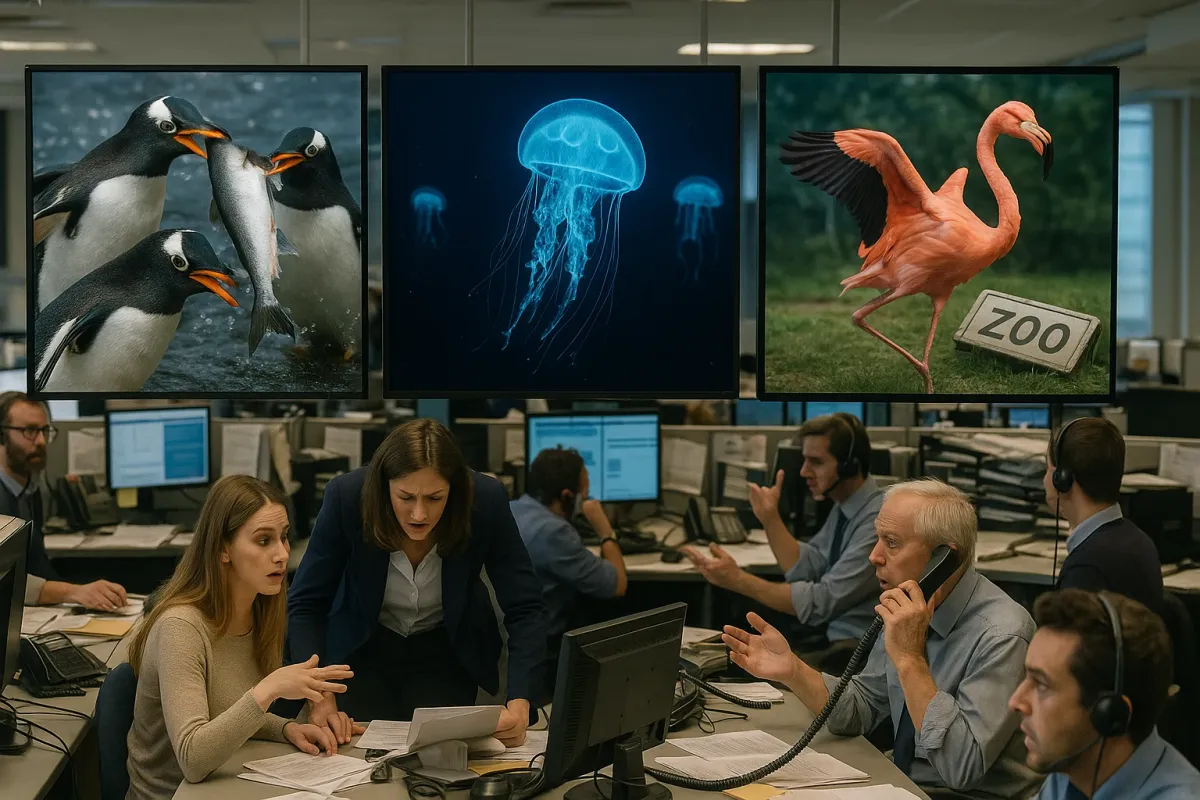
The news cycle right now is a screaming blender full of elections, tech chaos, and people arguing about things they definitely didn’t read past the headline. So let’s do what any emotionally responsible adult would: ignore all that and look at what the animals are up to this week.
Today’s chaos is loosely inspired by real headlines about penguins dodging extinction, AI-powered wildlife monitoring, and some very opinionated birds popping up in global news feeds. Science is doing science, animals are being dramatic, and honestly? It’s their world, we’re just doomscrolling in it.
Here are 5 wild, actually-happening-right-now animal stories reimagined for your entertainment — and your “omg LOOK AT THIS” group chat.
1. Penguins Just Got A Data-Driven Hype Squad
Somewhere between climate reports and “we trained an AI to write emails worse than you already do,” scientists quietly did something useful: they’re now using AI and satellites to track penguin colonies in Antarctica in almost real time.
Translation: there is literally a space-based penguin census happening above your head right now. Instead of sending humans to slip on ice and get side‑eyed by 10,000 birds in tuxedos, researchers can monitor if colonies are shrinking, moving, or thriving — and respond faster with protections. It’s like Google Analytics, but for “how many small flightless chaos beans are still alive.”
Even better, this data is helping climate scientists see how warming oceans and vanishing sea ice are impacting these birds. If the krill buffet disappears, so do the penguins. So yes, somewhere out there is a supercomputer screaming: “WE NEED MORE ICE FOR THE BIRDS,” and humanity should probably listen.
Share factor: “Penguins now have better satellite tracking than my lost luggage” is the kind of line that does numbers on social.
2. Flamingos Keep Using GPS Like It’s Tinder For Better Weather
Flamingos around the world are currently doing what many of us threaten to do every winter: moving if the weather is rude. Recent tracking projects (yep, more wildlife GPS, less being mysterious) show flamingos changing migration routes and timing to dodge storms, heatwaves, and messed‑up monsoon patterns.
Basically, climate change has turned their travel calendar into a full‑time problem, so they’re winging it. Literally. Some are arriving earlier at breeding sites, others are staying longer in weird temporary wetlands, and a few groups are popping up in places locals didn’t even know could host a flamingo rave.
Scientists are watching this in real time and going, “Cool, the planet is breaking, but wow, these birds are flexible.” The concern: there’s only so far they can vibe-adjust before food and nesting spots just… don’t exist anymore.
Share factor: You can absolutely caption a flamingo photo with “Me trying to relocate my entire personality every time life gets inconvenient” and no one will question it.
3. Coral Reefs Are Getting Their Own Underwater Security Cameras
Yes, we are now putting AI-powered cameras underwater to spy on fish — for their own good. Several marine research teams have launched projects where automatic cameras sit on reefs and use machine learning to recognize species, count them, and flag changes.
Before, this required humans in scuba gear doing the underwater version of the world’s slowest inventory. Now, a camera can tell the difference between “healthy reef with fish gossiping” and “uh oh, everyone’s dead or left for a less apocalyptic neighborhood.”
This helps track how heatwaves, bleaching events, and pollution are hitting reef communities in places like the Great Barrier Reef and the Indian Ocean. And it means scientists don’t have to guess which species are disappearing first; they’ve got timestamps, receipts, and HD footage of stressed-out parrotfish side‑eyeing the destruction.
Share factor: “Even the fish are on camera and still living a more mysterious, interesting life than I am” is peak internet relatability.
4. Elephants Are Officially Better At Networking Than You
Across Africa and Asia, researchers are dropping new studies like, “Hey, turns out elephant families are even more emotionally complicated than we thought.” Using audio recordings, GPS collars, and long‑term observation, scientists are finding that elephant herds:
- Recognize dozens of individuals by voice
- Have social “in-laws” between groups
- Remember old friends and enemies for YEARS
- And adjust migration routes based on shared information
So while humans are arguing in comment sections, elephants are out here running generational LinkedIn. Families are rerouting to avoid poaching hotspots, dried‑up waterholes, and noisy human areas. That’s not random wandering; that’s “someone told someone who told someone’s aunt’s cousin’s matriarch.”
With poaching still a massive threat and habitats getting carved up, understanding these social networks helps conservation teams protect the paths and spaces elephants actually use, not just what looks good on a map.
Share factor: Drop “Elephants have a better support network than my entire group chat” on Instagram and watch the empathetic chaos unfold.
5. City Foxes And Coyotes Are Speedrunning Urban Survival Mode
While we were busy arguing about whether remote work is “real work,” urban wildlife quietly hit New Game+. New papers and city reports are showing that foxes, coyotes, raccoons, and even wild boars are:
- Learning traffic patterns
- Syncing their movement to our garbage schedule (rude but impressive)
- Avoiding surveillance cameras more than certain politicians
- Shifting to more nocturnal lifestyles to dodge humans
In cities from London to Chicago to Tokyo, these animals are evolving their behavior in just a few generations. Not physically (no coyote is growing thumbs… yet), but mentally: bolder, smarter, faster to figure out which neighborhoods feed them and which ones call animal control.
Some cities are responding with wildlife corridors, smarter trash systems, and public education campaigns that boil down to “stop hand‑feeding the furry chaos gremlins, you are not Snow White.” Others are… less organized. But the animals aren’t waiting for policy; they’re already adapting.
Share factor: That trending video of a fox trotting down a crosswalk like it pays rent? Yeah, that’s basically documentary footage now.
Conclusion
Right now, while the internet fights about literally everything, the animal world is:
- Calling in satellites to save penguins
- Rewriting flamingo travel guides on the fly
- Putting coral reefs under 24/7 AI surveillance
- Letting elephants run multi‑generational social networks
- And turning city streets into a live‑action survival game
The plot twist? Every one of these stories is also a flashing neon sign about climate change, habitat loss, and how fast life on Earth is being forced to adapt because we can’t stop treating the planet like a rental deposit we’re never getting back.
So share this with a caption like:
“BREAKING: Animals continue to be iconic while humans speedrun the apocalypse,”
then maybe donate, sign a petition, or at least stop pretending penguins don’t need Wi‑Fi from space to survive now.