
You go to bed. You scroll, you doom, you pass out.
You assume the world goes quiet.
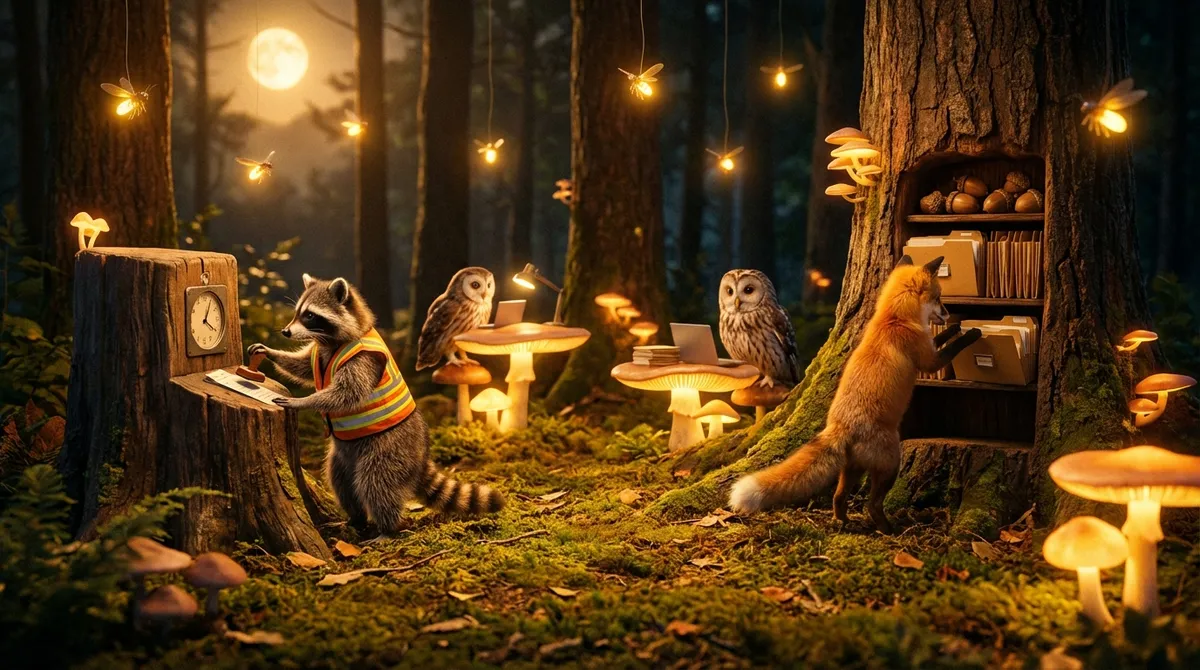
Meanwhile, outside your window: a full-blown, cross-species nightclub is happening, and you were not invited.
Welcome to the secret night shift of the animal kingdom, where hedgehogs patrol, octopuses cosplay, and your cat is absolutely leading a crime syndicate.
The Night Shift Is Packed (You’re the Weird One for Sleeping)
Humans like to think we run the world, but most of Earth’s creatures looked at daylight, squinted, and said, “No thanks, I’ll work nights.”
Tons of animals are nocturnal (active at night) or crepuscular (fancy word for “rush hour gremlin” — active at dawn and dusk). While you’re drooling on your pillow, they’re:
- Hunting, flirting, screaming, or all three
- Avoiding predators who are stuck in 9–5 mode
- Dodging the heat like it’s an ex at a party
- Using darkness to sneak, scheme, and snack without getting eaten
Owls, bats, foxes, raccoons, moths, hedgehogs, big cats, tiny rodents — it’s less “peaceful night” and more “Black Friday at the mall” out there.
So if you’ve ever stared into the dark and thought you saw something move: you did. It probably saw you first and judged your pajamas.
Owls: Professional Face-Swivelers with Night-Vision Goggles
Owls are what happens when nature designs the perfect stealth pilot, then gives it a permanent “I know what you did” stare.
At night, they’re:
- Flying almost silently thanks to specialized feathers that muffle sound
- Using insanely good hearing to locate a mouse under snow, leaves, or your emotional baggage
- Seeing in low light better than your phone camera in Night Mode
- Rotating their heads up to 270 degrees like it’s no big deal
Their eyes are so big they can’t even move them in their sockets — the whole head has to turn. They’re basically living security cameras with murder claws.
Imagine being a tiny mouse, chilling in the dark like, “I’m invisible,” and then a whisper-quiet feathered sniper drops from the sky and ends your whole career.
Owls: majestic, terrifying, and absolutely judging your sleep schedule.
Octopuses: Underwater Night Cosplayers with 8 Arms and No Chill
While you’re asleep dreaming about accidentally showing up to school naked, octopuses are out here doing full wardrobe changes in the dark.
At night, many octopus species:
- Creep out of their hiding spots like squishy cat burglars
- Change color and texture in seconds to match rocks, coral, sand, or “dramatic villain reveal” mode
- Use eight arms to investigate, steal, or rearrange literally everything
- Open jars, solve mazes, and occasionally escape tanks in aquariums because “doors are a suggestion”
They have specialized cells called chromatophores and papillae that let them flip their look from “meh rock” to “lava demon” faster than you can change a selfie filter.
If humans had octopus powers, every party would just be people changing outfits and textures mid-conversation.
Also, many octopus species are more active at night specifically to avoid predators — because even geniuses know not to get eaten before doing something chaotic.
Raccoons: Tiny Trash Bandits Running an Interdimensional Heist
You know that weird noise outside your house at 2:37 a.m.? Yeah, that’s probably a raccoon unlocking your garbage can with the enthusiasm of someone opening a mystery box.
Raccoons are basically:
- Nocturnal burglars with built-in burglar masks
- Furry little problem-solvers that can open latches, doors, and containers
- Walking chaos equipped with extremely sensitive, almost hand-like paws
- The reason your trash looks like a crime scene in the morning
They use their super-sensitive front paws to “see” what they’re touching, especially in water. Their brains are like, “Hands first, vibes second.”
They’re not just raiding bins out of desperation either — raccoons are opportunistic omnivores, which is science speak for “will eat almost anything and will absolutely steal it from you.”
So when you see a raccoon frozen in the beam of a flashlight, holding a stolen slice of pizza like it’s a sacred artifact: that’s a professional on the job. Respect the hustle.
Cats: Running Parkour Trials at 3 A.M. for No Reason
If you live with a cat, you already know: their peak performance window is from exactly “when you’re trying to sleep” to “when your alarm is in 3 hours.”
Domestic cats are crepuscular, which means:
- They’re hardwired to be active at dawn and dusk, like tiny furry gladiators
- They inherited their schedule from wild ancestors who hunted when prey was active
- Your 3 a.m. hallway sprints are basically pre-installed firmware
So those things your cat does in the middle of the night?
- Launching themselves off furniture like a parkour influencer
- Staring into the dark like they’re seeing ghosts (it’s usually just great night vision)
- Kneading your internal organs at 4 a.m. because “time for affection or death, human”
It’s not personal. Your cat’s body clock just thinks you should be out hunting too. Or at least awake to admire their zoomies.
You are not their owner. You’re their confused day-shift roommate.
Glow-in-the-Dark Animals: Nature’s Rave Party You Weren’t Invited To
While humans are out here paying for neon signs and LED strips, nature casually invented bioluminescence — living things that literally make their own light.
At night, the world secretly glows:
- Fireflies flash coded light signals to flirt (“Hey, nice abdomen”)
- Some deep-sea fish use glowing lures to attract prey straight into their mouths
- Plankton create glowing waves so beautiful they should charge admission
- Certain squid and jellyfish light up like floating UFOs
Bioluminescence can help animals:
- Find mates
- Confuse predators
- Attract dinner
- Or just look unreasonably cool (probably not the evolutionary reason, but still)
Meanwhile, humans discovered glow sticks in 1969 and have been feeling smug ever since. The ocean has been doing silent discos for millions of years.
Next time you see a video of glowing waves or a firefly meadow: just remember, that’s the night crew having a full-on light show while you’re indoors arguing with your router.
Conclusion
Every night, when you declare “I’m logging off,” the animal kingdom is like, “Finally, the main character left. Party time.”
Owls glide in silence. Octopuses cosplay. Raccoons raid like masked goblins. Cats practice parkour and emotional manipulation. The ocean literally lights up.
So if you’re ever awake at 2 a.m., staring into the dark and feeling like the world is boring: it’s not. You just don’t have night-vision, eight arms, or a trash can to flip.
Yet.
Sources
- [National Geographic – Nocturnal Animals](https://www.nationalgeographic.com/animals/article/nocturnal-animals) – Overview of why many animals are active at night and how they’re adapted to darkness
- [Cornell Lab of Ornithology – All About Owls](https://www.allaboutbirds.org/news/the-nuts-and-bolts-of-owls-all-about-owls/) – Details on owl vision, hearing, and head rotation
- [Smithsonian Ocean – Octopus Camouflage](https://ocean.si.edu/ocean-life/invertebrates/octopus-camouflage) – How octopuses change color and texture, especially in low light
- [National Park Service – Raccoons](https://www.nps.gov/articles/raccoons.htm) – Information on raccoon behavior, nocturnal habits, and clever problem-solving
- [NOAA Ocean Service – Bioluminescence](https://oceanservice.noaa.gov/facts/bioluminescence.html) – Explains how and why marine organisms produce light in the dark ocean