
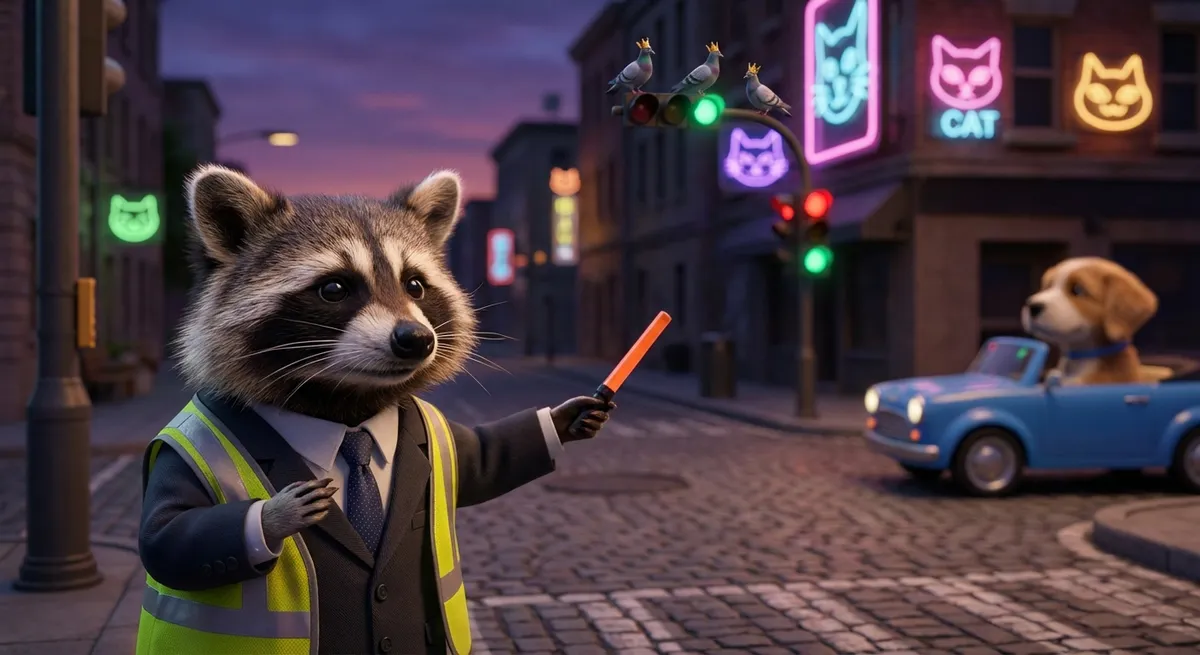
If humans suddenly disappeared for, like, one commercial break, a truly chaotic question appears: which animals would immediately start running the planet? Not in a “Circle of Life” way. In a “we’re forming a government, please fill out these forms” way.
Spoiler: some species are already conducting full-scale operations while we’re over here forgetting why we walked into the kitchen.
This is your backstage pass to the animals that are one minor human extinction event away from taking over—and why they’re way more organized than your group chat.
Crows: The Neighborhood Surveillance Committee You Didn’t Ask For
Crows aren’t just birds; they’re basically tiny goth detectives with wings.
Scientists have found that crows can recognize human faces, remember who was rude, and tell their friends about you. That means if you once chased one off your trash can in 2014, there is a non-zero chance you are still on a crow watchlist.
They use tools, solve multi-step puzzles, and can figure out cause and effect like a toddler—except the toddler can fly and holds grudges for years. In experiments, crows learned to use sticks to reach food, and then used better sticks later, which is more strategic thinking than most of us apply to our careers.
If humans disappeared, crows would absolutely form a HOA:
- Hold regular “caw-cus” meetings on power lines
- Enforce trash redistribution policies
- Run a surveillance state with 360-degree sky coverage
Shareable point: Crows can recognize your face and pass that info down to their kids. You are literally lore in crow society.
Octopuses: The Escapist Geniuses Plotting Something (Probably)
Octopuses are what happens when you give a brain to living Silly Putty and tell it, “Good luck.”
They can solve mazes, unscrew jars from the inside, and escape aquariums like it’s a side quest. They’ve been caught sneaking out of tanks at night to eat fish in neighboring tanks and then slinking back like nothing happened. That is criminally mastermind behavior.
Each arm has its own mini nervous system, meaning their limbs are basically running side processes like background apps. They’re known to play with objects, which suggests curiosity, not just survival smarts. Some even squirt water at lights in labs to short-circuit them—yes, they figured out “break lamp, get darkness.”
If humans dipped for five minutes, octopuses would:
- Crack open locked food stores in record time
- Rewire underwater equipment out of sheer “what does this button do” energy
- Become legends in dolphin conspiracy podcasts
Shareable point: Octopuses are so smart scientists worry about them getting bored in labs. Imagine being such a brainiac that humans apologize to you for not being interesting enough.
Ants: The Overachieving Workaholics Already Running a Super-Empire
Ants don’t need five minutes. They’re already running the planet. We’re just renting it.
An ant colony functions like one big superorganism, with workers, soldiers, and a queen all operating with terrifying efficiency. They coordinate traffic, farming (yes, leafcutter ants literally farm fungus underground), waste disposal, and warfare.
Some colonies have millions of individuals and can stretch for miles. There are even “supercolonies” involving multiple nests that recognize each other as part of the same ant empire instead of enemies. That’s more political cooperation than most countries manage.
If humans blinked out of existence:
- Ants would clear our crumbs, garbage, and possibly our dessert-stained couch
- They’d expand into abandoned buildings like tiny real-estate developers
- Global ant alliances would quietly rezone the planet for their convenience
Shareable point: There’s an ant supercolony in Europe that stretches over 3,700 miles. That’s not a bug problem—that’s an empire.
Rats: The Street-Smart Survivors Who Could Outlive the Apocalypse
Rats are the ultimate “you can’t get rid of me, I’m the main problem” animal.
They’re insanely adaptable, living in cities, sewers, farms, ships—basically everywhere humans have dared to drop a crumb. They’re smart enough to learn mazes, remember routes, and even show signs of empathy: rats have freed other trapped rats in experiments, even when there was a snack bribe available. That’s… oddly wholesome?
Their reproduction strategy is also terrifyingly effective. One pair of rats can theoretically lead to hundreds of descendants in a year. Add in their ability to chew through plastic, wood, and even weak concrete, and they’re practically post-apocalyptic lockpickers.
If humans bailed for one episode of whatever show you’re binging:
- Rats would move into pantries, offices, and probably that fancy building lobby you never felt good enough to enter
- They’d dominate food stores and quietly reorganize the food chain
- Some brave rat would definitely become urban legend Level: “King of the Grocery Aisles”
Shareable point: Rats are smart enough to pass certain psychological tests used on humans—except they don’t cry over emails afterward.
Elephants: The Gentle Giants Who Might Build Emotional Democracies
Elephants are living proof that you can be enormous and still more emotionally mature than everyone in your group chat.
They recognize themselves in mirrors (self-awareness unlocked), appear to mourn their dead, and remember locations and water sources for years. Herds are often led by older females who guide the group based on decades of knowledge—basically wise aunt energy but with tusks.
They use infrasonic sounds (too low for humans to hear) to communicate over long distances, like a secret calling plan built into their bodies. They cooperate to rescue calves, protect injured members, and even interact gently with other species.
If humans took a five-minute cosmic break:
- Elephants would continue their quiet reign over enormous territories
- They’d inherit abandoned farmland and turn it into stompy highways and dust-bath spas
- Their matriarch-led system would make half our political structures look like chaotic group projects
Shareable point: Elephants remember individual humans—even years later—and respond differently based on whether they think you’re a threat or a friend. You can be on an elephant’s “trusted contacts” list.
Conclusion
If humans disappeared for five minutes, nature wouldn’t panic—it would update the group roster.
Crows would be running intel, octopuses would jailbreak everything underwater, ants would silently expand their ant-taxes across the globe, rats would take over every snack-based economy, and elephants would manage large-scale territories with more calm leadership than most of us have on a Monday.
So next time you see a crow watching you, an ant line on the sidewalk, a rat in the subway, an elephant on a documentary, or an octopus clip online, remember:
You’re not just looking at an animal.
You’re looking at a future department head in Earth’s “Post-Human Management Team.”
Maybe… be nice to them. Just in case.
Sources
- [National Audubon Society – The Amazing Intelligence of Crows](https://www.audubon.org/news/the-amazing-intelligence-crows) – Details crow facial recognition, memory, and problem-solving abilities
- [Smithsonian Magazine – Why Do Octopuses Escape Their Tanks?](https://www.smithsonianmag.com/smart-news/why-do-octopuses-try-escape-their-tanks-180961199/) – Covers octopus intelligence, escape behavior, and curiosity
- [BBC Future – The Remarkable World of Ant Supercolonies](https://www.bbc.com/future/article/20140916-ants-are-building-a-new-world) – Explains how ant colonies form massive cooperative supercolonies
- [National Geographic – Rats: Surprising Facts and Why They Thrive](https://www.nationalgeographic.com/animals/article/rats) – Discusses rat adaptability, intelligence, and urban success
- [American Museum of Natural History – Elephants’ Complex Social Lives](https://www.amnh.org/exhibitions/past-exhibitions/elephants/elephants-in-the-wild/social-structure) – Describes elephant memory, social structure, and communication