
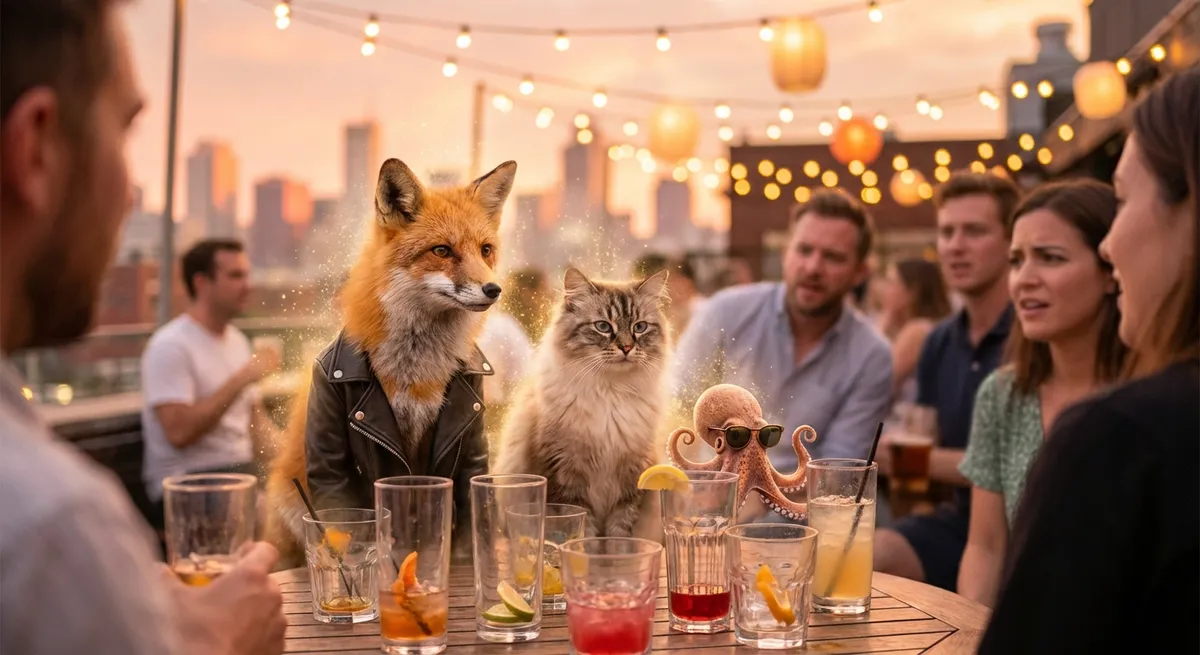
You think animals are all wholesome Disney sidekicks and loyal emotional-support fluffballs? Incorrect. A shocking number of them would absolutely leave you on read, eat your snacks, and then pretend they never met you. Nature is full of tiny red flags with fur, feathers, and an alarming number of teeth.
Welcome to the Animal Kingdom’s unofficial dating app: every creature is a walking “It’s not you, it’s my evolutionary strategy” message.
Below are five deeply shareable reasons animals are chaotic, unbothered, and 100% likely to ghost you.
The Octopus: Genius Escape Artist with Commitment Issues
If the octopus had a relationship status, it would be: “Can squeeze out of this anytime.”
Octopuses are famously smart—like “solve puzzles, open jars, escape tanks, remember people” smart. Some in aquariums have been caught sneaking out of their enclosures at night, raiding other tanks for snacks, and then returning like nothing happened, as if they didn’t just do a full Mission: Impossible run before sunrise. They are the coworkers who eat your labeled lunch and then compliment your “discipline” for not eating at all.
Their brains are wild: two-thirds of their neurons are in their arms. Each limb is out here freelancing, tasting, feeling, and making micro-decisions like, “Hey, what if we just… left?” If you went on a date with an octopus, you’d turn to look at the menu and by the time you turned back, it would be gone, fake name and all, eight arms already ordering appetizers across town.
Also, they’re famously solitary. They do the bare minimum of socializing necessary to make more octopuses, and then it’s “okay, never speak to me again.” The ultimate situationship: intense, mysterious, over in one season, and you’re left trying to decode the emotional meaning of a cephalopod that can literally change colors when stressed but still won’t send you a clear text.
Share this with that one friend who keeps dating “emotionally unavailable creatives.”
Penguins: Adorable, Loyal… and Low-Key Rock Addicts
Penguins have convinced the entire human race they are soft, wholesome snow potatoes who waddle around being cute. That’s only half the story. The rest of it? Rock-based drama.
Many penguin species build nests out of stones, and a high-quality pebble is basically real-estate gold. Some males spend ages collecting the perfect stones to impress a mate. Others? They just steal. Straight up robbery. Some penguins are known to sneak into neighbors’ nests, swipe rocks, and wobble off quickly like “no thoughts, only crime.”
And the famous “penguin proposes with a rock” thing? Actually, emperor penguins don’t do that at all; it’s mostly based on the behavior of other penguin species like Adélies and gentoo penguins, where stones are serious courting currency. Imagine being proposed to with a pebble that was almost definitely stolen from Susan down the ice shelf.
Penguins will also spend weeks taking turns protecting an egg while the other goes to sea to hunt. Noble. Adorable. But if that egg rolls away? No insurance. No refund. No extended warranty. They’ll sometimes just stare at the lost egg like “huh, that’s unfortunate” and move on with their lives.
Send this to someone who thinks “they’re cute” automatically means “emotionally stable.”
Crows: Hyper-Intelligent, Extremely Petty, Never Forget a Face
Crows are the “gifted kid with revenge arc” of the bird world. They recognize individual human faces, remember them for years, and can decide whether you go on their “friendly” or “absolute enemies” list. Researchers who wore “bad” masks while trapping crows found that the birds later scolded those masks on sight—and even passed the warning to other crows who weren’t there for the original drama.
So if you annoyed a crow once in 2018? It might still be thinking about it. Meanwhile, you can’t even remember what you had for lunch yesterday.
They also hold crow funerals, where groups gather around a dead crow, make loud calls, and seem to inspect the area—essentially a crime scene investigation plus emotional processing. They’re not just mourning; they’re learning, like, “Avoid suspicious guy with that specific haircut.”
On the flip side, crows sometimes bring “gifts” to humans who feed them: bottle caps, shiny scraps, little trinkets. Cute. Sweet. Possibly mob behavior. That’s mafia energy: “Nice patio you got here. Shame if something happened to it. Anyway, here’s a little token of appreciation. Keep the peanuts coming.”
Tag someone who knows they’d accidentally end up in a long-term feud with a bird.
Cats: Domestic Roommates Who Never Signed the Lease
Cats are not “pets” so much as “tiny landlords with murder mittens.” They helped humans by controlling rodents, we repaid them by inventing the concept of “cat mom,” and they have not stopped silently judging us since.
Despite thousands of years of hanging out with humans, cats are still only semi-domesticated compared to dogs. Their default mode is “independent contractor with vibes.” They rub their faces on you not because they’re obsessed with you (sorry), but to mark you with scent glands and log you in as “mine” in their personal database—which is stored somewhere between their whiskers and their chaos centers.
Scientifically, cats can recognize their names and their owner’s voice, but many simply choose not to respond. That’s not ignorance; that’s a conscious “nah.” You are in a one-sided group chat with a furry creature who thinks you are both beneath and responsible for them.
Also, the dead-animal “gifts” they bring you? That’s them trying to train you like a useless oversized kitten who can’t hunt. “You can’t even catch your own food? Try this. I’ll demonstrate again tomorrow.” Brutal honesty disguised as a horror delivery.
Share this with the person whose cat owns three beds, four towers, and still sleeps in the cardboard box.
Dolphins: Ocean Himbo Geniuses with Main Character Energy
Dolphins are like if theater kids, frat bros, and honor students merged into one extremely wet chaos entity.
They have names—no, really. Individual signature whistles act like name tags, and dolphins respond to their own whistle and can even remember the whistles of other dolphins years later. They’re extremely social, forming complex alliances and friend groups that honestly sound like high school politics with more splashing.
They use tools: some dolphins in Australia have been observed putting sponges on their noses to protect themselves while foraging along the seafloor. That’s DIY PPE, underwater edition. They also teach this skill to their offspring—a full-on generational family hack.
Dolphins play a lot: surfing waves, tossing seaweed, even play-chasing other species. But they also have a chaotic edge—harassing other animals, bullying porpoises, and generally doing things that would definitely get them a “we need to talk about your behavior” email if the ocean had HR.
If you dated a dolphin, every date would be thrilling, mildly dangerous, and end with them vanishing to “hang with the pod” while you’re still emotionally decompressing. You’d be left saying, “That was magical and also a red flag.”
Send this to the friend who only falls for charismatic chaos machines.
Conclusion
Animals are not just cute background characters in our human drama; they’re out here living full, messy, complex lives—hoarding rocks, plotting petty revenge, ignoring calls, and inventing home tools from sea sponges. If the Animal Kingdom had social media, we’d be the weird neighbors they occasionally subtweet.
The more we learn about them, the more obvious it is: they’re not just “like us”—in some ways, they’re more honest versions of us. No filter. No PR team. Just raw instincts, weird habits, and surprisingly sophisticated social games.
So the next time you lock eyes with a crow, get blanked by a cat, or see a penguin in a documentary, remember: you are in the presence of a creature that could absolutely ruin you in a group chat… if it had thumbs.
Now go send this to someone who is 100% getting ghosted by an imaginary octopus.
Sources
- [Smithsonian Magazine – How Smart Are Octopuses?](https://www.smithsonianmag.com/science-nature/how-smart-are-octopuses-180978710/) – Explains octopus intelligence, problem-solving, and escape behavior.
- [BBC – The Secret Lives of Penguins](https://www.bbc.com/future/article/20140701-the-secret-lives-of-penguins) – Covers penguin courtship, nesting with stones, and social behavior.
- [University of Washington – Crow Research](https://www.washington.edu/news/2011/04/26/crows-recognize-human-faces-warn-others-and-are-furious-at-you/) – Details studies showing crows recognize human faces and share social information.
- [Cornell University – Cat Domestication](https://www.vet.cornell.edu/departments-centers-and-institutes/cornell-feline-health-center/health-information/feline-health-topics/history-domestic-cat) – Outlines how cats became semi-domesticated and their relationship with humans.
- [National Oceanic and Atmospheric Administration (NOAA) – Dolphin Social Behavior](https://www.fisheries.noaa.gov/feature-story/what-you-should-know-about-dolphins) – Discusses dolphin intelligence, communication, and social structure.