
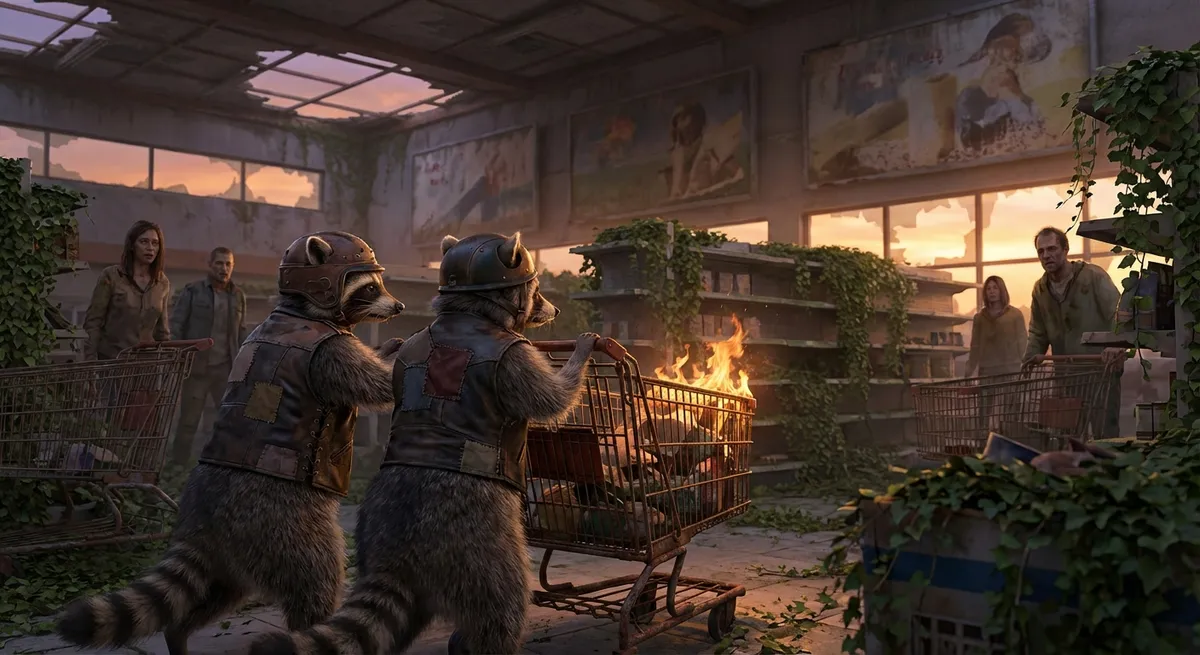
If the world suddenly hit the uninstall button tomorrow, most of us would last about three YouTube videos and half a granola bar. Meanwhile, several animals are out there built like DLC characters with all the survival perks unlocked.
These creatures don’t just “live in nature” — they spawn-camp the apocalypse. And once you see what they can do, you’ll realize your greatest natural advantage is…having thumbs and Wi‑Fi.
Let’s meet the walking cheat codes.
The Tardigrade: The Indestructible Raisin of Doom
Tardigrades (aka water bears) look like someone shrank a vacuum bag and gave it legs, but they are basically nature’s “try again” button.
When things get bad, they don’t die. They just…pause.
- They can survive being boiled, frozen, blasted with radiation, and yeeted into outer space.
- Scientists literally launched them into low Earth orbit. They shrugged, came back, and kept vibing.
- When conditions get rough, they curl into a dried-up ball called a “tun” and shut down almost everything. Years later, add water, and boom: tiny apocalypse raisin resurrected.
Meanwhile, you skipped breakfast and forgot your charger once and said “today is actually the worst day of my life.”
If we ever get hit with some world-ending event, humans will be arguing on social media about whose fault it is, and tardigrades will be like: “Cool, nap time.”
Viral share pitch: Tag a friend who would absolutely fold faster than a lawn chair compared to a microscopic space-proof dumpling.
The Cockroach: The Unkillable Tenant of Your Nightmares
Cockroaches are the reason every apocalypse movie feels a little too optimistic. These things are built like nature’s unwanted spam folder: you cannot get rid of them.
Here’s why they’re terrifyingly overqualified to outlive you:
- They can go about a week without their head. Not metaphorically. Literally. Their brain’s in their body, they breathe through holes in their sides, and they just…walk around headless until they dehydrate.
- They can live a month without food. You panic if your food delivery is 15 minutes late.
- They’re ridiculously radiation-resistant compared to humans.
- They’ve survived 300+ million years already. That’s multiple extinction events. They’re basically on Season 5 of “Surviving Things That Should Have Killed Us.”
When humanity is gone, the roaches will be holding committee meetings in your former kitchen, wondering why nobody is dropping crumbs anymore.
Viral share pitch: Share this with someone who screams at bugs but thinks they’d “totally be fine” in the Hunger Games.
The Alligator: Living Fossil With Zero Interest in Your Drama
Alligators have been around since before the dinosaurs checked out, and they’re still here, silently lurking like scaly grandpas who have seen absolutely everything and are unimpressed.
Why they’re winning long-term:
- They can slow their heart rate to just a few beats per minute and chill underwater for over an hour.
- When it gets super cold, they do something called “icing,” where they stick their snouts out of freezing ponds and let the rest of their body freeze in place like a reptile popsicle…then thaw and walk it off.
- Their bite force is ridiculous, but they conserve energy like professionals — they’re basically minimalists with murder potential.
- They’ll eat almost anything that wanders too close, which is a great strategy when DoorDash doesn’t exist.
While you’re out here debating whether you can microwave leftovers twice, gators are napping in mud, waiting out climate events like, “Wake me when the loud mammals stop.”
Viral share pitch: Send this to your chillest friend who looks lazy but is secretly just conserving energy for the end times.
The Ant Colony: Tiny Superorganism With Better Teamwork Than Your Group Chat
One ant: tiny, confused crumb enthusiast.
Millions of ants together: unstoppable underground empire that would absolutely run the world if they were bigger than a paperclip.
Why ants will outlast your entire bloodline:
- They operate like one big “superorganism” — every ant is basically a cell in a giant, living strategy game.
- They have division of labor, communication systems, farming (yes, some farm fungus), and even ant “cows” (aphids) they herd and milk for sugary liquid.
- Certain species make living bridges out of their own bodies, so when the environment says “no,” they just physically become “yes.”
- Some ants are insanely heat-tolerant, some can handle floods, and invasive species like Argentine ants create mega-colonies that span thousands of kilometers.
Meanwhile, your group project can’t even decide on a font.
Post-apocalypse, while humans are arguing over who left the bunker door open, ants will quietly inherit everything and build a functioning society out of your abandoned cereal boxes.
Viral share pitch: Tag your most organized friend and tell them they have “ant queen energy.”
The Ocean Blob Squad: Jellyfish, Deep-Sea Weirdos, and Everything That Will Replace Us
If the surface world shuts down, the ocean is just going to keep doing whatever chaotic nonsense it’s already been doing for millions of years.
Top contenders for “most likely to still be vibing”:
Jellyfish:
- Some species are basically biologically immortal. The “immortal jellyfish” (Turritopsis dohrnii) can revert its cells back to a younger stage and start over like it hit “new game+.”
- No brain. No heart. Just a floating, mildly poisonous water bag that refuses to commit to an ending.
- These creatures live in crushing pressure, in total darkness, near hydrothermal vents that spew hot, mineral-rich water.
- They rely on chemosynthesis instead of sunlight — so if the sun went full rage quit, they’d just keep living their weird lava-pipe lives.
- Many of them look like rejected Pokémon concepts: transparent bodies, glowing teeth, nightmare jaws that unhinge.
Deep-sea life in general:
On land, we’re complaining about the Wi‑Fi being slow. In the ocean, a fish with a headlamp attached to its face is eating something with more teeth than sense, in pitch darkness, like it’s a normal Tuesday.
Viral share pitch: Share this with someone whose life goal is “vibe with no responsibilities” and tell them they are spiritually a jellyfish.
Conclusion
If the world ever actually ends, remember:
You are squishy, emotionally unstable, require snacks every 3–4 hours, and complain in online reviews.
Tardigrades are sleeping through radiation.
Roaches are casually walking off decapitation.
Gators are frozen in a lake like it’s a spa day.
Ants are running a microscopic civilization with HR, agriculture, and urban planning.
Jellyfish are respawning themselves like a glitch that never gets patched.
You are not the main character of Earth’s survival story. You are the limited-time guest appearance.
But you can be the one who sends this article to your friends and says, “If we all die, at least now we know which tiny raisin bug takes over.”
So go ahead: share this, tag your apocalypse party, and decide which animal you’re drafting as your team captain when everything goes sideways.
Sources
- Smithsonian Magazine – Tardigrades: 'Water Bears' in Space - Overview of tardigrade toughness and survival in extreme environments, including outer space experiments
- U.S. Environmental Protection Agency – Cockroach Allergens - Background on cockroaches, their biology, and resilience in human environments
- National Park Service – American Alligator - Official information on alligator behavior, adaptations, and habitat
- University of California, Berkeley – Ant Colony Behavior - Educational resource on ant colonies, division of labor, and social structure
- National Oceanic and Atmospheric Administration (NOAA) – Deep Sea Life - Explains how deep-sea organisms survive extreme pressure, darkness, and unique environments