
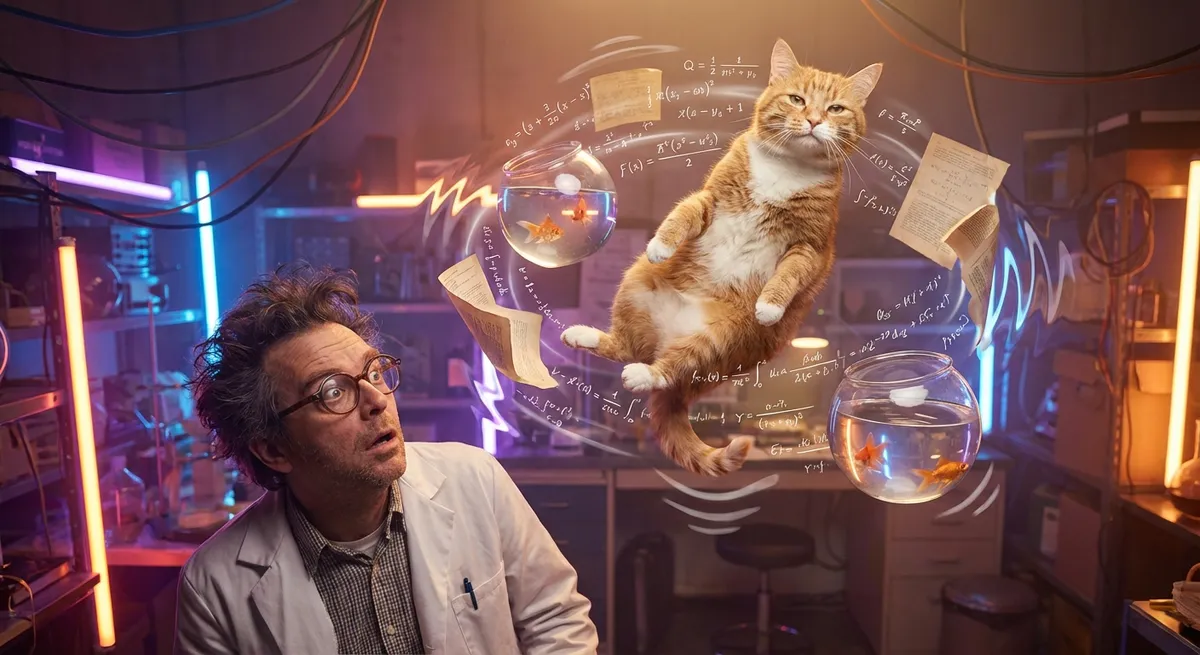
If you’ve ever watched an animal and thought, “That can’t be legal,” congratulations: you’ve witnessed nature’s patch notes in action. From cats who turn into liquid to birds who apparently skipped the part of evolution where fear was installed, animals are out here freestyle-rapping over the laws of physics—and winning.
Let’s unpack some of the most shareable, “WHAT did I just watch?” animal behaviors that feel less like biology and more like a glitch in the Matrix that nobody bothered to fix.
The Cat-Liquid Phenomenon (Science Accidentally Approved This)
Cats do not care about Euclidean geometry. They will become a loaf, a puddle, a noodle, a circle, or a cube depending on the emotional chaos they are trying to inflict.
Here’s the wild part: scientists have actually studied this. There’s a real paper about cats as liquid because they can adapt their shape to fit containers over time like some kind of furry, judgmental slime. Ever seen a cat melt into a bowl, a sink, or a shoebox three sizes too small? That’s not just cute; that’s fluid dynamics with side-eye.
Physically, cats are hyper-flexible because of their uniquely structured spines and lack of a rigid collarbone, which lets them twist, fold, and compress like they’re made of soft-serve. Mentally, they do it because they know we’ll drop everything to take a photo and they live for the attention.
Shareable takeaway: somewhere, a scientist’s actual job was to describe your cat as a “non-Newtonian fluff fluid,” and honestly that feels correct.
Goats: Parkour Athletes Who Missed the Memo on Gravity
Goats look like they were designed by a game developer who maxed out the “climb” stat and forgot everything else. You’ve seen the pictures: goats on cliff faces, goats on near-vertical dams, goats perched in trees like someone mis-clicked “spawn” in a video game level editor.
Their secret is in their hooves and balance. They have split hooves with rough, grippy pads that act like built-in climbing shoes, plus an insane sense of equilibrium. While we’re out here tripping over flat floors, goats are casually hanging out on a 90-degree rock wall like they’re waiting for a bus that also defies physics.
They don’t just survive in wild, rocky terrain—they thrive, because their ridiculous parkour skills let them reach food and spaces no predator (or human with normal health insurance) is willing to climb to.
Shareable takeaway: if life has you feeling clumsy, remember there’s a goat somewhere peacefully standing on what is basically the side of a mountain, contemplating nothing and fearing less.
Birds That Forgot They’re Supposed to Be Afraid of Heights
Most birds fly. Some birds flex.
Albatrosses spend so much time soaring over oceans that they can sleep while gliding. Actual mid-air naps. Imagine hitting “autopilot” on your own body and letting the wind carry you while you take a power snooze over thousands of miles of water. That’s not just flying—that’s unlocking DLC-level travel perks.
Then there are peregrine falcons, who don’t just dive; they weaponize gravity. They can reach speeds over 200 mph in a hunting dive, casually becoming feathered bullets with eyes. They’re basically nature’s guided missiles, except instead of software, they’re powered by vibes and an ultra-aerodynamic skull.
And penguins? They can’t fly at all, but they yeet themselves out of the ocean at high speed, launching onto ice like slippery torpedoes that missed their calling as Olympic athletes.
Shareable takeaway: birds aren’t just “in the sky.” Some of them are up there speed-running existence with a physics engine we clearly did not get access to.
Octopuses: Escape Artists With Extra Brains and Zero Bones
Octopuses are what happen when evolution says, “What if we put ‘hacker’ into the ocean?” They have no bones, three hearts, blue blood, and so many neurons in their arms that each tentacle basically has its own side-hustle brain.
Because they lack bones, octopuses can squeeze through any gap larger than their beak—the only hard part of their body. That means drainpipes, tiny holes, jar lids, aquarium filters… you name it. There are real stories of octopuses in aquariums unscrewing lids, escaping tanks at night, snatching snacks from neighboring enclosures, and then slinking back like nothing happened.
They can also change color and texture in milliseconds using specialized skin cells, turning from squishy rock to sand to coral like they’re flipping through camouflage presets.
Shareable takeaway: somewhere in the ocean is a boneless, hyper-intelligent, color-changing alien who could pick a lock, raid your fridge, and slip under your door—and science just shrugs and calls it a “cephalopod.”
Squirrels: Secret Acrobat-Stunt Coordinators With Terrible Planning
Squirrels are chaos gremlins with Olympic-level parkour skills and the memory of a 2004 office printer.
They routinely launch themselves from tree to tree at high speeds, make mid-air corrections like tiny furry fighter jets, and somehow stick most landings. They can rotate their ankles 180 degrees to climb down trees headfirst, which is both impressive and mildly cursed.
But here’s the plot twist: they bury food all over the place for later… and then forget where a solid chunk of it is. That absent-mindedness accidentally plants millions of trees. Forests. Actual forests. Because a rodent had the impulse control of someone opening 47 browser tabs and revisiting none.
Shareable takeaway: squirrels are out here speedrunning extreme sports, messing up their own meal prep, and accidentally reforesting the planet. That’s not just a glow-up—that’s environmentalism by sheer chaotic energy.
Conclusion
Animals are not just cute background characters in our lives; they’re running full-blown physics experiments without informed consent from gravity.
Cats melt. Goats scale vertical death-walls. Birds nap in the sky. Octopuses jailbreak their own tanks. Squirrels plant trees by forgetting where they put their snacks. None of this should work, and yet it does—beautifully, hilariously, and extremely share-worthy.
Next time you see a video of an animal doing something that makes you question reality, just remember: Earth is basically a giant sandbox level, and the animals have clearly found the cheat codes before we did.
Now go send this to the friend who insists “we’ve seen everything nature can do.” Nature read that and said, “Bet.”
Sources
- [Why Cats Can Fit Into Tight Spaces](https://www.cfa.org/cat-info/cat-care/why-cats-fit-into-small-spaces) - Cat Fanciers’ Association explains feline flexibility and anatomy
- [Mountain Goats and Their Gravity-Defying Climbing](https://www.nps.gov/olym/learn/nature/mountain-goats.htm) - U.S. National Park Service overview of mountain goat adaptations and behavior
- [Peregrine Falcon Speed and Hunting Dives](https://www.audubon.org/news/meet-peregrine-falcon-worlds-fastest-animal) - National Audubon Society on the peregrine falcon’s extreme diving speeds
- [Octopus Intelligence and Escape Behavior](https://ocean.si.edu/ocean-life/invertebrates/octopus) - Smithsonian Ocean Portal summary of octopus biology and problem-solving skills
- [How Squirrels Help Forests Grow](https://www.fs.usda.gov/features/how-squirrels-help-plant-forests) - U.S. Forest Service explains squirrel caching and its role in forest regeneration