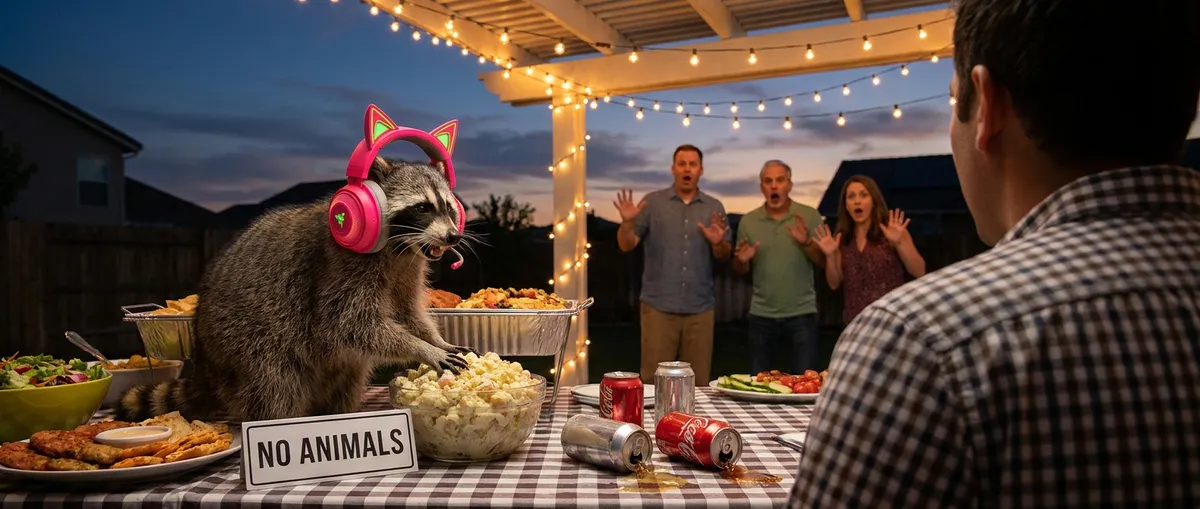
Animals have absolutely no idea what our “social norms” are, and frankly, they’re thriving because of it. While we’re out here overthinking texts and Googling “how many exclamation points is too many,” a raccoon is raiding three trash cans and a cat is knocking a $600 iPad off the counter just to see what gravity’s up to today.
This is your backstage pass to the animal kingdom’s most chaotic energy. These are the creatures who look at human civilization and go, “Cute. Anyway…”
The Goose Agenda: Why They Walk Like They Own The Parking Lot
Geese are living proof that confidence is 90% of survival and 10% honking at strangers.
Canada geese have figured out the glitch in the matrix: if you walk slowly enough and scream confidently enough, cars will literally stop for you. They’ve watched us build roads, parking lots, office parks—and decided they’re all just extended goose crosswalks.
You, a licensed driver with insurance and bills: gently brakes for goose.
Goose, wearing a permanent scowl and no pants: I accept your tribute, mortal.
They’re not actually just being jerks (well… not only that). They like open spaces with short grass—exactly what we design for sports fields, suburban lawns, and office parks. To them, your local strip mall is an all-inclusive resort with free ponds and salad flooring.
Share value: Show someone a goose blocking traffic and they’ll laugh. Show them the reason geese love corporate campuses, and suddenly rush hour feels like you’re in a nature documentary called “Planet Mildly Inconvenienced.”
Squirrels: Tiny Furry Bankers With Acorn Amnesia
Squirrels are the chaotic neutral accountants of nature. They bury food everywhere, then immediately forget where half of it is like they’re running a brain powered entirely by browser tabs.
The wild part? That “oops I forgot my acorn” move accidentally plants trees. Whole forests owe their existence to squirrels misplacing snacks. Somewhere out there is a squirrel walking through a mature oak forest like, “Wow, who’s the rich guy that buried all this?”
Scientists estimate that this scatter-hoarding—burying lots of food in lots of places, then not recovering all of it—helps reforest areas and spread tree species. Translation: squirrels are doing long-term environmental planning completely by accident while you forget where you put your phone that you are literally holding.
Share value: Next time someone calls you forgetful, just say you’re “reforesting the planet, like a squirrel.” Bonus points if you say it while holding three snacks and looking suspicious.
Crows: The Neighborhood Kids Who Keep Unlocking New Brain Levels
If birds had a gifted program, it would just be crows and ravens sitting in the front row, judging everyone.
These birds recognize human faces, remember who was nice or rude to them, and share that info with their flock. If you regularly feed them, they might start bringing “gifts” like shiny objects, bottle caps, or anything they think looks cool. Somewhere out there, a crow has a mental scrapbook labeled “Guy Who Provides Snacks” and “Lady Who Swung a Broom”.
They’ve also been caught using tools, solving multi-step puzzles, and dropping nuts in traffic so cars crack them open. That’s a level of work-smart-not-hard that’s frankly inspirational.
Scientists run puzzle tests and the crows speed-run them like they’ve watched the walkthrough on YouTube. Meanwhile, you and I are still clicking “Forgot password” like it’s a daily ritual.
Share value: Tag that one unnervingly observant friend with, “You’d be a crow in the animal kingdom and we all know it.”
Octopuses: Eight Arms, Zero Respect for Tank Security
Octopuses are basically the jailbreak experts of the ocean. Zoo keepers and aquarium staff know this deeply, painfully, and personally.
They can unscrew jar lids, squeeze through holes the size of their eyeball, and remember routes around obstacles. There are real documented cases where octopuses:
- Escaped their tanks at night
- Slid across the floor
- Munched snacks from another tank
- Slid back into their own tank like nothing happened
Imagine coming into work and realizing the quiet roommate with eight arms committed a full stealth heist and left zero fingerprints.
Their brains are wild: not only are they smart, but some of their neurons are spread through their arms. Each arm can kind of “think” for itself. That’s eight mini-brains attached to one big brain in a creature with zero interest in our concept of “stay inside the glass box, please.”
Share value: The next time your pet stares at you like they know too much, send this and say, “At least you can’t open jars… right?”
Pigeons: City Birds Running a One-Species Loyalty Program
Pigeons have the reputation of “feathered subway rats,” but scientifically speaking, they’re low-key impressive. They can recognize individual human faces, navigate long distances, and even understand abstract concepts like categories and patterns when trained.
Historically, they carried wartime messages across continents like feathery USB drives. Now they spend their days people-watching and judging your sandwich choices.
On a busy plaza, they know exactly which human archetypes are most likely to drop food:
- Toddler in stroller: crumbs guaranteed
- Person eating while texting: 72% spill rate
- Tourist with too much bread: jackpot
They’ve also been trained in lab settings to distinguish between different art styles and even between written words and non-words. So yes, there are pigeons out there that have passed pattern-recognition tests many humans would struggle with on low sleep.
Share value: The next time you see a pigeon staring at you, assume it’s silently grading your life choices and posture. Then send this to your group chat with the caption, “This bird is more qualified than my last manager.”
Conclusion
While we’re trying to “be normal” and “follow rules” and “not cause scenes at the grocery store,” animals are out here:
- Blocking traffic
- Planting forests by accident
- Running long-term revenge plots
- Escaping tanks like it’s Ocean’s Eleven: Aquarium Edition
- Judging our snack game with advanced pattern recognition
They don’t care about our meeting schedules, productivity apps, or whether we answered that email with the right level of enthusiasm. They’re just vibing, causing mild chaos, and occasionally saving ecosystems by forgetting where they put lunch.
Maybe the real life goal isn’t “be more organized.” Maybe it’s “be just chaotic enough to accidentally improve the world.”
Now go share this with someone who definitely would be a goose, a squirrel, a crow, an octopus, or a pigeon—and start an argument over who’s who.
Sources
- Cornell Lab of Ornithology – All About Birds: Canada Goose – Background on Canada goose behavior, habitat, and why they love human-made landscapes
- National Park Service – Squirrels: The Foresters of the Animal World – Explains how squirrel caching helps forests grow and regenerate
- University of Washington – Crow Research Group – Details on crow intelligence, facial recognition, and social behavior
- Smithsonian Magazine – Octopus Outsmarts Aquarium Keepers – Real-world examples of octopus escape artistry and problem-solving
- American Psychological Association – Pigeons Show Off Their Intelligence – Research discussing pigeon cognition, pattern recognition, and learning abilities