
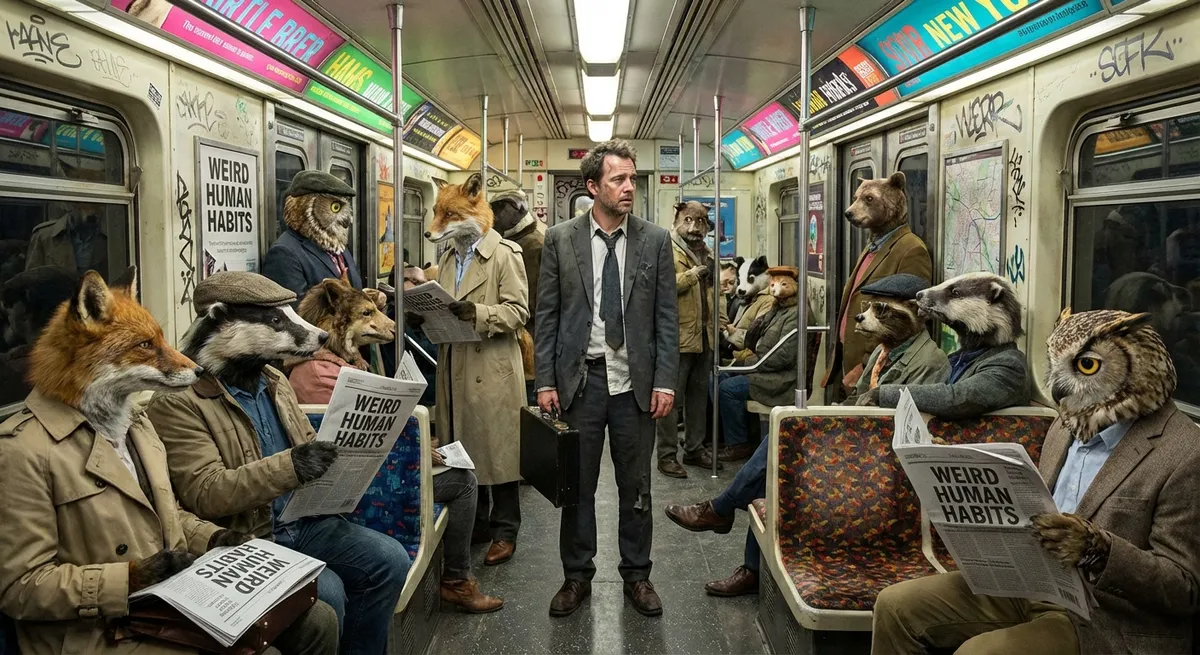
Somewhere out there, a raccoon is watching a human walk a dog in a sweater and thinking, “Yeah, no, I’m the normal one here.” We like to assume animals are just roaming around doing Animal Things™, but a lot of them are absolutely judging us, ignoring us, or straight-up outsmarting us.
Let’s take a quick safari through the animal kingdom’s gossip column and meet the creatures that, if they had group chats, would absolutely be roasting humanity in them.
The Ocean Is Basically a Haunted House Run by Octopuses
Octopuses are what you get when you mix “escape artist,” “mad scientist,” and “petty roommate.” They have nine brains (one main brain plus a mini-brain in each arm) and use all of them to cause problems on purpose.
Aquariums have reported octopuses:
- Sneaking out of tanks at night to steal fish from neighboring exhibits
- Unplugging electrical equipment they find annoying
- Memorizing feeding schedules and splashing specific keepers they don’t like
One octopus in New Zealand, named Inky, literally escaped through a tiny drain and slid his squishy self back into the ocean like he was in Shawshank Redemption: Cephalopod Edition. Meanwhile, we’re over here losing our minds if we misplace our phone for 30 seconds.
Octopuses can also recognize individual human faces, solve puzzles, and unscrew jars from the inside. If they ever figure out door handles, it’s over for us. They’re already solving problems; “open door, reclaim ocean,” is just Step 2.
Why you’ll share this: Because deep down you know the next ocean horror movie should just be a documentary about slightly annoyed octopuses.
Crows Have Mafia-Level Memory and They Hold Grudges
Crows don’t just remember faces—they hold emotional receipts.
Researchers found that if you treat a crow badly (like capturing it for a study), that crow will remember your face for years. Not only that, it will tell other crows about you. Those crows will then start harassing you too, even if they never met you before. That’s not a bird, that’s a neighborhood watch committee with wings.
They also:
- Bring gifts to humans they like (keys, buttons, shiny stuff, probably your missing earring)
- Drop nuts in the road so cars crack them open
- Wait for traffic lights to stop cars before retrieving their snack
Crows attend what look like “crow funerals,” where they gather around deceased birds—likely to learn about danger in the area. That’s an actual meeting. With an agenda. We can’t even schedule brunch.
Why you’ll share this: You have at least one friend whose entire personality is “I never forget a grudge,” and they deserve to meet their bird soulmate.
Cats Are Running a Very Successful Human Training Program
We think we “own” cats, but let’s be honest: we are the staff.
Cats have literally evolved their meows to manipulate us. Adult cats don’t normally meow to each other; they mostly do it for humans. Some cats even develop a meow that mimics a baby’s cry in pitch and urgency, because they know that sound hacks our brains into “MUST RESPOND” mode.
Other fun cat flexes:
- They can recognize their own name—and will often look at you, blink slowly, and ignore you anyway.
- They’ve been domesticated for thousands of years, but their brains and bodies are still extremely close to their wild ancestors. Translation: your fuzzy roommate is 80% house pet, 20% “could live in the desert and eat lizards.”
- They train us with rewards. Cat rubs against you → you pet them → they rub again. That’s operant conditioning, and you are the lab rat.
They’re also excellent at reading our body language, using scent mapping, and navigating complex spaces in 3D. Meanwhile, some of us still walk into the same table edge three times a day.
Why you’ll share this: Every cat owner needs confirmation that yes, they are in a toxic yet adorable power imbalance.
Dolphins Are Having a Whole Soap Opera Without Us
Dolphins are not just “smart fish that aren’t fish.” They have advanced social lives that make human high school look calm.
Dolphins:
- Have unique “signature whistles” that function like names
- Call each other by those names
- Form alliances and coalitions with other dolphins
- Use tools, like sponges over their noses to protect themselves while foraging on rough seafloors
They also teach their kids cultural behaviors, like specific hunting techniques that are unique to their pod. That’s not just instinct—that’s tradition.
And while we’re over here arguing about the group chat name, dolphins have been found to coordinate complex group hunts, communicate over long distances, and possibly use something close to grammar in their clicks and whistles.
There’s also evidence of them recognizing themselves in mirrors, which means they have self-awareness. You and a dolphin both looking in a mirror at the same time are technically having the same existential crisis: “Is that…me?”
Why you’ll share this: Because the idea that dolphins are running multi-season drama arcs underwater is too good to keep to yourself.
Elephants Are Emotional Juggernauts With Better Memories Than Your Phone
Elephants are walking, feeling, 6-ton empathy machines.
They can:
- Recognize dozens of individual elephants—and humans—over many years
- Comfort distressed herd members by touching and vocalizing
- Seem to mourn their dead, sometimes revisiting bones and tusks of lost relatives
- Use different calls for different threats (like humans vs. bees)
Elephants also cooperate to solve problems. In one study, pairs of elephants had to pull two ends of a rope at the same time to get food. They quickly learned to wait for a partner and coordinate their pulls—teamwork that would put most group projects to shame.
And yes, the “elephant never forgets” thing is kinda real: their spatial memory helps them remember water sources and safe routes over insane distances and time spans. They store landscapes in their brains like Google Maps but with better offline mode.
Why you’ll share this: Because somewhere out there, an elephant remembers a kind human from 20 years ago and you can’t even remember what you had for breakfast.
Conclusion
While humans are busy inventing apps that remind us to drink water, animals are:
- Coordinating prison breaks (octopuses)
- Running winged vendetta networks (crows)
- Emotionally manipulating us for snacks (cats)
- Calling each other by name underwater (dolphins)
- And casually operating as emotional geniuses (elephants)
The real plot twist isn’t “Are animals smart?” It’s “How long until they realize they could unionize against us?” Until that day, the least we can do is respect their chaos, learn from their weirdness, and maybe stop underestimating the raccoon going through our trash at 2 a.m. That’s not garbage—it’s data.
Now go send this to a friend who thinks humans are the main characters. The animals would like a word.
Sources
- Smithsonian National Museum of Natural History – Octopus Intelligence - Overview of octopus problem-solving, escape behavior, and cognitive abilities
- University of Washington – Crow Research (John Marzluff Lab) - Explains studies on crow facial recognition, social learning, and long-term memory
- Cornell University College of Veterinary Medicine – Feline Behavior - Details on how cats communicate with humans and interpret our behavior
- National Oceanic and Atmospheric Administration (NOAA) – Dolphin Communication & Intelligence - Discusses dolphin vocalizations, social structures, and cognitive skills
- Elephant Voices – Elephant Cognition & Emotion - Summarizes elephant memory, social behavior, and emotional communication