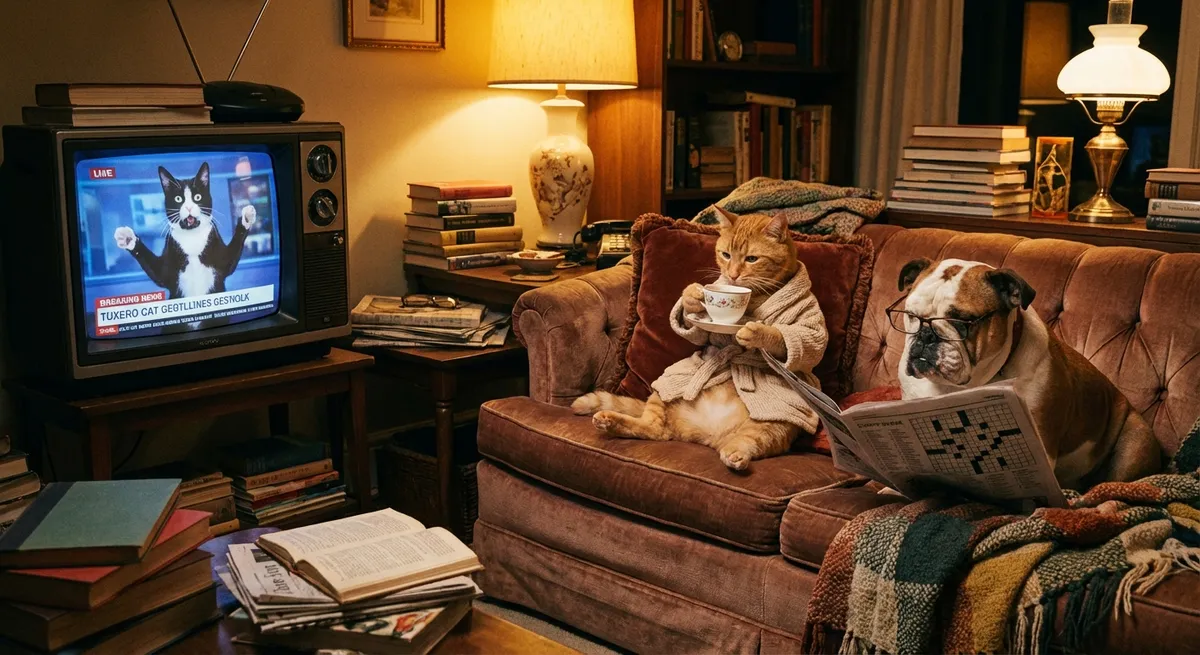
Some animals act like animals. Others wake up, choose chaos, and live like badly-coded humans trapped in fuzzy bodies. These are the ones that stare at us across the room like, “Pay rent? Absolutely not. But I will sit in your chair and judge your life choices.”
Let’s talk about the creatures who are dangerously close to figuring out taxes, group chats, and emotional support snacks. These 5 points are scientifically real, but also emotionally unhinged.
1. Crows Are Basically Gossiping Sky Neighbors
Crows don’t just fly around screaming for vibes. They recognize faces, remember who wronged them, and tell their friends. That’s not a bird. That’s a tiny feathered auntie with receipts.
Researchers have found that crows:
- Recognize individual human faces
- Hold grudges against specific people
- Warn other crows about “bad” humans
- Remember that beef for years
So if you ever yelled at a crow for being loud, congrats: you now have a flying nemesis with a better memory than you have for passwords.
This means somewhere above your neighborhood, there is a crow group chat that goes:
“Guy in blue hoodie = trash. Do NOT land near his car.”
“He also parks terribly.”
“He knows what he did.”
They also bring gifts to humans they like. Shiny objects. Bits of metal. Sometimes random trash. Are you dating a crow or is this just what human dating is now?
2. Octopuses Are Escape Artists With Zero Workplace Loyalty
Octopuses look like aliens, move like spilled slime, and have the personality of bored IT professionals who are so done with your nonsense.
In labs and aquariums, octopuses have been caught:
- Escaping tanks at night
- Crawling across floors to other tanks
- Eating other animals, then getting back before morning
- Unscrewing jars, opening latches, and solving puzzles
- Shooting jets of water at lights and scientists they don’t like
Imagine being a marine biologist, coming into work, and realizing your octopus not only escaped, hunted, ate someone, and got back in their tank—but also changed the filter settings out of petty spite.
Octopuses have individual personalities: shy, bold, curious, chaotic. Some like people. Some hate everyone. Some repeatedly flood the lab by messing with valves like, “This whole situation is above my pay grade. I’m unplugging the ocean.”
If humans ever vanish, give it 200,000 years and the planet will be run by extremely anxious, extremely smart water noodles.
3. Parrots Are Drama-Fueled Audio Recorders With Opinions
Parrots don’t just “repeat words.” They absorb your entire house vibe and then weaponize it.
Parrots have been documented:
- Using words in context (like “Hello” only when the phone rings)
- Calling pets by name
- Mimicking laughter at the right time
- Arguing back with phrases they picked up
- Learning hundreds of words and concepts
The late African grey parrot Alex could identify colors, shapes, numbers, and even say things like “Wanna go back” when he was tired of an experiment. That’s more emotional honesty than most group chats.
Also: parrots in UK zoos have gotten removed from public areas for teaching each other to swear and then roasting visitors on repeat like feathered stand-up comedians. Imagine bringing your kid to see the birds and getting verbally destroyed by a green insult machine hanging from a branch.
Some parrots use phrases like:
- “No” when they don’t want to step up
- “Stop it” when annoyed
- “Good boy” about themselves, which is iconic
Your smart speaker listens. Your parrot listens, judges, and gives performance notes.
4. Dolphins Are Clever, Chaotic, and Low-Key Running Social Experiments
Dolphins have big brains, strong opinions, and absolutely no boundaries when it comes to messing with other species—us included.
Studies show dolphins:
- Recognize themselves in mirrors
- Use tools (like sponges) to protect their noses while foraging
- Have unique “name” whistles for each individual
- Teach tricks and habits to each other
- Play with rings of bubbles just because it looks cool
Mirror recognition is a sign of self-awareness. Humans pass this test. Great apes pass. Some birds pass. Dolphins? They also pass—then flex in front of the glass.
And then there’s the chaos. Dolphins have been seen:
- Bullying pufferfish (which can release neurotoxins) and possibly getting mildly high
- Playing pranks on other animals
- “Helping” humans by nudging swimmers and scaring off sharks
They are basically the ocean’s combination of gifted kid, class clown, and that one guy in the friend group who always says, “Hear me out…” right before something illegal happens.
If they ever figure out TikTok, we’re done.
5. Dogs Have Human-Level Feelings About You (Yes, You Specifically)
Dogs are not just loyal. They’re running full emotional software in their heads with your face as the lock screen.
Research using brain scans shows dogs:
- React strongly to the smell of their humans
- Process some human words separately from tone
- Prefer praising voices over neutral ones
- Understand pointing gestures like toddlers do
Your dog isn’t just excited because “sound! food!” They’re excited because you walked through the door and their brain just hit the “all caps” button.
Also:
- Dogs get jealous if their human gives attention to another dog
- They watch your facial expressions to know if things are safe
- They remember routines better than you remember birthdays
Your dog at 6 p.m.: “It is Walk O’Clock and you are 7 minutes late, taxation is theft.”
Dogs can also fake injuries to get more attention, pretend they didn’t do the crime while standing in the crime, and learn that the magic word “bath” means “absolutely not.” They live in the house, eat your food, and emotionally manipulate you with eye contact.
A roommate, basically.
Conclusion
Animals aren’t just out there doing “animal things.” They’re:
- Holding grudges
- Escaping secure facilities
- Swearing at tourists
- Running social experiments
- Having emotional breakdowns because you’re 4 minutes late with dinner
The line between “person” and “non-person” is blurrier than your vision after three hours of scrolling. So next time you see a crow staring at you, a parrot side-eyeing you, or a dog judging your life choices, remember: they might not have thumbs, but they absolutely have opinions.
And honestly? They might be right.
Sources
- [National Audubon Society – Crows Never Forget a Face](https://www.audubon.org/news/crow-facts) – Overview of crow intelligence, facial recognition, and social learning
- [Smithsonian Magazine – The Mind of an Octopus](https://www.smithsonianmag.com/science-nature/mind-of-the-octopus-72863339/) – In-depth feature on octopus intelligence and escape behavior
- [Harvard Gazette – Parrot Intelligence](https://news.harvard.edu/gazette/story/2007/09/the-mind-of-the-parrot/) – Discussion of Alex the African grey parrot and his cognitive abilities
- [American Museum of Natural History – Dolphin Intelligence](https://www.amnh.org/explore/videos/biodiversity/dolphin-intelligence) – Explores dolphin cognition, self-recognition, and social behavior
- [National Institutes of Health (NIH) – How Dogs Process Speech](https://www.ncbi.nlm.nih.gov/pmc/articles/PMC5618821/) – Research article on dog brain responses to human words and intonation