Somewhere on this planet, a crow is side‑eyeing you like, “Wow, you can’t even open a walnut with your face? Tragic.”
Humans love to think we’re in charge of the animal kingdom, but a suspicious amount of evidence suggests that, actually, we might be the emotional support himbos of planet Earth.
Let’s expose a few species that are absolutely treating us like their weird, furless roommates.
The Crow Mafia Is Probably Gossiping About You
Crows don’t just have good memories—they have petty memories.
Researchers have found that crows can recognize individual human faces and remember people who were rude to them… for years. They even tell other crows who to love and who to roast. Somewhere above you, there’s probably a bird screaming, “That’s the one who stole my fry in 2019. Boo this man.”
They also bring gifts to humans they “like”: beads, buttons, lost earrings, shiny trash that looks like it comes from a crow Dollar Store. That’s not random kindness—that’s emotional manipulation. They reward the humans that keep the snack pipeline open.
Every time you put out food for “the nice crows,” understand this: those birds have successfully domesticated you. Next they'll be demanding dental and a retirement plan.
Shareable take: Crows literally pass down stories about specific humans like family tea. You are either “Snack Deity” or “That Clown from the Yard Incident.” There is no in‑between.
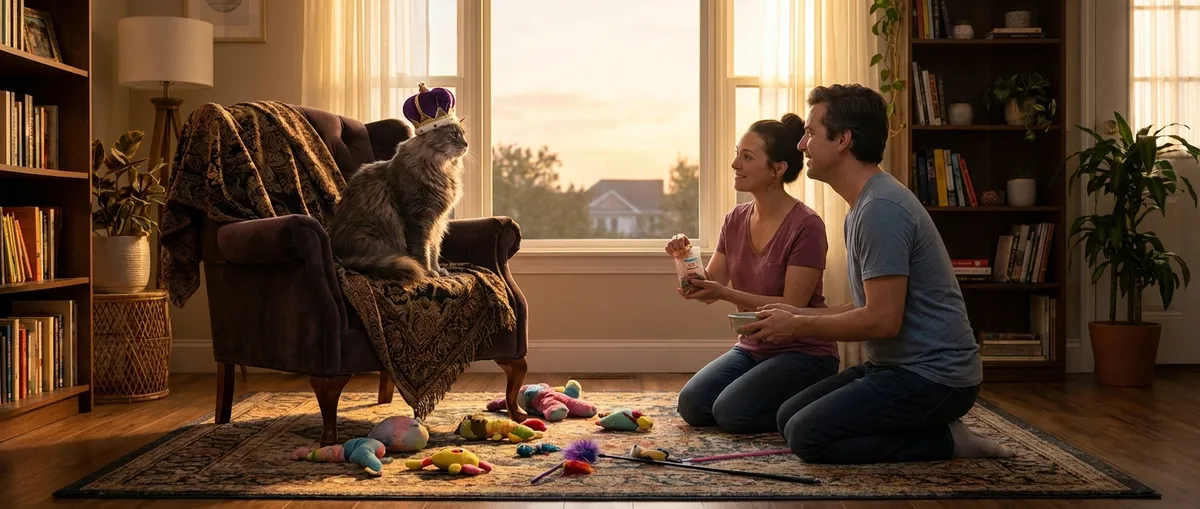
Your Cat Is Running a Psychological Experiment
Cat people say things like, “She doesn’t like most humans, but she chose me.”
Congratulations, you’ve been recruited into an unpaid behavioral study.
Cats meow at humans in a way they don’t use with other cats. They’ve basically invented a custom language to press our emotional buttons like a furry soundboard. That high‑pitched “meeeeh” is suspiciously tuned to sound like a crying baby, and your brain is hardwired to respond. That’s not affection; that’s strategic audio warfare.
They also “present” dead mice and birds like, “You clearly cannot hunt and will die if I don’t handle this.” In their minds, you’re the weird, slow, food‑dispensing roommate who needs regular enrichment and cannot be trusted near the outdoors.
And the way they knock things off tables while looking you dead in the eye? That’s not random chaos. That’s a scientist testing gravity for the 473rd time, except you’re the test subject whose blood pressure is being charted.
Shareable take: Your cat doesn’t live in your house; you are an underperforming live‑in butler inside theirs.
Dolphins Are Treating Us Like Reality TV
If any animal is watching us like a chaotic Netflix series, it’s dolphins.
Dolphins have names for each other—unique whistles that function like “Hey, Jessica!” Which means when you go on a dolphin tour, somewhere under the water a dolphin is probably going, “You guys gotta see this group. Their ‘Jessicas’ all scream at once.”
They also do things purely for the drama. Spinning, leaping, passing pufferfish around like a narcotic beach ball… Scientists have found they play, prank each other, and possibly get mildly high from certain fish toxins. Meanwhile, we’re on the boat like, “Wow, nature is beautiful,” and they’re doing underwater TikTok trends for their squad.
On top of that, wild dolphins will sometimes bring random gifts to humans: seaweed, sponges, fish, and occasionally straight-up trash. That’s either generosity or a performance art piece about littering. Either way, we’re the unknowing audience.
Shareable take: To dolphins, we are background characters in a long‑running soap opera called “The Splashing Hairless Ones”.
Pigeons Are Urban Surveillance With Wings
Pigeons get clowned on as “rats with wings,” but these birds are secretly out here running data analytics on us.
Studies show pigeons can recognize individual human faces, distinguish between different art styles (yes, really), and even tell the difference between words and nonsense letter strings. Meanwhile, some of us still type passwords as “password123.”
They can also find their way home from miles away using landmarks, the sun, Earth’s magnetic field, and probably sheer disrespect. For centuries, humans used them for delivering messages, which means pigeons had access to way more tea than the average medieval peasant.
Nowadays they hang out in cities, watching us share fries with our “emotional support espresso” while we pretend we’re not being judged by a bird that can do complex pattern recognition but chooses to nap on a traffic light.
Shareable take: You’re not “walking through town”—you’re being scanned by a distributed network of feathery security cameras with strong opinions.
Octopuses Are Escape Artists Judging Us From Jars
If aliens ever visit Earth, they’re going to look at octopuses and go, “Ah, our people.”
Octopuses can solve puzzles, open jars from the inside, remember human handlers, and squirt water at specific people they dislike. Zookeepers have reported them sneaking out of tanks at night, grabbing snacks, and slithering back like nothing happened. That’s not a pet; that’s a heist movie protagonist.
They also camouflage their bodies, change textures, and even fake colors they can’t see with their own eyes. Meanwhile, humans are still forgetting where they parked. Again. For the third time this month.
When an octopus stares at you from behind glass, it’s not thinking, “Wow, a majestic apex predator.” It’s thinking, “You locked yourself out of your car, didn’t you?” And statistically? Yes. Yes, you did.
Shareable take: Octopuses aren’t trapped in aquariums; they’re just staying in for research. On you.
Conclusion
If you’ve ever suspected that animals are quietly roasting us, the evidence is… brutal. Crows hold grudges, cats run social experiments, dolphins treat us like live entertainment, pigeons do aerial surveillance, and octopuses are out here being eight‑armed escape geniuses.
The real plot twist: we’re not “domesticating” animals. A suspicious number of them have figured out how to get free food, free housing, medical care, and endless enrichment… by letting us think we’re in charge.
So next time you lock eyes with a smug crow, a judgmental cat, or a deeply unimpressed octopus, remember: you might not be looking at wildlife. You might be looking at your supervisor.
Now go send this to that friend who swears their pet is “just a little guy.” No. That’s a tiny furry mastermind.
Sources
- [National Audubon Society – Crows Never Forget a Face](https://www.audubon.org/news/crows-never-forget-face-especially-one-they-hate) - Explains how crows recognize and remember specific humans and share that information.
- [Smithsonian Magazine – What Your Cat’s Meow Really Means](https://www.smithsonianmag.com/science-nature/what-your-cats-meow-really-means-20648266/) - Discusses how cats use meows primarily to communicate with humans, not other cats.
- [NOAA Fisheries – Dolphin Intelligence](https://www.fisheries.noaa.gov/feature-story/how-smart-are-dolphins) - Breaks down cognitive abilities, social behavior, and communication in dolphins.
- [BBC – How Smart Is a Pigeon?](https://www.bbc.com/future/article/20140714-how-smart-is-a-pigeon) - Reviews research on pigeons’ memory, recognition skills, and surprising intelligence.
- [Scientific American – The Mind of an Octopus](https://www.scientificamerican.com/article/mind-of-the-octopus/) - Explores octopus problem-solving, escape behavior, and interactions with humans.