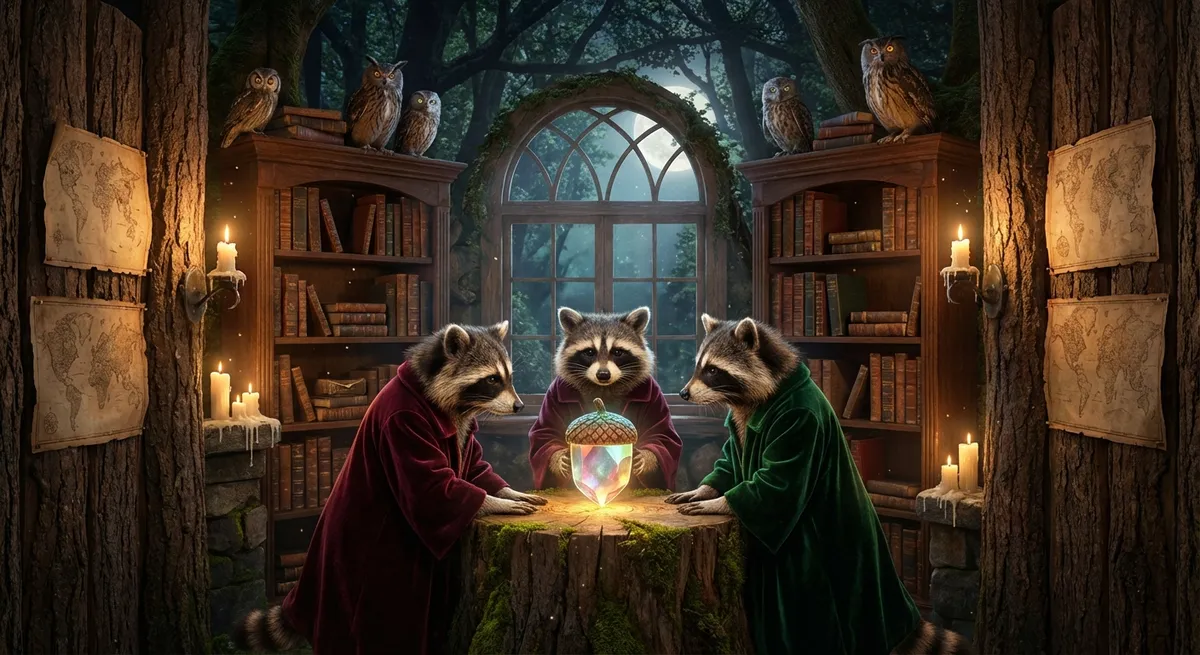
Somewhere on this planet right now, an animal is doing something so strangely organized, dramatic, and suspicious that if humans did it, we’d call it a “shadow cabal” and make a Netflix documentary. Animals aren’t just cute; a lot of them are operating with the kind of coordination and chaos that screams: underground committee meeting at 3 p.m., bring snacks.
Let’s expose some of the furred, feathered, and finned masterminds quietly running their own secret societies while we struggle to remember why we walked into the kitchen.
The Crow Council That Definitely Knows Your Face
Crows are out here running a full surveillance operation and nobody told us.
Researchers have found that crows can recognize individual human faces, remember who was rude to them, and then tell their crow friends about it. That’s not a bird; that’s a neighborhood watch with wings and generational grudges. Imagine walking outside and a crow is like, “That’s the one who stole my parking spot in 2016,” and the whole murder (yes, that’s the actual term for a group of crows, very casual) just stares at you in judgmental silence.
They also hold what look suspiciously like funerals. When a crow dies, others gather around, observe the body, and then seem to “discuss” what happened. Scientists say it’s likely a way to learn about danger in the area. I say that is criminally close to a briefing: “Agenda item one: Jeff flew into the window. We will not be doing that.”
If your FBI agent had feathers, it would be a crow. Respect the bird, apologize for your past sins, maybe offer snacks.
The Meerkat Neighborhood Watch Program
Meerkats don’t just stand up and look cute for memes; they run a desert HOA with better communication than your entire group chat.
They’re famously organized: one keeps lookout, others forage, some babysit. They take turns in roles like they’re running shift schedules on a shared Google Calendar you’re not allowed to see. When danger shows up, the guard meerkat has specific alarm calls for different threats—one sound for “snake on the ground,” another for “bird of death above,” another for “panic immediately.”
They also teach their kids how to handle dangerous prey in stages, starting with disabled scorpions before moving to live ones. That’s an apprenticeship program. That’s onboarding. That’s: “Welcome to Meerkat Corp, here’s your training module and your death-stinger practice toy.”
If humans coordinated like meerkats, we’d probably have flying cars by now instead of 40 unread emails and a fridge with only mustard.
The Octopus Escape Artists Plotting from the Tank
If any animal is going to figure out how to open a portal and leave this planet, it’s an octopus.
These soft, bendy masterminds can unscrew jars, open latches, sneak through holes the size of your anxiety, and in multiple aquariums, they’ve literally crawled out of their tanks at night to explore, eat snacks, and sometimes squirt water at things they dislike. That’s not a pet. That’s a coworker who knows the building security codes.
They can also recognize individual people, and some of them straight-up pick favorites. If they don’t like you, they might just blast you with water. Imagine clocking in at the aquarium and getting passive-aggressively hosed by an octopus who has decided your vibes are wrong.
Scientists studying octopus brains say their intelligence evolved very differently from ours, which basically means there’s a parallel squid-shaped thinking style currently reviewing us like: “Interesting. They invented TikTok instead of universal healthcare.”
If your kitchen sponge ever moves on its own, don’t ask questions. Just assume a local octopus unionized your cleaning supplies.
Pigeon City Planners in the Sky
Pigeons get zero respect, but they are quietly operating like tiny feathered GPS systems with better signal than your phone in an elevator.
They can navigate long distances using the Earth’s magnetic field, the position of the sun, visual landmarks, and possibly smells. Meanwhile, many of us can’t make it home without Google Maps reminding us what turn we’ve taken every single day for the last three years. Pigeons were literally used as wartime messengers because they were more reliable than early tech. Someone trusted their top-secret battle plans to a bird best known today for loitering outside Starbucks.
They also have a suspicious sense of direction toward food. Drop a single crumb anywhere in a city and a pigeon will materialize like it just fast-traveled there. Are they texting each other? Using shared location? “Bro, carbs spotted at coordinates 42.361–71.057. Go, go, go.”
So yes, while we complain that urban design is a mess, pigeons have already mapped the city in 3D, identified peak crumb zones, and formed aerial traffic lanes. Somewhere, there’s a pigeon city planner in a tiny hard hat, deeply unimpressed by your sense of direction.
Dolphin Friendship Networks That Feel Kind of Mafia
Dolphins have social lives more complex than your entire extended family group chat, and with way fewer awkward birthday messages.
They form alliances, then alliances of alliances—basically friend groups that merge like interconnected social pyramids. Male dolphins sometimes team up long term to court females, protect each other, and block rival males. That’s not casual hanging out; that’s a strategic partnership. Those boys are in a LinkedIn pod they never log out of.
They also have signature whistles that function like names. If a dolphin is separated from its buddy, it can literally “call their name” across the water. That’s adorable, but also… terrifyingly organized. Imagine if your friend could @ you just by whistling into the ocean.
Some dolphins have even been observed teaching each other new hunting tricks, like trapping fish with mud rings. One invents a method, others copy it, and suddenly you have dolphin culture. Meanwhile, you’re still trying to get your friends to stop saying “let’s circle back” in normal conversation.
If dolphins ever get thumbs, we’re done. They will roll up to shore, sign some paperwork, and quietly take over management.
Conclusion
While we’re over here doomscrolling in sweatpants, entire species are out there:
- Running surveillance (crows),
- Enforcing neighborhood security (meerkats),
- Testing escape routes (octopuses),
- Optimizing traffic and logistics (pigeons),
- And building social networks with better loyalty programs than your credit card (dolphins).
Animals aren’t just existing; they’re organizing, remembering, teaching, and low-key running operations that would require at least three committees and a PowerPoint if humans tried it.
Next time you see a random bird staring at you, a meerkat standing suspiciously tall, or a pigeon walking like it pays rent, just know: you might not be the main character. You might be an uncredited extra in their extremely well-coordinated secret society.
Hit share so everyone else can start giving our undercover animal overlords the respect (and snacks) they clearly deserve.
Sources
- [National Audubon Society – What Crows Know](https://www.audubon.org/news/crows-never-forget-faces-they-associate-bad-feelings) – Explains how crows recognize human faces and remember threats.
- [Smithsonian Magazine – Meerkat Behavior](https://www.smithsonianmag.com/science-nature/how-meerkats-teach-their-young-1470705/) – Details meerkat sentry duty and how they teach pups to handle prey.
- [Scientific American – The Astonishing Intelligence of Octopuses](https://www.scientificamerican.com/article/the-mind-of-an-octopus/) – Covers octopus problem-solving, escape behavior, and cognition.
- [BBC – The Genius of Pigeons](https://www.bbc.com/future/article/20160926-the-surprising-brainpower-of-pigeons) – Discusses pigeon navigation, memory, and urban adaptation.
- [Proceedings of the National Academy of Sciences (PNAS) – Dolphin Social Alliances](https://www.pnas.org/doi/10.1073/pnas.1720377115) – Research on complex alliance networks and long-term social bonds in dolphins.