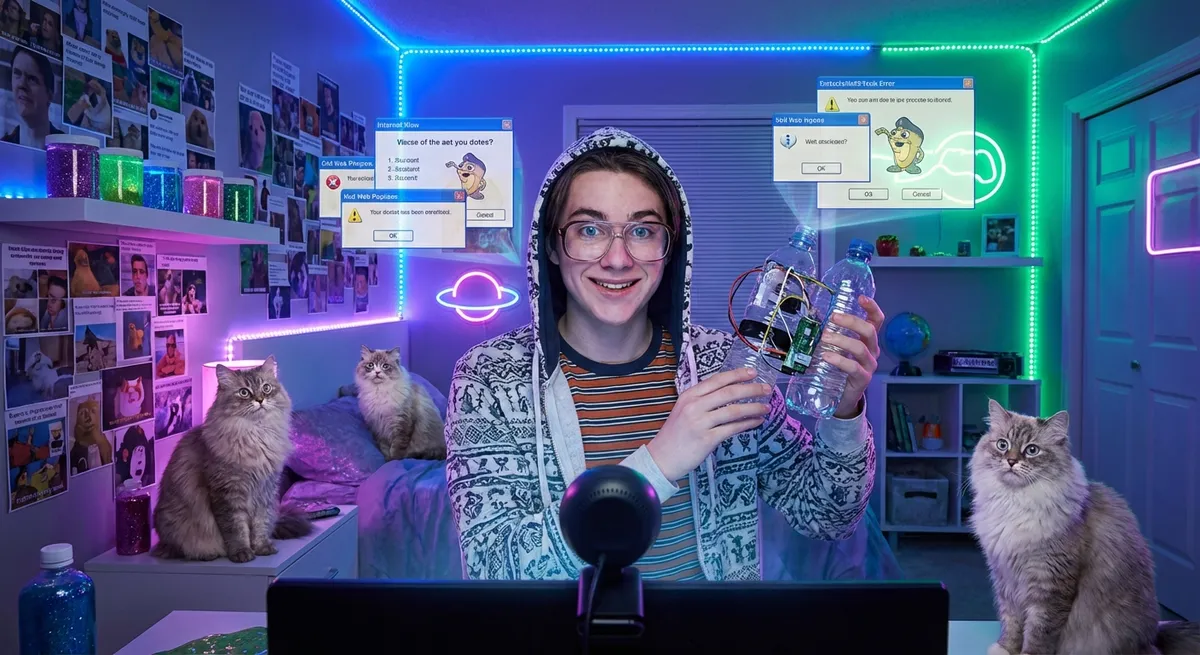
If you’ve ever tried to fall asleep and your brain suddenly hits you with a memory of That One Thing You Said In 2014… congratulations, you are a human being with Wi‑Fi and regrets.
This is your official permission slip to stop haunting yourself. The stuff you call “cringe”? That’s literally just you being a slightly outdated version of yourself. Like an iOS from three updates ago that still thought skeuomorphic leather was sexy.
Let’s talk about why your weird phases, chaotic posts, and unhinged hobbies are not only fine, but actually kind of legendary—and why this might be the most shareable love letter to your cringe you’ll read today.
Your “Cringe” Past Is Just Free Character Development
Somewhere on an old hard drive, there is a photo of you with a filter that turned your skin orange and your eyes into anime dinner plates. You may refer to this as “a mistake.” Psychology calls it “evidence of growth.”
When you look back and go “ew, why was I like that,” what you’re really saying is, “wow, look how much I’ve changed.” Feeling cringe about your past is literally proof your brain has been updating its software in the background while you were busy doomscrolling.
Think about it: every awkward confession, overshared status update, or disastrous haircut became data. Your brain went, “Cool, noted: we will never do that again,” and quietly patched the bug. That “omg I can’t believe I said that” memory is just a change-log entry in your personal patch notes.
Also, fun fact: other people are generally way more focused on their own embarrassing highlight reel than your 2012 fedora era. Your “worst moment” is usually just a background NPC event in someone else’s story.
Shareability bait: Post this with a screenshot of your most cursed old selfie and the caption: “Character development arc unlocked.”
Being Weird Out Loud Is Low-Key A Superpower
You know that one friend who is absolutely unhinged in public in the best possible way? The one who dances at the crosswalk, makes friends with bartenders, and somehow has a story for everything? That person might look chaotic, but they’re doing something your social anxiety app keeps blocking: they’re practicing being seen.
Research on vulnerability and authenticity shows we actually like people more when they’re a bit imperfect and honest, not when they’re “flawless robot with curated aesthetic and seven Lightroom presets.” The person who says the slightly-too-real thing in the group chat? That’s usually the one everyone trusts.
Being a little weird out loud does two sneaky things:
- It filters out people who are allergic to your personality so you don’t waste time on them.
- It sends a bat-signal to other weirdos like, “Hi, yes, this is a safe space for feral energy.”
The line between “cringe” and “iconic” is just how confidently you commit.
Shareability bait: Tag that one chaotic friend with: “You are the reason civilization is still fun.”
The Internet Forgets Way Faster Than Your Brain Does
You: “Everyone remembers that one disastrous tweet I posted in college.”
The Internet, three hours later: “New trend who dis.”
Unless you did something genuinely newsworthy (and not in the good way), your moments of “ugh why did I post that” are buried under 45,000 daily memes, 18 new micro-trends, and one celebrity breakup. Your brain, however, is like: “Let’s replay this mistake in 4K at 2 a.m. for no reason.”
Studies on memory show we’re biased to remember our own awkwardness way more vividly than anybody else’s. It’s called the “spotlight effect”: your brain thinks a stadium is watching when in reality, three people glanced over and then opened TikTok.
Meanwhile, the apps are designed to move on instantly. Stories vanish, feeds refresh, algorithms forget you exist if you don’t post for a week. Your inner critic is basically running Windows 95 on dial-up while the rest of the internet is on 5G.
Shareability bait: Write: “Reminder: I’m the only one still thinking about my 2016 Facebook drama,” and watch 14 people comment “attacked.”
Your Future Self Is Already Judging You—And That’s Good
Ten years from now, Future You is going to look back at Current You and say, with love, “Wow. Choices were made.” And that’s perfect.
Right now, you’re probably doing at least one thing that 2036 You will find deeply questionable:
- your texting style
- your haircut
- your sleep schedule
- your taste in people
- that one niche hobby you’re way too obsessed with
That doesn’t mean stop doing it—it means that living authentically right now is part of the deal. The only way to avoid being cringe to your future self is to never try anything, never care about anything, and never take any risks. That’s not “cool,” that’s emotional airplane mode.
Also, fun twist: your future self will also be low-key grateful you made those weird choices, because they’ll have stories, experiences, and possibly several “this can’t be real” anecdotes to tell at parties.
Shareability bait: Post: “Sending love to my 3-years-from-now self who will be cringing at this exact post.”
The People Having The Most Fun Have Already Given Up On Being Cool
Here’s a dangerous thought: what if “cool” has been a scam this whole time?
Think about the last time you saw someone fully, unironically enjoying something:
- the guy loudly singing in his car at a red light
- the girl in the grocery store aisle dancing to whatever’s on her headphones
- the middle-aged dad absolutely losing it over a board game
You might smile, maybe laugh, but there’s also this tiny jolt of “wait… I kind of want to be that unbothered.”
Trying to be cool is exhausting. You’re basically running a 24/7 PR department for your personality:
- “Is this outfit ironic enough?”
- “Will this song choice make me look basic?”
- “If I admit I like this, does it ruin my brand?”
The plot twist: no one “cool” is checking. People are drawn to energy, not aesthetics. To enthusiasm, not perfectly aligned outfits. To the person doing the dorky thing, not the person standing nearby pretending not to care.
The ones who’ve realized this are out there living like NPC glitch bosses, having the time of their lives while the rest of us are editing our internal highlight reels.
Shareability bait: Caption a ridiculous selfie with: “Cool is cancelled. I’m going full main-character goblin mode.”
Conclusion
You are not cringe. You are a limited-edition beta version of a human constantly patching, updating, and occasionally hard-crashing mid-conversation.
Your weird phases? Data.
Your embarrassing posts? Time capsules.
Your chaotic stories? Premium lore.
The stuff you’re most tempted to hide is often the same stuff that makes people feel less alone, more seen, and way more likely to send your post to the group chat with: “This is literally you.”
So go ahead:
- Wear the outfit that’s “too much.”
- Start the hobby that’s “too extra.”
- Post the thought that’s “too honest.”
Let somebody’s future nostalgia feed be full of your fearless, unedited nonsense. If you’re going to haunt yourself anyway, you might as well be iconic about it.
Sources
- [American Psychological Association – What Is Self-Compassion?](https://www.apa.org/monitor/2012/07-08/self-compassion) - Explains how being kind to your past self supports growth instead of shame
- [Harvard Business Review – The Power of Imperfect Leaders](https://hbr.org/2023/01/the-power-of-imperfect-leaders) - Discusses why vulnerability and visible flaws can increase trust and connection
- [Greater Good Science Center (UC Berkeley) – Why We Should Be Less Afraid of Embarrassment](https://greatergood.berkeley.edu/article/item/why_we_should_be_less_afraid_of_embarrassment) - Breaks down how embarrassment is perceived and why others judge us less than we think
- [Verywell Mind – What Is the Spotlight Effect?](https://www.verywellmind.com/what-is-the-spotlight-effect-5186405) - Describes our tendency to overestimate how much other people notice our mistakes
- [Pew Research Center – Social Media and the Spiral of Silence](https://www.pewresearch.org/internet/2014/08/26/social-media-and-the-spiral-of-silence/) - Shows how fear of judgment shapes what we share online and why authenticity still matters