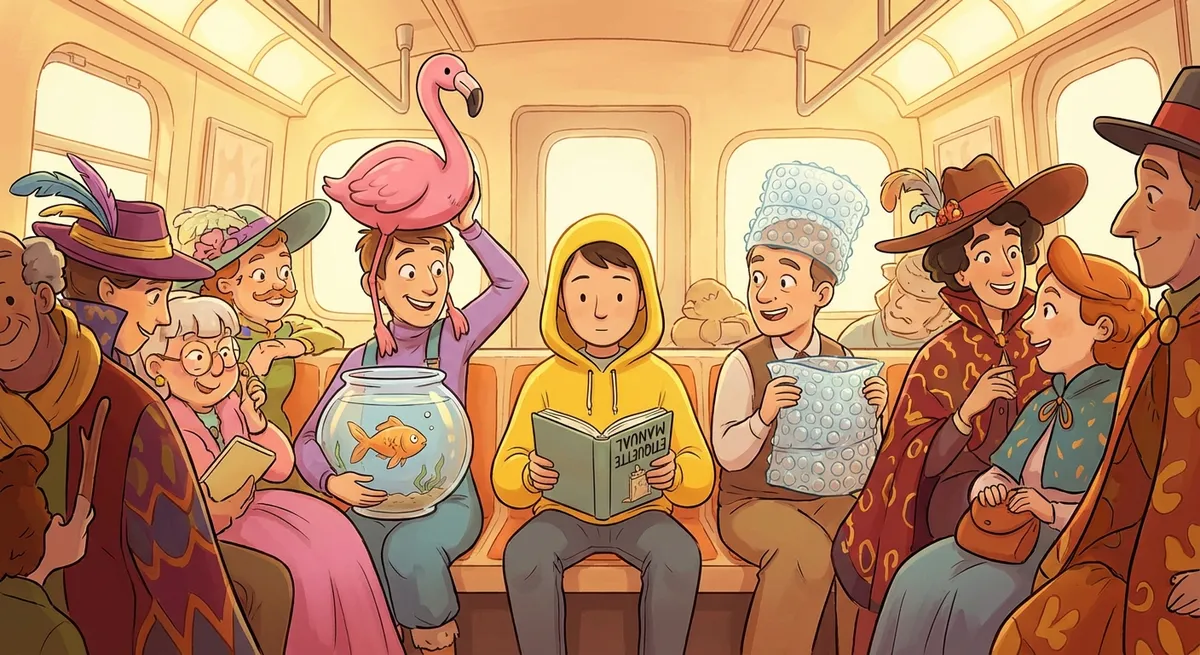
You are not “socially awkward.” You are a limited-edition human trying to interact with beta-version software called Other People. That’s it. That’s the article.
…Okay fine, here’s the long version.
This is your unofficial survival guide for people who overthink every text, replay every conversation at 3:14 a.m., and say “you too” to the waiter after they tell you to enjoy your meal. You are not broken. You are just playing life on Ultra Hard Mode with too many brain tabs open.
Share this with the friend who leaves every party and immediately types, “Did I talk too much??” Yes, you. This is about you.
1. The Ancient Ritual Of Replaying Every Conversation Ever
You know how some people finish a conversation and just… move on with their day? Couldn’t be you.
Your brain:
“Remember that time you mispronounced ‘gyro’ in 2014?”
You: “We’ve grown since then.”
Your brain: “Doesn’t matter. Here’s a 4K remaster in surround sound.”
Social anxiety is basically your brain trying to be your PR manager and your worst hater at the same time. You said “Bye, see you!” and your brain turned it into a 14‑season scandal.
Here’s what’s wild: most people forget what you said approximately three nanoseconds after you stop talking because they’re too busy starring in their own internal drama. The guy you think you “embarrassed yourself in front of” went home and misused the word “literally” six times in one sentence. No one is winning here.
Viral‑shareable truth: if you overanalyze your conversations, remember that everyone else is probably doing the same. It’s not awkward; it’s a group project in mutual self‑cringe.
2. The Art Of Saying “You Too” When It Makes Zero Sense
“Enjoy your flight.”
“You too.”
Silence.
Existential dread.
You will think about that interaction until the sun explodes.
Here’s a short list of phrases we’ve all accidentally “you-too’d”:
- “Happy Mother’s Day!” – from someone without kids
- “Good luck on your exam!” – to your professor
- “Have a great shift!” – to the unemployed friend
- “Welcome to the show!” – “You too.” (???)
The secret plot twist: studies in social psychology show people are weirdly forgiving of tiny social blunders. The “spotlight effect” means you massively overestimate how much people notice your mistakes. They don’t. They’re busy thinking about the time they called their teacher “mom” in 2009.
So that time you said “You too” to the movie ticket guy when he told you to enjoy the film? That’s not a personality flaw. That’s a rite of passage. You are now a citizen of Planet Earth.
Viral‑shareable truth: If you haven’t said “You too” when it absolutely did not apply, are you even alive or just a hologram with good social reflexes?
3. Texting: The Olympic Sport Of Misinterpreting Everything
Texting is where perfectly normal people become full-time cryptographers.
He texted “lol.”
What he meant: He chuckled slightly, maybe.
What you read:
- Is he mad?
- Is this passive-aggressive?
- Did I overshare?
- Is “lol” short for “lack of love”?
You send a message, see “typing…” for 3 seconds, then nothing. Now you’re in Season 7 of “What Did I Do Wrong?” and the show just got renewed.
Meanwhile, your friend just got distracted by a sandwich.
Reality check: tone is notoriously terrible over text. That’s not a you problem, that’s a medium problem. Linguists and communication experts point out that digital conversation strips away facial expressions, body language, and intonation, which is like trying to understand a movie by only reading the subtitles, on mute, during an earthquake.
Pro tip that feels illegal: you’re allowed to send clarifying messages. “Wait, that came out weird, I meant this.” Or, “This is supposed to be a joke, before you cancel me.” People do not mind. Half of them are relieved you broke the “act normal at all costs” curse.
Viral‑shareable truth: Everyone is just guessing the tone of each text and hoping it wasn’t the wrong vibe. We’re all just vibes scientists and the lab is on fire.
4. The Introvert-Extrovert Glitch In Your Settings
You know you’re a social glitch when:
- You’re excited for plans. You make an outfit. You hype yourself up.
- The day of: “What if I just… didn’t?”
- You go anyway. You have fun.
- You come home and need three business days to emotionally reboot.
Some people can go to brunch, three birthday parties, and a concert in one day and still text, “What’s everyone doing tonight?” They’re operating on a different battery type. You? You are a phone that goes from 87% to 3% after one FaceTime.
Psychology actually has your back here: introversion/extroversion isn’t about “liking people” or not. It’s about where you get your energy. Extroverts recharge with people, introverts recharge by being left alone with Wi‑Fi and snacks. Ambiverts exist too—people who are both—and they are just as confused as you are.
So no, you’re not antisocial because your favorite part of the party is the moment you get home and can finally take off your “I am tolerable” face. That’s just your social battery telling you she’s done for today.
Viral‑shareable truth: “I like people in very controlled doses” is not a personality flaw—it’s a settings menu.
5. Your Weird Is Literally Your Superpower (Sorry, But It Is)
Think about the people you actually like the most. Are they the flawless, perfectly smooth, never-awkward ones? Or the ones who say bizarre things like:
- “I can’t stop thinking about how big whales are.” (in the middle of lunch)
- “Sometimes I rehearse saying ‘here’ in class so I don’t mess it up.”
- “I Google symptoms and then reassure my doctor it’s probably nothing.”
Those are the people you remember. Not because they’re “weird,” but because they’re real.
Psych research on attraction and likability shows something delightful: a little awkwardness can make people more relatable and likable. It’s called the “pratfall effect”—when someone competent messes up slightly, we like them more because they seem human. So your weird laugh, your too-long stories, your habit of waving back at people who weren’t waving at you? That’s character development.
Internet culture runs on this. The stories that go viral are never “I behaved perfectly and everyone clapped.” They’re “I accidentally told my boss ‘love you’ and then moved to another country emotionally.”
Viral‑shareable truth: You are not the glitch in the simulation; you are the main character with chaotic side quests.
Conclusion
You’re not socially broken. You’re just a conscious human in a world where everyone is slightly confused, pretending not to be confused, and then going home to think about how confused they seemed.
So the next time you:
- say “you too” when it absolutely doesn’t apply,
- misread a “lol” like it’s a legal document,
- need three days alone after one (1) brunch, or
- replay a five-second interaction for five years,
remember: this is normal. Painfully, hilariously, universally normal.
Send this to the friend who always says “omg same” whenever you confess something you thought was uniquely embarrassing. You’re not alone. You’re just human—with patchy Wi‑Fi and too many tabs open.
And honestly? That’s kind of iconic.
Sources
- [American Psychological Association – Social Anxiety Disorder](https://www.apa.org/topics/anxiety/social-anxiety) - Explains what social anxiety is and how common social fears show up in everyday life
- [Verywell Mind – What Is the Spotlight Effect?](https://www.verywellmind.com/what-is-the-spotlight-effect-2795905) - Breaks down why we think everyone notices our mistakes way more than they actually do
- [Greater Good Science Center (UC Berkeley) – Are You an Introvert or Extrovert?](https://greatergood.berkeley.edu/article/item/are_you_introvert_or_extrovert) - Discusses introversion, extroversion, and ambiversion and how they affect social energy
- [Simply Psychology – The Pratfall Effect](https://www.simplypsychology.org/pratfall-effect.html) - Describes why small mistakes can make people seem more likable and human
- [NYTimes – Why We’re So Awkward Over Text](https://www.nytimes.com/2022/07/15/style/texting-etiquette.html) - Looks at how tone and meaning get lost over text and why it makes communication tricky