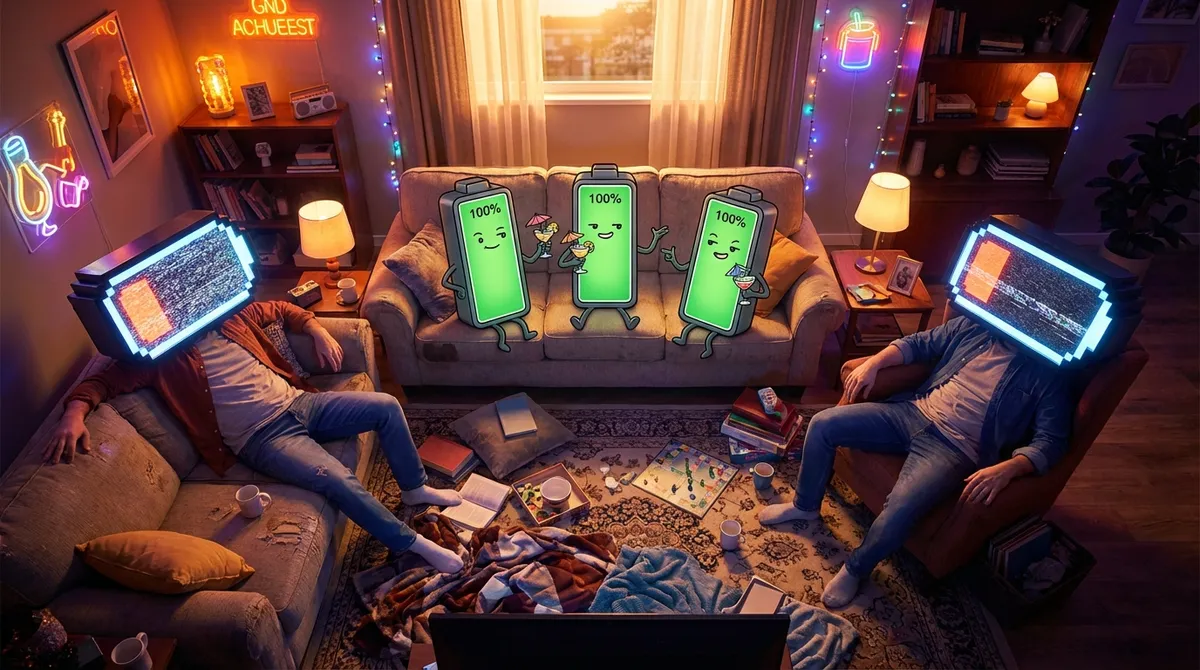
You know that moment when you’re having fun, your brain is like “yay humans,” and then suddenly—out of nowhere—you’re done? Not sleepy. Not sad. Just mentally yeeted out of existence.
Congratulations: you’ve met your social battery. The fake little progress bar in your head that never tells the truth, never charges properly, and definitely did not agree to that 3-day group trip.
Let’s unpack why everyone is pretending to be fine, why we’re all secretly fighting for the same corner seat, and how to survive the chaos without becoming a full-time hermit who only talks to customer service chats.
The Myth of the “Chill Hang” (It’s Never Chill)
People love saying, “It’s just a chill hang, nothing big.” Lies. All lies.
“Chill hang” can mean:
- Four people grabbing tacos, or
- Seventeen people, three new couples, a dog, a Bluetooth speaker, and someone asking, “What’s your five-year plan?” unprompted.
- The “fun one”
- The “good listener”
- The “person who somehow knows how to split the bill”
- The “tech translator” trying to connect the TV to literally anything
- Laughed at three mediocre jokes
- Nodded through a story that had five false endings
- Explained what you do for work but “like, in normal person words”
Your social battery doesn’t drain from how many people are there; it drains from how many social roles you’re playing at once:
By the time you’ve:
…your battery is down to 7% and the “low power mode” is you staring at a random plant like it’s the most interesting thing on Earth.
Shareable takeaway #1: Nobody is actually “chill.” We’re all just buffering at different speeds.
The Secret Olympian Sport: Strategic Ghosting (Without Being a Monster)
Modern social life is just inventing increasingly creative excuses to go home without sounding like a villain.
Classic exit lines:
- “I have an early morning” (It’s Saturday.)
- “I have a thing tomorrow” (A thing = your couch.)
- “I told myself I’d be productive tonight” (You will absolutely not be productive tonight.)
- The Soft Exit:
- The Group Fade:
- The Irish Vanish 2.0 (Wi-Fi Edition):
But there is an art to socially responsible ghosting:
You start saying “I’m probably going to head out soon” 25 minutes before you actually move. This gives everyone time to emotionally detach.
You quietly attach your goodbye to someone else’s: “Yeah I’ll go too actually.” Bonus: all attention goes to the first leaver. You are a stealth ninja.
You leave the group chat unread for exactly 23 minutes after you get home so nobody can calculate how fast you changed into pajamas.
The key is remembering: other humans ALSO want to leave. When one person breaks the seal, everyone’s like “oh thank god, it’s socially legal to go now.”
Shareable takeaway #2: At any given gathering, at least 40% of the people are waiting for someone else to leave first.
The “Extrovert vs. Introvert” Plot Twist You Didn’t Ask For
People love to divide the world into:
- Extroverts: “Human contact is oxygen.”
- Introverts: “If you ring my doorbell unannounced, I will ascend to another plane.”
But in real life? Most of us are just tired raccoons wearing people costumes.
Here’s the scam:
- Extroverts still get drained. They just hit low battery in silence, mid-conversation, while saying things like “Yeah totally” to a sentence they did not hear.
- Introverts sometimes want crowds. They just want to be invisible in them, like a background NPC at a coffee shop.
- The “Schedule My Fun” Person: Needs 3–5 business days’ notice before doing anything that involves pants.
- The “I Wasn’t Going Out But Now I’m Here” Person: Fully in pajamas at 9 PM, somehow in a karaoke bar at 10:17.
- The “One Plan Per Day” Person: If they had brunch, they cannot physically attend dinner. “I’ve already been alive once today.”
The real categories:
You’re not broken; you just have weird firmware. Welcome to the club.
Shareable takeaway #3: You’re not an introvert or extrovert—you’re a “depends on who, where, and is there food”-vert.
Texting, Typing, and the Art of Social Pretending
Your social battery also lives in your phone, and wow, it is unwell.
Scenarios:
- You see a text. You mentally respond. You absolutely do not actually respond.
- Group chat pops off. You type “haha” then delete it 14 times, because what if your “haha” energy doesn’t match the current vibe?
- Someone sends a voice note. You stare at it like it’s a tax document.
- You are posting memes.
- You are liking stuff.
- You are very online.
- You are also “too tired to reply” because reactive socializing (tapping a heart) is so much easier than active socializing (“How are you really?”).
Meanwhile:
Your brain ranks responses like this:
Low effort: Reacting with 👍, 😂, 🔥
Medium effort: “Lmao I can’t”
High effort: “Okay so here’s the thing…”
Boss-level: Making plans that involve leaving your home
It’s not that you don’t care—it’s that every meaningful reply costs battery points, and sometimes all you have left is the strength to send a GIF of a raccoon eating grapes.
Shareable takeaway #4: If someone got a full sentence from you today, that was an act of emotional cardio.
How to Recharge Without Fully Quitting Society
You don’t have to disappear into the woods to protect your social battery. (Though that does sound tempting.) You just have to stop treating yourself like a phone you never unplug.
Some actual, non-cursed strategies:
- Pre-decide your exit time.
Tell yourself, “I’m staying until 10:15.” When the clock hits, you leave—no internal debate, no guilt. You followed the contract.
- Have a “safe person” at events.
The one person you can stand next to when your brain crashes. You don’t have to talk; you just mutually exist. Certified human charging dock.
- Build buffer zones.
Don’t stack plans like dirty dishes. If you have big social energy on Saturday, Sunday morning should be reserved for staring at a wall, scrolling, or becoming one with your blanket.
- Use honest-but-light excuses.
“My brain’s out of words for today but I love you, rain check?” is more refreshing than fake dentist appointments.
- Schedule antisocial joy.
Activities that refill your bar: solo walks, reading, gaming, aggressively reorganizing your closet, watching a comfort show where nothing truly bad happens and people just have mild problems in cozy kitchens.
Your goal is not “become a social superhero.” It’s “stop treating every day like a battery percent speedrun.”
Shareable takeaway #5: “I’m low on social battery” is not a flaw—it’s a built-in safety feature.
Conclusion
Your social battery isn’t broken, unreliable, or dramatic—it’s just louder now.
You’re not “too much” for needing recovery time. You’re not “boring” for opting out. You’re not “flaky” for realizing that three hangouts in one week turns your brain into mashed potatoes.
You’re a person with a limited number of conversations, smiles, and small-talk jokes per day—and you’re allowed to spend them intentionally, on people and moments that actually feel worth it.
So next time you hit 1% in the middle of a party, remember:
Somewhere in that room, at least five other people are also pretending they’re not already imagining the sweet, sweet embrace of their bed.
Sources
- [American Psychological Association – Social Support and Health](https://www.apa.org/topics/stress/social-support) – Overview of how social interaction and support impact mental health and stress.
- [Mayo Clinic – Social Isolation and Loneliness](https://www.mayoclinic.org/diseases-conditions/depression/in-depth/depression-and-loneliness/art-20572790) – Explains the mental health effects of too much or too little social interaction.
- [University of Minnesota – Taking Charge of Your Wellbeing: Social Health](https://www.takingcharge.csh.umn.edu/social-health) – Breaks down what healthy social connection looks like and how to balance it.
- [Harvard Health Publishing – The Health Benefits of Strong Relationships](https://www.health.harvard.edu/newsletter_article/the-health-benefits-of-strong-relationships) – Discusses why meaningful relationships matter more than constant socializing.
- [Cleveland Clinic – Introvert vs. Extrovert](https://health.clevelandclinic.org/introverts-vs-extroverts) – Clarifies common myths about personality types and how they handle social energy.