You know that weird moment when everyone is laughing at something you said and you’re like, “Wait… that was a joke?”
Congratulations: you might be accidentally hilarious.
The fun twist? Research suggests humans are much funnier (or at least, more entertaining) than they give themselves credit for—especially in everyday chaos like typo-ridden texts, unhinged group chats, and awkward social encounters we replay at 3 a.m.
Let’s break down why you’re probably funnier than you think… and why your brain refuses to admit it.
1. The “Accidental Comedy” Effect (You’re Not In On Your Own Joke)
You ever send a totally serious message and someone replies with “LMAO” and three crying emojis?
You: genuinely concerned.
Them: comedy special.
A big reason is timing: jokes aren’t just about clever words—they’re about surprise. When you’re not trying to be funny, you’re unpredictable, and unpredictability is the golden retriever of comedy: chaotic, lovable, and occasionally destructive.
Also, your brain is biased against you. It sees your entire director’s cut—all the overthinking, the panic, the “oh no, did I say that out loud?”—and labels it cringe, not comedy. Other people only see the highlight reel: the punchline, the weird phrasing, the dramatic facial expression.
They get the meme.
You feel the embarrassment.
Two different movies, same scene.
Shareable takeaway: Your “most awkward moments” are probably your friends’ favorite funny stories. You’re not the side character—you’re the accidental sitcom lead.
2. Group Chats: Where You’re Secretly a Stand-Up Comedian
In real life, you might speak like a normal human.
In group chats? You’re unhinged.
Screenshots don’t lie: that time you sent a 3-paragraph rant about stepping on a Lego, or your Olympic-level use of reaction images, or your typo that changed “I’m on my way” to “I’m on my mayo”—that’s all unintentional comedy gold.
Texting actually remixes how funny you are:
- You get time to come up with a savage reply.
- You can edit, delete, or pretend “sorry just saw this” for three business days.
- You communicate in cursed images, chaotic GIFs, and keyboard smashes that look like spells.
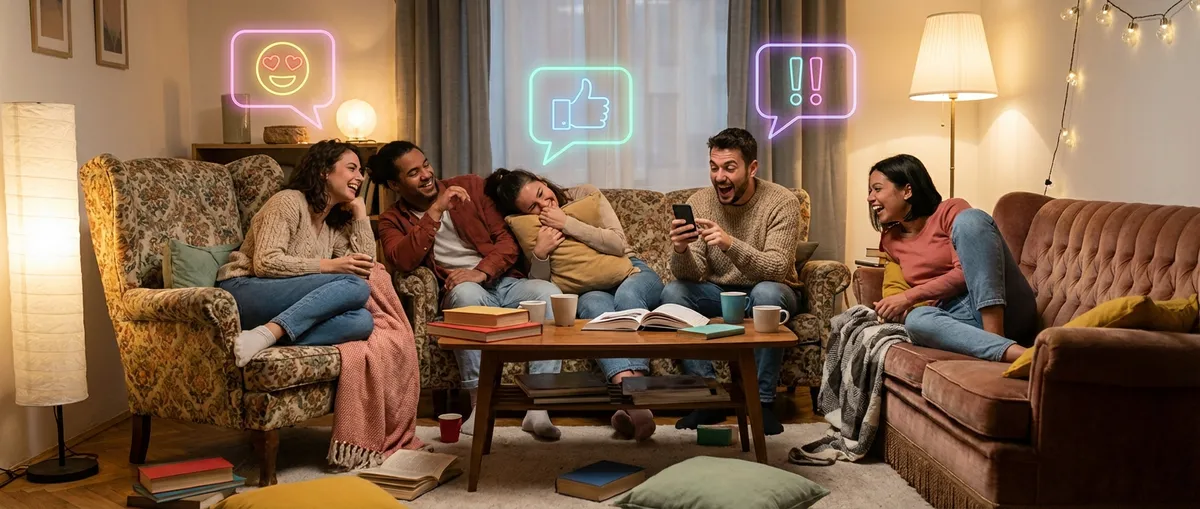
And because group chats are basically private chaos laboratories, your humor gets amplified. People react more, send more emojis, and someone inevitably types, “I’M SCREAMING.” That feedback loop tells your brain: “This is safe. We can be weird here.”
So you push it further. That’s how people who say they’re “not funny” become full-time menace to their group chat.
Shareable takeaway: If your messages end up screenshotted and sent to other chats… congratulations, you’re exporting comedy.
3. Your Brain Is Hardwired To Laugh At Dumb Stuff (Blame Evolution)
You ever laugh at something and immediately think, “Why am I like this?”
Example:
- Someone trips but doesn’t get hurt → giggle.
- You misread “public parks” as “public sharks” → sudden snort.
- Your Wi‑Fi name is “FBI Surveillance Van” → absolutely unnecessary, somehow hilarious.
Laughter actually has deep survival roots. Early humans probably used laughter to signal “We’re safe, that was just a weird noise, not a tiger,” and to bond with the group. Basically, we evolved to cackle at ridiculous moments so everyone knows: “No danger, just vibes.”
Your brain is constantly scanning for tiny absurdities and errors in reality:
- Unexpected words
- Weird timing
- Social awkwardness
- Mismatched expectations (like a tiny dog with a huge bark)
That’s why TikToks of people doing completely normal things in slightly unhinged ways are weirdly addictive. Your brain sees the glitch and hits the “laugh = safe + bonding” button.
Shareable takeaway: You’re not “immature” for laughing at dumb stuff. You’re evolutionarily advanced. Tell your teacher/boss/scowling coworker it’s biology.
4. Your Own Voice Ruins Your Joke (But Not For Other People)
Ever record a video of yourself, listen back, and think, “Why do I sound like a confused toaster?”
That exact feeling ruins your ability to recognize how funny you are.
Here’s what’s going on:
- You hear your voice from inside your skull most of the time, not from the outside.
- Your brain is used to your own expressions, your own mannerisms, your own chaos.
- Familiar = boring. New = interesting.
So when you crack a joke, you judge it way more harshly than your friends do, because to you it’s “just how I talk.” To them, it might be comedy. To you, it’s just Tuesday.
This is also why you think other people’s reactions are over-the-top:
- You: “I just made a small comment.”
- Them: wiping tears, saying “STOP, I CAN’T BREATHE.”
- Your brain: “They’re exaggerating.”
- Reality: you actually are funny, you just can’t experience yourself the way they do.
Shareable takeaway: You’re the only one who doesn’t get to watch the show. Everyone else is enjoying the series called “You: Unscripted.”
5. The Chaos Of Being Relatable Is Comedy Fuel
People don’t just share content because it’s clever. They share it because it whispers, “This is your life, and it’s a mess, and that’s okay.”
Think about the stuff that explodes online:
- People forgetting why they walked into a room.
- Replaying imaginary arguments in the shower like it’s the season finale.
- Saying “you too” when the server says “enjoy your meal” and then needing witness protection.
That’s not high-level wit. That’s global, collective, “we’re all broken in the same way” energy.
Your daily disasters are pre-packaged, high-quality, export-ready content:
- Your “I’ll go to bed early” lie that turns into a 2 a.m. deep dive on otter videos.
- That one hyper-specific fear you thought only you had until someone posted a meme about it.
- The way you narrate your own life in your head like a chaotic documentary.
People want to feel less alone in their weirdness. When you describe your weirdness out loud, others see it as brave, honest, and yes—funny.
Shareable takeaway: The stuff you’re most embarrassed about often makes people say, “Wait… SAME.” That “same” is what goes viral.
Conclusion
You don’t need a Netflix special, a mic, or a brick wall behind you to be funny. You just need:
- Your everyday chaos
- People who witness it
- A brain willing to accept that maybe—just maybe—you’re not the least funny person in the room
Your friends are already quoting you, your group chat already has your greatest hits, and your most awkward moments are probably someone else’s comfort story.
So the next time someone says, “You’re actually really funny,” don’t argue with them.
They’ve seen the show. You haven’t.
Sources
- American Psychological Association – The Science of Laughter – Explores how and why we laugh, including social and psychological effects of humor.
- BBC Future – Why Do We Laugh? – Breaks down the evolutionary roots of laughter and why we find things funny.
- National Institutes of Health – Humor and Health – Research article on how humor and laughter affect mental and physical health.
- Stanford University – The Social Functions of Humor – Philosophical and psychological overview of humor, including its role in bonding and social interaction.
- Harvard Business Review – The Benefits of Laughing at Work – Discusses how humor shapes perception, relationships, and influence in social and professional settings.