You know that weird time of night when everything is suddenly hilarious, your group chat becomes a chaotic think tank, and even the word “moist” sends you into uncontrollable laughter? Yeah. Your brain is running a secret comedy club, and you’re the headliner… whether you’re ready or not.
Let’s pull back the curtain on why you’re accidentally funniest at the worst times, why your jokes hit differently in different groups, and why your “sense of humor” is actually a glitchy piece of social survival software.
Share this with the friend who thinks they’re not funny (they are) and the friend who thinks they’re the funniest person alive (they are… occasionally).
1. Late-Night Brain Is Basically a Chaotic Improv Team
Daytime you: “I should drink more water and answer those emails.”
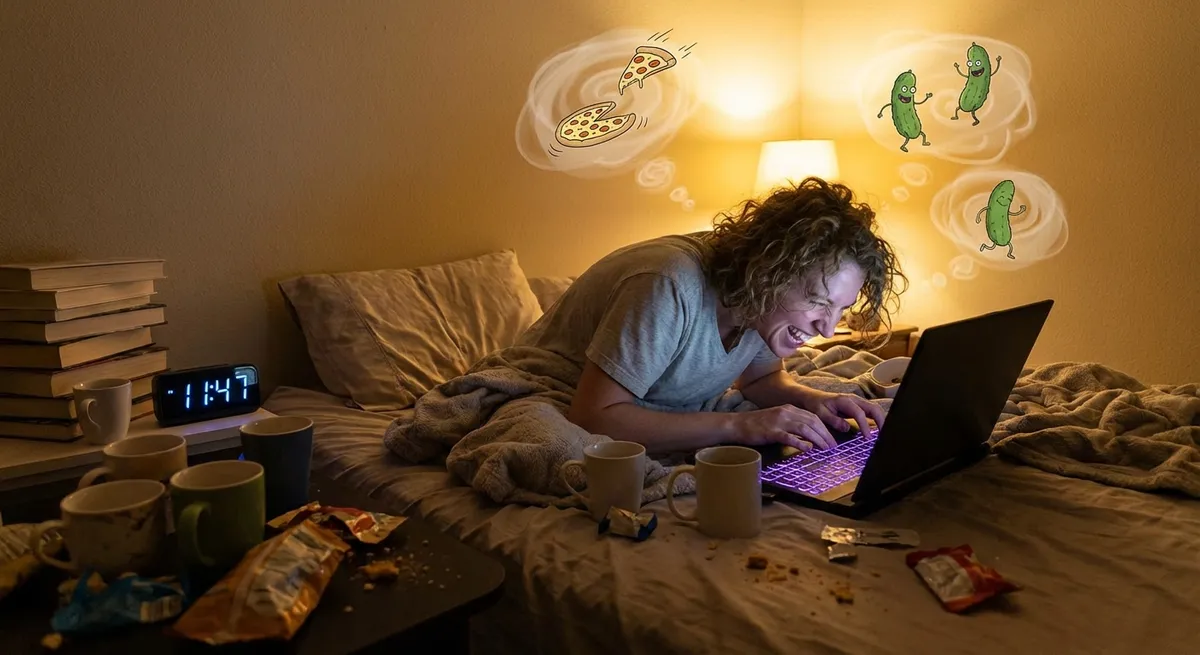
11:47 PM you: “What if pigeons think we’re the government?”
Scientists actually have a name for this: sleep pressure and circadian rhythm. As you get tired, your brain gets worse at filtering out “bad ideas.” Which, tragically, is exactly when you become accidentally hysterical.
- Your prefrontal cortex (the sensible adult in your head) starts clocking out.
- Your emotional brain (the goblin with a fog machine and a Spotify playlist) takes over.
- Result: unhinged connections, bizarre mental images, and jokes that make NO sense in the morning.
This is why 1 a.m. group chats are full of things like:
“What if Wi-Fi is just the Earth purring because we pet it with electricity?”
You’re not “becoming weird” at night. You’re just running your brain on low battery mode, and all the content filters crashed.
Share factor: Everyone has sent a late-night message they would absolutely not approve in daylight. Hit share as an apology to your future self.
2. Your Laugh Is a Social Cheat Code, Not a Personality Quirk
You think you laugh because something is funny. Your brain is like: “Sort of, but also… politics.”
Laughter is one of our oldest social tools. Before we had language, memes, or passive-aggressive Slack messages, we had weird animal noises to say: “I’m safe, you’re safe, let’s not bite each other today.”
Modern version:
- You laugh to say “I’m with you.”
- You laugh to say “I get the reference.”
- You laugh to say “I want you to like me so I’m going to act like that joke deserved this reaction.”
Studies show people are 30 times more likely to laugh in a group than alone. Which means:
- That Netflix special you chuckle at alone? With friends, it’s suddenly “funniest thing ever.”
- That meme you didn’t fully get but your crush sent? Congratulations, it’s now your favorite joke.
Your laugh is less “spontaneous joy” and more “wireless connection signal”:
Two bars = polite chuckle.
Full bars = ugly silent laugh with wheeze and potential chair falling.
Share factor: Tag someone whose laugh is way too loud for how mid the joke was. They’re doing God’s social work.
3. Your “Sense of Humor” Is a Glitchy Survival Setting
You know those “difficulty settings” in video games? Your brain did that with humor, but badly, and without telling you.
Your humor settings are influenced by:
- Childhood: What your family laughed at (sarcasm? dad jokes? dark humor? unhinged chaos?).
- Environment: What your friends found funny and you pretended to understand until it actually became funny.
- Self-defense: Using jokes to dodge awkwardness, criticism, or feelings. (Ah yes, the “haha anyway I’m dead inside” classic.)
Then your brain quietly coded all of that into a system:
- If Awkward Situation = TRUE, then Deploy Joke.
- If Feeling Vulnerable = TRUE, then Deflect with Humor.
- If Group Tension = HIGH, then Activate “Funny One” Mode.
The plot twist: people who use humor to cope aren’t broken; studies suggest humor can reduce stress and help with resilience. Your coping mechanism has patch notes and footnotes.
So when you crack a joke during a serious meeting or at a funeral (may God have mercy), that’s not you being heartless. That’s your brain slamming the “humor emergency button” and hoping no one notices the panic behind your eyes.
Share factor: Send this to the friend who says “I cope with humor” and then drops the most unhinged one-liner during emotional crises.
4. You’re Funnier Around Some People Because Your Brain Is Doing Stand-Up A/B Testing
Have you noticed you’re “the funny one” in one group but suspiciously average in another?
That’s not your imagination. That’s social calibration.
Your brain is constantly scanning for:
- Who laughs at what
- What topics instantly kill the vibe
- Who is secretly offended but pretending not to be
Then it adjusts your humor style like a Netflix algorithm:
- Around your chaotic friends: “Yes, let’s absolutely make a joke about this disaster we’re all in.”
- Around your coworkers: “That was almost a personality, but let’s keep it LinkedIn-safe.”
- Around your family: “Rebooting… loading harmless observation about weather and traffic.”
You are not one fixed “funny person.” You are five different versions of “moderately unhinged” depending on who’s in the room.
Also: humor is contagious. The more people laugh around you, the more risks you take with jokes, which makes you funnier, which makes them laugh more, and now suddenly the whole table is crying over a story about a sandwich.
Share factor: Call out your “I’m funnier when you’re here” friend. You are each other’s laugh track.
5. Cringe Jokes Age Like Milk, But That’s Weirdly a Good Sign
Have you ever remembered something you said in 2014 and physically flinched?
That’s growth. Also: psychological jump scare.
Humor ages fast because:
- Society changes.
- Internet culture mutates every six minutes.
- The joke that once got 100 likes now reads like evidence at your future cancellation trial.
But here’s the useful bit: when your old jokes make you cringe, it means:
- Your empathy settings got updated.
- Your awareness of context improved.
- Your comedy taste leveled up from “chaotic neutral” to “somewhat responsible agent of chaos.”
Even professional comedians retire jokes because they don’t land the same way anymore. So if your old Twitter jokes make you want to walk into the sea, congratulations: you just ran a software update on your morals and your meme brain.
Share factor: Post this as a subtle apology for your 2012 Facebook posts. We saw them. We remember.
Conclusion
Your sense of humor isn’t random, broken, or boring. It’s your brain’s glitchy survival toolkit doing improv 24/7:
- It gets weirder when you’re tired.
- It turns up when you’re with people you like (or want to impress).
- It evolves as you do, leaving a long trail of digital and emotional cringe behind you.
So the next time you’re crying-laughing at something objectively stupid at 11:47 p.m., just remember:
You’re not immature.
You’re not “too online.”
You’re just a human with a brain that went,
“Things are hard. Let’s make it funny so we can stand it.”
Now send this to the people who make you laugh the hardest and let them know:
Their chaos is scientifically justified.
Sources
- [American Psychological Association – The science behind laughter](https://www.apa.org/monitor/2016/11/humor) – Overview of how humor and laughter function in the brain and social settings
- [National Institutes of Health – Circadian rhythms](https://www.nigms.nih.gov/education/fact-sheets/Pages/circadian-rhythms.aspx) – Explains how our internal body clock affects cognition and behavior (including late-night brain weirdness)
- [Mayo Clinic – Stress relief from laughter](https://www.mayoclinic.org/healthy-lifestyle/stress-management/in-depth/stress-relief/art-20044456) – Describes how humor and laughter can reduce stress and improve health
- [BBC Future – Why we laugh inappropriately](https://www.bbc.com/future/article/20170522-why-do-we-laugh-at-inappropriate-moments) – Discusses nervous laughter and why we joke in serious situations
- [Oxford University – Social laughter and endorphins](https://www.ox.ac.uk/news/2011-09-13-laughter-really-strong-medicine) – Research on how laughter in groups strengthens social bonds and releases endorphins