
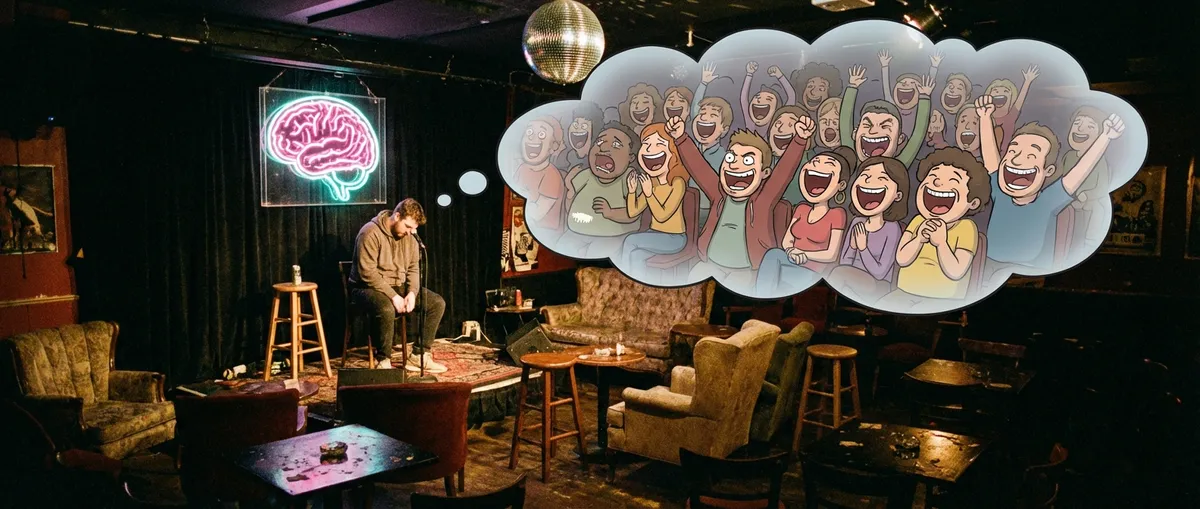
Somewhere between your third shower thought and that unhinged meme you almost posted at 2:37 a.m., you’ve probably wondered: “Am I actually funny, or are my friends just too tired to leave the group chat?”
Plot twist: you are funny. But not for the reasons you think.
Welcome to the chaotic little science experiment known as your sense of humor—part psychology, part weird brain glitch, part “did I really laugh at that?” This is your crash course in why you laugh, why other people laugh, and why that one joke from 2014 refuses to die.
Below are five delightfully unhinged truths about funny that you’ll absolutely want to send to your group chat with the caption: “This is us fr.”
1. Your Laugh Is Basically Your Brain Screaming “I Didn’t Expect That”
You know that feeling when your brain just… blue-screens for half a second and then you burst out laughing? That’s not random. That’s your brain getting jump-scared by an idea.
Most humor is built on incongruity—your brain predicts one thing, the joke gives it something wildly different, and your nervous system hits the “lol” button as a coping mechanism. Dad jokes, puns, that one kid in class who responded “your mom” to everything—same core glitch: broken expectations.
Example:
“I told my computer I needed a break… it gave me a KitKat.”
Your brain: “Oh, work break.”
The joke: chocolate ambush.
That tiny gap between “what I thought was coming” and “what actually happened” is where the laugh lives. Whenever you say, “I don’t know why that was so funny,” translation: “My brain did not have the patch update for that scenario.”
Shareable angle:
That friend who sends the most cursed memes? They’re not just chaotic. Their entire personality is weaponized expectation mismanagement.
2. Inside Jokes Are Basically Emotional Wi‑Fi Passwords
You know that one joke your friend group finds hysterical but makes total strangers stare at you like you’re broken NPCs? That’s not just weird—it’s social superglue.
Inside jokes are how humans mark territory in relationships. When you and someone else find the same thing funny, your brain drops a tiny emotional bookmark: “Ah yes, this one is My People.” The more shared references you build—misheard song lyrics, disastrous first dates, that one time someone confidently used a word wrong—the stronger that invisible group chat energy gets.
It’s why your best friend can just say “mango incident” and you both lose it like it just happened yesterday, while everyone else looks concerned and lightly afraid.
Laughter in groups also spreads like a virus. Your brain literally has mirror systems that make you more likely to laugh if someone else is laughing—especially if you like that person. That’s why you’ve laughed at jokes that were objectively mid: emotional peer pressure plus FOMO.
Shareable angle:
Send this to your group chat and see how many people reply with your most cursed inside joke like: “So we’re just not gonna talk about The Elevator Situation of 2019?”
3. Awkward Laughing Is Your Brain’s Emergency Escape Hatch
You don’t just laugh at funny things. Sometimes you laugh when nothing is funny, everything is terrible, and your entire body is saying “abort mission.”
Job interview? Nervous chuckle.
Serious conversation? Inappropriate giggle.
Teacher says “pair up” and you have no friends in class? Hysterical inner meltdown.
Your brain uses laughter to defuse tension—especially social tension. It’s like your internal tech support trying to keep the system from overheating: “We are panicking, but make it… socially acceptable.”
That’s why people laugh when they trip, mess up a word, spill coffee on themselves, or send a text to the wrong person (the Olympic sport of digital humiliation). The laugh is you saying: “I see the cringe. I acknowledge the cringe. We ride.”
Even in dark situations (hello, gallows humor), jokes can act like a tiny pressure valve for emotions that are otherwise unbearable. It’s not you being heartless—it’s your brain trying not to crash.
Shareable angle:
Tag someone who laughs when the teacher says “this won’t be on the test” and then immediately puts it on the test.
4. Your Sense of Humor Is a Weird Flex… and a Compatibility Test
People like to pretend humor is just “haha funny noises,” but your taste in jokes is basically your personality wearing clown shoes.
Research shows that what you find funny can reveal how you think, how you process emotions, and how much chaos you’re comfortable with. Some people love puns. Some love absurdity. Some want jokes that are basically therapy in disguise. Some love slapstick because apparently seeing a human fall down stairs is still peak comedy, even in 2026.
Also: humor is a flirt. Studies keep screaming the same thing—people consistently rate a “good sense of humor” as one of the most attractive traits. Not because we all want stand-up comedians, but because making each other laugh signals shared values, timing, and the ability to survive disasters with at least one solid meme.
Dating apps know this. That’s why half the prompts are secretly humor auditions:
- “We’ll get along if…” = tell me your vibe, but make it funny.
- “The dorkiest thing about me is…” = how honest and self-aware can you be and still make it cute?
Shareable angle:
Send this to your situationship with the message: “This says we’re compatible. Science. Sorry, I don’t make the rules.”
5. Memes Are the Internet’s Group Diary (That We’re All Pretending Isn’t Therapy)
Memes are our generation’s cave paintings, except instead of bison and handprints it’s a frog drinking tea with “me minding my own business” slapped on top.
They work because they’re hyper-shareable shortcuts for complex feelings:
- “I am tired.”
- “Capitalism is weird.”
- “I love you but in a feral, unhinged way.”
All of that, boom, one screenshot of a raccoon holding bread.
Your brain loves memes because they’re snack-sized jokes with built-in social context. The second you hit share, you’re saying: “I feel this” and “I think you feel this” and “If you don’t feel this, we might not be the same species.”
Some memes even function like emotional weather reports. Sad memes? “I’m not okay but I’m also not ready to talk about it directly.” Unhinged chaotic memes at 3 a.m.? “My mental stability is on airplane mode, please stand by.”
The wildest part? Humor spreads ideas faster than facts alone. That clever tweet, that stitched TikTok, that meme about your job being a circus—the joke carries truth in disguise. You’ll forget the serious article, but you’ll remember the meme that dragged your soul.
Shareable angle:
Drop this in your group chat and ask: “Which meme describes your current mental state?” Then watch the emotional damage roll in.
Conclusion
You’re not accidentally funny. You’re a walking, talking, deeply confused little laugh generator powered by:
- broken expectations
- emotional Wi‑Fi
- social anxiety
- weird flexes
- and an unhealthy attachment to memes
Every time you and someone else laugh at the same ridiculous thing, your brains are basically high‑fiving in secret. So yes, you are funny—maybe not in a Netflix special way, but definitely in a “my friends screenshot my texts for later” way.
Now go weaponize this knowledge:
Text this article to someone with the caption, “This explains 97% of my personality,” and see who replies, “No, this is literally you.”
Sources
- [APA Dictionary of Psychology – Humor](https://dictionary.apa.org/humor) – Overview of how psychology defines humor and its functions
- [ScienceDirect: The Cognitive Psychology of Humor](https://www.sciencedirect.com/science/article/pii/S0388000197000211) – Explores incongruity and expectation in why we find things funny
- [BBC Future – Why We Laugh](https://www.bbc.com/future/article/20170524-the-complicated-truth-about-why-we-laugh) – Discusses social laughter, awkward laughs, and bonding
- [Greater Good Science Center – How Laughter Brings Us Together](https://greatergood.berkeley.edu/article/item/how_laughter_brings_us_together) – Research on laughter, social bonding, and group dynamics
- [Psychology Today – Humor, Laughter, and Health](https://www.psychologytoday.com/us/blog/fulfillment-any-age/201904/why-we-laugh-according-science) – Summarizes scientific findings on humor, relationships, and well-being