
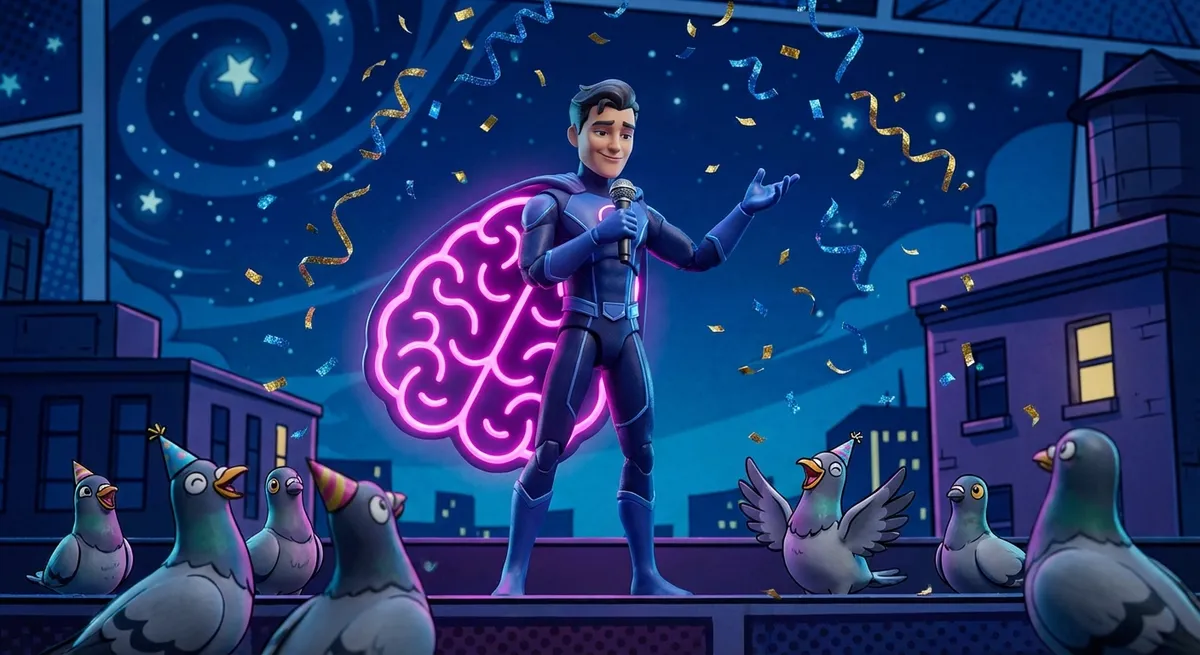
If you’ve ever sent a meme so good your friend replied “I HATE YOU 😂,” congratulations: you’ve harnessed one of humanity’s most chaotic powers. Being funny isn’t just about cracking jokes; it’s social Wi‑Fi, emotional armor, and free therapy with worse licensing. Let’s dissect why humor is secretly a superpower—and why your ability to make people snort-laugh might be your most underrated flex.
Humor Is Social Cheat Codes (You’re Basically Speedrunning Friendship)
Being funny is like walking into a room with a built‑in “skip tutorial” button for awkwardness.
Humor lowers people’s defenses faster than small talk ever could. Instead of, “So what do you do for work?” (the verbal equivalent of beige paint), you drop a mildly unhinged observation like, “Do you ever think about how every email is just two people pretending to be polite?” Suddenly, you’re not strangers—you’re co‑stars in the same weird sitcom.
Psychologists have found that shared laughter makes people feel more connected and more likely to open up. It signals “I’m safe, I get you, and I also think life is a ridiculous mess.” That’s why the “funny one” in a friend group often becomes the unofficial therapist, scheduler, and emergency meme dispatcher.
And no, you don’t have to be a stand‑up comedian. Even “quiet funny” counts:
- The subtle one‑liner in a group chat
- The perfectly timed reaction GIF
- The dry comment in a meeting that makes three people look away to hide their smiles
If people are tagging you under memes with “this is so you,” your social superpower is very much operational.
Laughing Is Free Healthcare (Not A Doctor, But Science Agrees)
Your laugh might sound like a dying accordion, but biologically? It’s kind of elite.
Research shows that laughter:
- Lowers stress hormones
- Boosts endorphins (the brain’s feel‑good chemicals)
- Can even help with pain tolerance
Your body doesn’t fully care if you’re laughing at highbrow satire or someone getting lightly attacked by a rogue umbrella in a windstorm. It just sees: “We’re laughing? Cool. Deploy happiness juice.”
Even fake laughing can trick your brain into feeling better. This means:
- Laughing at your own bad joke = free mood upgrade
- Watching stupidly funny videos after a long day = extremely valid coping mechanism
- Sending cursed TikToks to your group chat at 2 a.m. = community health initiative (kinda)
You’re not “wasting time” scrolling through comedy; you’re running a chaotic little wellness program with questionable curation.
Funny People Look Smarter (Even When They Absolutely Are Not)
Humor is basically brain sparkle.
To land a joke, your brain has to:
- Spot a pattern
- Flip it or break it
- Deliver it fast enough for people to connect the dots
That kind of mental gymnastics is why studies often link humor with higher intelligence and creativity. When someone makes a clever joke, we don’t just think “that was funny”; we think “wow, that was quick.” It signals fast thinking, social awareness, and the ability to see multiple angles at once.
This is why:
- A well‑timed sarcastic comment in a meeting can make you seem sharper than a 20‑slide presentation
- A witty email subject line mysteriously gets more responses than “Follow‑up on yesterday”
- Comedians often make sharp social or political observations—wrapped in jokes, so we don’t cry (as much)
You don’t have to solve quantum physics. If you’ve ever said something so unexpectedly funny that everyone needed a second to recover, your brain just did a tiny Olympic routine.
Humor Is Emotional Armor (But Make It Fashionably Unhinged)
Life throws weird boss levels at everyone. Being funny just gives you better armor skins.
Using humor is one of the most powerful ways people cope with stress and chaos. Not the “everything’s fine 😊” fake positivity, but:
- The “if I don’t laugh, I will scream” type jokes
- The “my life is a rom‑com written by a raccoon” storytelling
- The “I survived this, so now it’s content” mentality
Psychologists call this “adaptive coping.” Instead of pretending your problems don’t exist, you turn them into something you can play with. You’re still acknowledging the mess—you’re just also narrating it with commentary like a sports announcer.
That doesn’t mean you have to joke about everything. But being able to say:
- “Well, that was a disaster, but at least it’s a good story”
- “I’m not having a breakdown; I’m having a character development arc”
…turns you from victim to unreliable main character, which is at least more fun.
Funny Is a Love Language (Romantic, Platonic, Absolute Chaos)
“Sense of humor” isn’t just a dating app cliché; it’s one of the top traits people look for in friends and partners. Not abs. Not fame. Just: “Can you make me laugh when everything feels like a glitchy video game?”
Humor does a lot of heavy lifting in relationships:
- It diffuses tension in arguments (“Okay, we’re both being dramatic, right?”)
- It makes boring chores less awful (“Couples who roast each other while doing laundry, stay together”)
- It builds inside jokes—tiny private universes only you and your people understand
Those running gags you share with friends or family? That’s emotional Velcro. It keeps you stuck together even when life pulls you in different directions.
Fun bonus: people often remember how you made them feel more than what you actually said. So if you’re the person who consistently brings the chaos, the memes, and the stupid little jokes that show up in their brain days later? You’re not just funny. You’re unforgettable.
Conclusion
Being funny isn’t just about getting laughs—it’s proof that your brain, heart, and chaos instincts are all working together. It helps you make friends faster, survive rough days, look smarter, handle feelings, and build stronger relationships, all while sounding like a live‑action meme.
So no, you’re not “just the funny one.”
You’re the unofficial morale officer, emotional support goblin, and social superglue in human form.
Keep sending unhinged memes. Keep making people snort in public. Your sense of humor might be the most powerful thing about you—and the reason people can’t wait to share your chaos with someone else.
Sources
- [Mayo Clinic – Stress relief from laughter? It’s no joke](https://www.mayoclinic.org/healthy-lifestyle/stress-management/in-depth/stress-relief/art-20044456) – Explains how laughter affects stress hormones, mood, and physical health.
- [Psychology Today – The Social Benefits of Laughter](https://www.psychologytoday.com/us/blog/joyful-child/201902/the-social-benefits-laughter) – Discusses how shared laughter strengthens social bonds and relationships.
- [Scientific American – What’s So Funny? The Science of Why We Laugh](https://www.scientificamerican.com/article/whats-so-funny-the-science-of-why-we-laugh/) – Breaks down the psychology and evolution of humor.
- [Greater Good Science Center (UC Berkeley) – Humor as a Character Strength](https://greatergood.berkeley.edu/article/item/humor) – Looks at how humor supports resilience, well‑being, and social connection.
- [Personality and Individual Differences – Intelligence and Humor](https://www.sciencedirect.com/science/article/abs/pii/S0191886915004957) – Research examining links between cognitive ability and the production of humor.