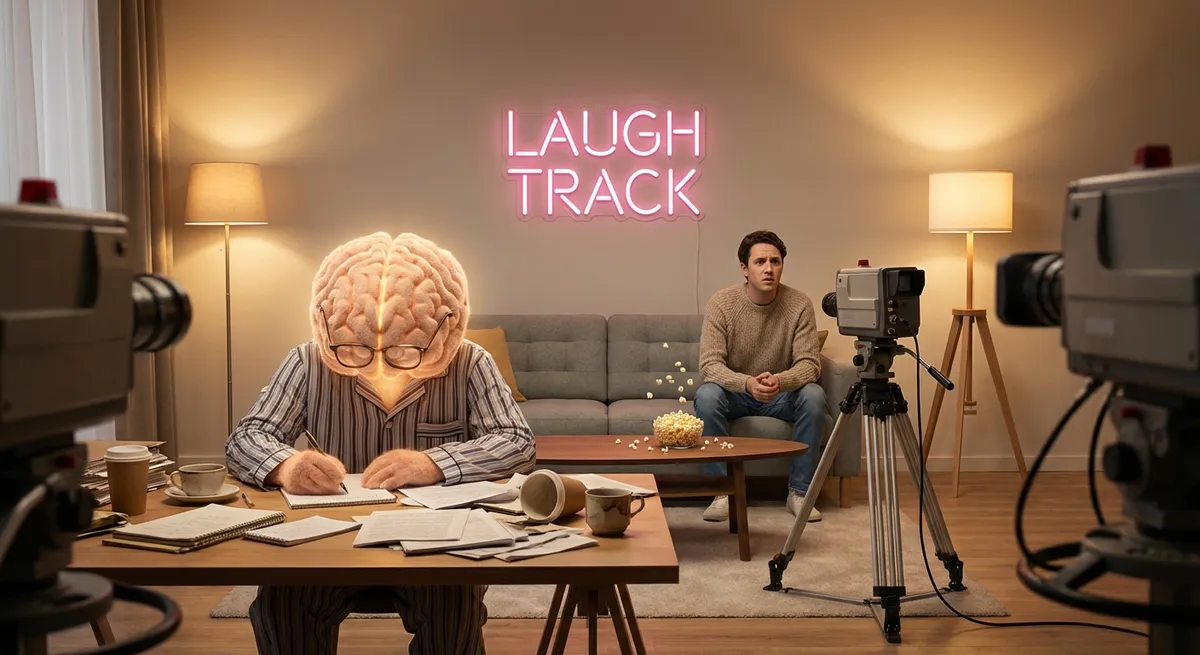
Your life feels chaotic because your brain is running a 24/7 improv show without telling you. That awkward thing you said in 2016? Reruns every night at 2:37 a.m. That perfectly timed comeback you thought of in the shower three hours too late? Deleted scene.
You are not a serious, majestic being gracefully gliding through existence. You are a walking blooper reel, and your brain is the unhinged scriptwriter just vibing. The good news? Once you see how hilariously glitchy your mind actually is, you can stop cringing and start laughing—and yes, that’s absolutely shareable content.
Your Internal Monologue Is Basically A Loud, Underqualified Sports Commentator
Your brain narrates your life like it’s the championship game, except the commentator has no chill and zero expertise.
You walk into a room: “AND THEY HAVE ENTERED… what were we doing again? Nobody knows. We’re panicking.”
Try to fall asleep: “Let’s replay every embarrassing moment since age 9 in 4K. Also, what if the fridge is slightly open? What is electricity, really?”
Your internal voice gives dramatic commentary on everything:
- Trips on nothing in public? “DOWN GOES THE ATHLETE! ZERO PRESSURE, FULL FAILURE!”
- Sends one risky text? “We’re LIVE with the worst decision of the week, stay tuned for regret.”
- Hears someone laugh across the room? “That was definitely about us. Definitely. 100%.”
This is not a bug; it’s a feature. Psychologists have found that self-talk is linked to how we regulate emotions and focus attention. The problem is your self-talk didn’t get the memo about staying calm or being helpful—it’s just there, constantly saying, “Hey, what if we didn’t relax?”
If you’ve ever caught yourself narrating what you’re doing like you’re on a cooking show (“Now we gently add… the cereal… to the bowl”), congratulations: your brain has cast you as both main character and dramatic voiceover, and it’s not even paying you.
Your Memory Is Less ‘Hard Drive’ And More ‘Chaotic Fan Fiction’
You think your memory is a reliable archive. It is not. It’s a bored raccoon with a Sharpie, rewriting history for fun.
You’ll remember the ONE weird look someone gave you in high school, but not where you put your keys 12 seconds ago. You can quote a random Vine from 2013 word-for-word, but could you tell us what you had for lunch yesterday? Absolutely not.
Here’s what your memory does all the time:
- Deletes important details like a shady IT intern with admin access
- Mashes random moments together into one cursed “mega memory”
- Adds drama: no, your teacher didn’t “scream in front of the whole school,” she just raised an eyebrow
- Invents details and then swears they’re real (this is literally called “false memory,” and yes, your brain is just freelancing lies now)
Research shows memory is reconstructive, meaning every time you remember something, you’re basically redrawing it from scratch like a chaotic courtroom sketch artist. So when you lay awake thinking about that time you “ruined your entire life” by mispronouncing a word in a meeting, just know:
That event was probably 60% less dramatic than you recall, 30% invented, and 10% your anxiety doing improv.
Your memory is not a documentary. It’s a fan edit with questionable music.
Your Brain Loves Drama More Than Netflix Ever Will
Your brain has one core hobby: overreacting.
Evolution wired you to notice threats—back then, “threat” meant tiger. Now “threat” means “email that starts with ‘per my last message’.” The same hardware, totally different storyline.
So your brain:
- Makes a mildly uncomfortable situation feel like a season finale
- Turns “they didn’t text back yet” into “they hate me, the group hates me, the universe hates me”
- Interprets “K.” as emotional violence
- Sees one unread notification and goes, “We are absolutely not emotionally stable enough for this.”
There’s even a name for your brain’s obsession with negativity: the negativity bias. You naturally remember bad stuff more clearly than good stuff because your ancestors who ignored danger got eaten, and their genes did not make it to the party.
So if your brain reacts to:
- A compliment: “Eh, suspicious.”
- A tiny bit of criticism: “We must move to another country and change our name.”
…you’re not broken; you’re just running outdated prehistoric software on modern Wi-Fi.
The funniest part? Your brain will ignore 17 good things that happened today and hyperfocus on the one awkward moment where you said “you too” to the waiter after they said “enjoy your meal.”
Your Social Anxiety Is Just Your Imagination Doing Theater
If you have ever replayed a conversation 19 times thinking, “Why did I say it like that?”, welcome to Social Anxiety Theater. Your imagination is the lead actor. Your dignity is the understudy.
You assume:
- Everyone noticed your weird laugh
- That one pause in conversation was a sign they secretly hate you
- That joke landed so badly they’ve formed a group chat about it
Meanwhile, reality:
- They are too busy worrying about their own weird laugh
- No one remembers what you said because they’re thinking about deadlines, dinner, and whether they locked their front door
- That group chat? It’s memes and logistics, not you
Studies on the “spotlight effect” show humans massively overestimate how much others notice us. Your brain thinks a single awkward moment = social catastrophe. Everyone else probably forgot within 30 seconds and moved on to wondering if birds ever get tired of flying.
You think you’re on a world stage. You’re actually in a very small, very tired community theater where everyone is also forgetting their lines and hoping nobody notices.
So when your brain whispers, “They’re all judging you,” just remember: they are—mostly judging themselves.
Your Future Self Is Just You, But Slightly More Tired And Still Confused
Your brain is convinced that “Future You” is a separate, more competent person who will absolutely handle it.
Current You: “I can’t do this right now.”
Brain: “Don’t worry. Future You is going to wake up at 5 a.m., go for a run, answer all emails, clean the house, start a side hustle, and finally fold that laundry.”
Future You, upon arrival: “Why have you done this to us.”
Psychologists actually study this: we think of our future selves almost like different people, which is why it’s so easy to throw problems at them like they’re customer support.
Your brain genuinely believes:
- Future You will understand taxes
- Future You will stop doomscrolling at 1 a.m.
- Future You will learn to cook something that isn’t toast
- Future You will absolutely be “a morning person” even though historically you have never been awake on purpose before 9
Spoiler: Future You is just Regular You with slightly worse posture and more browser tabs open.
Once you accept this, life gets funnier and weirder in the best way. You stop expecting a mythical upgraded version of yourself to appear and realize:
“Oh. It’s just me. Chaos Goblin Version 3.2. Okay then. Let’s make this funny at least.”
Conclusion
Your brain is not a serious institution. It’s a barely managed improv troupe trying to perform Shakespeare with no script, too much caffeine, and a deep love of overthinking.
Your internal narrator is dramatic. Your memory is a chaos editor. Your anxiety is a failed mind-reader. Your future self is… you, but with more emails.
You can either:
- Treat all this as evidence that you’re a disaster, OR
- Realize you’re living inside the funniest, weirdest, most relatable sitcom ever written—and you’ve got front-row seats.
Next time your brain decides to replay that awkward moment, just think: “Ah yes, a new episode,” and mentally roll the credits. Then send this to someone whose brain is also doing the most. If we’re all going to be the punchlines, we might as well laugh together.
Sources
- American Psychological Association – Self-Talk - Explains what self-talk is and how it affects emotions and behavior
- Simply Psychology – Reconstructive Memory - Overview of how memory is reconstructed and why it’s not a perfect recording
- Verywell Mind – Negativity Bias - Describes why our brains focus more on negative experiences
- Psychology Today – The Spotlight Effect - Breaks down why we think people notice us more than they actually do
- Scientific American – Why We Think Our Future Selves Will Be Different - Discusses research on how we perceive our future selves as separate people