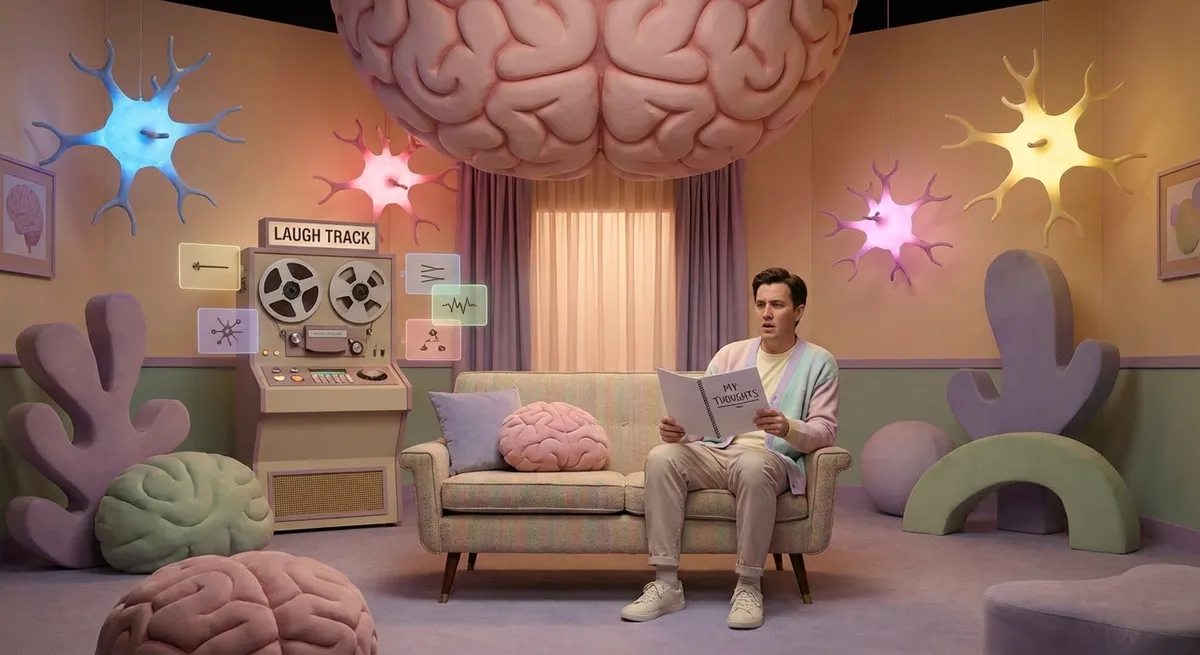
Your life is not a serious drama. It’s not a thriller. It’s not even a well-written indie film.
Your life is a low-budget sitcom where your brain is the chaotic writer, the unreliable director, and also the actor who keeps forgetting their lines.
The good news? Once you realize your brain is secretly producing a comedy show 24/7, everything starts feeling less “I’m failing” and more “wow, what a bold creative choice.” Let’s unwrap the weird, hilarious stuff your mind does that you’ll definitely recognize—and definitely want to send to that one friend who is always “fine” but also Googles “can stress evaporate your soul.”
Your Inner Monologue Is A Roasting Champion With No Off Switch
At some point, your inner voice stopped being a supportive life coach and became a chaotic open‑mic comedian who gets paid in anxiety.
You know the one:
- Drops a plate: “Of course you did. Gravity said ‘watch this.’”
- Sends a risky text: immediately scripts 19 worst‑case scenarios.
- Meets new people: replays every sentence you said for the next 7 years.
What’s wild is that scientists actually know we’re narrating our own lives like drama queens. Research on “inner speech” shows we constantly talk to ourselves in our heads, like a director’s commentary no one asked for. Sometimes it’s helpful (“Don’t forget the keys”), and sometimes it’s like, “Remember that embarrassing thing you did in 2013? Let’s rewatch it in HD.”
And yet, if a friend said half the things your brain says to you, you’d block them, report them, and start a group chat titled “Can you believe this clown?”
Share this with the friend whose brain roasts them harder than any hater ever could.
Your Memory Is Not A Filing Cabinet, It’s An Unhinged Fan Edit
You think your memory is a neat archive, but it’s actually a chaotic editor with a broken timeline and zero quality control.
That’s why:
- You remember a random Vine perfectly, but not where you parked.
- You can recite your childhood crush’s phone number, but not your current password.
- You’re 90% sure you “remember” things that are actually memes.
Psychologists call this “false memories,” but your brain calls it “creative freedom.” Instead of saving events like files, it saves them like TikTok drafts—chopped up, re‑mixed, and occasionally unrecognizable.
You’ll misremember movie lines, swear something happened “last year” (it was five years ago), and confidently argue about details you 100% made up. But it feels real, and that’s the hilarious part: your brain is basically the world’s least reliable witness, but also, the only one you’ve got.
Tag someone who argues about “what really happened” like they didn’t live the same chaotic day you did.
Your Brain Schedules Deep Thoughts Exclusively At 3:00 A.M.
Your brain has the entire day to be insightful. Does it choose:
- During work? No.
- During chores? No.
- During peaceful walks? Absolutely not.
It chooses 3:00 a.m., horizontal position, blanket already warm, when you’re one breath away from REM sleep. Then suddenly:
- “What if everyone secretly hates you?”
- “Did you turn the oven off… in 2018?”
- “Remember that weird thing you said in 8th grade?”
Sleep experts say stress and overthinking can mess with your ability to drift off, but your brain acts like night is prime time for an existential TED Talk. It’s like your mind opens 37 tabs: life goals, unpaid bills, random song lyrics, the exact layout of your childhood bedroom, a grocery list you will absolutely forget in the morning.
And yet, when your alarm goes off? Zero thoughts. Just vibes and regret.
Share this with the friend who says “I’ll sleep early tonight” like it’s not a lie every single time.
Anxiety: The Worst Weather App For Things That Aren’t Happening
Your brain is constantly trying to predict the future, which would be cool if it wasn’t so bad at it.
Instead of, “Everything will probably be okay,” it’s more like:
- “You’re 4 minutes late: they hate you.”
- “Boss sent ‘Can we talk?’: you’re fired, arrested, and exiled.”
- “Someone said ‘We need to chat later’: this is how you die.”
Psychologists actually have a term for this: catastrophizing—your brain’s talent for turning “slightly inconvenient” into “apocalypse but make it personal.” It’s trying to protect you from danger; it’s just using the emotional equivalent of a fire alarm that goes off every time someone makes toast.
The irony? Most of the time, the Thing You Dreaded ends up being:
- A calendar reminder.
- Boring feedback.
- Or “Hey, you’re doing great, just wanted to check in.”
Your brain: Oscar‑worthy disaster trailer.
Reality: Two‑minute email and a “Thanks!”
Send this to someone whose mental weather report is always “100% chance of doom” with scattered panic showers.
You Constantly Main-Character Yourself—And Nobody Got The Script
Your brain loves a storyline. So it puts you as the main character, everyone else as side quests, and the world as your set. That’s why:
- You walk with headphones on like you’re in a music video.
- You stare out the window like you’re in a sad montage.
- You overthink your outfit like paparazzi live in the cereal aisle.
But here’s the twist: everyone else is doing the exact same thing. They’re also busy starring in Their Own Show™, overthinking their lines, hair, and existence. There is no audience. Just a bunch of people thinking everyone is watching them, while no one is watching anything except their own reflection on their phone screen.
Psychologists call this the “spotlight effect”—we wildly overestimate how much people notice or care what we’re doing. Your brain: “Everyone saw that mistake.” Reality: they were trying to remember if they locked the front door.
The funniest part? Once you accept we’re all delusional main characters spinning in our own sitcoms, life gets a lot easier—and a lot funnier.
Tag your fellow main character. You know exactly who it is.
Conclusion
Your brain is dramatic, messy, occasionally unhinged, and accidentally hilarious. It misfiles memories, schedules anxiety during sleep hours, roasts you for sport, and still somehow gets you through every day.
So the next time your mind is spiraling, catastrophizing, or replaying that one awkward moment, try this thought:
Maybe you’re not failing at life. Maybe your brain is just running a very chaotic comedy show—
and you’ve been taking every improv bit way too seriously.
Now go send this to someone whose brain is also a glitchy, overcaffeinated writer’s room. They’ll feel seen. And slightly attacked. In a loving way.
Sources
- American Psychological Association – Inner Speech – Explains how and why we talk to ourselves in our heads and what inner monologue actually does.
- Harvard Medical School – Sleep and Insomnia – Covers how stress, anxiety, and mental health affect sleep and late‑night overthinking.
- Verywell Mind – Catastrophizing – Breaks down the habit of expecting the worst and how it shows up in everyday thinking.
- APA Dictionary of Psychology – False Memory – Defines and explains how memories can be distorted or completely fabricated.
- Cornell University – The Spotlight Effect – Summarizes research on why we believe people notice us more than they actually do.