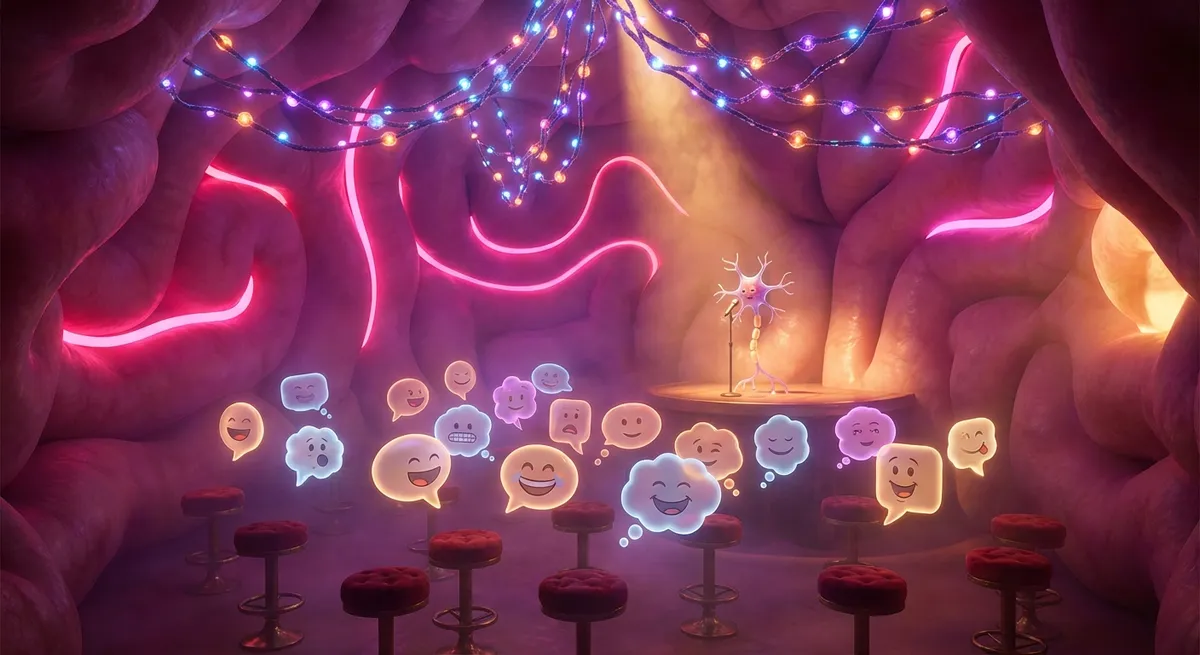
Your brain is secretly a full-time stand-up comedian, and you’re just the confused person holding the mic. Every time you laugh at something totally dumb, say the wrong thing in a serious moment, or giggle at 3 a.m. over a meme that wouldn’t survive daylight… that’s your brain doing improv with zero supervision.
This is your guided tour of the chaotic comedy show inside your skull. By the end, you’ll understand why you laugh at the weirdest things, why your friends aren’t as funny in texts as they think they are, and why your brain loves turning mild embarrassment into a full cinematic universe at 2 a.m.
Share this with someone whose internal monologue should honestly have a Netflix special.
Your Brain Thinks Surprise = Comedy (Which Explains Your Laugh Snorts)
Your brain LOVES patterns. It spends all day quietly predicting what’s going to happen: words people will say, how conversations will go, whether that door is push or pull (and still gets it wrong). Humor messes with this prediction machine on purpose.
Most jokes basically do this:
Set up a pattern: “A guy walks into a bar…”
2. Your brain: “Ah yes, I know where this is going.” 3. Punchline: “Ouch.” (The guy walked into the bar. Your brain: wait, what?)
That tiny moment where your brain’s prediction gets destroyed? That’s the spark. Your brain basically trips, spills its coffee, and then laughs to pretend it meant to do that.
This is why:
- Anti-jokes (“Why did the chicken cross the road? Because it needed to get to the other side.”) feel oddly cursed. Your brain revs up for surprise, gets nothing, and just sits there emotionally disappointed.
- Dad jokes are like low-budget jump scares. You know what’s coming, but you still laugh because your brain is too polite not to.
- Memes hit hardest when the punchline is both unexpected and somehow painfully accurate to your life. Your brain loves being ambushed by the truth.
Your laugh is literally your brain saying, “Okay, fine, that was a good one.”
Shareable angle: Tag someone who laughs hardest when things go mildly, stupidly wrong.
Your Friends Aren’t Funnier In Person—Your Brain Is Just Adding Special Effects
Ever tell a hilarious story to someone who “wasn’t there,” and it just… dies? Not even a sympathy chuckle? That’s not the story’s fault. Your brain runs a whole comedy editing studio in the background and nobody else got the director’s cut.
When something funny happens:
- Your brain records the visuals, the sounds, the feelings, and the utter chaos.
- It replays it later with upgraded graphics, 4D sound, and boosted cringe.
- You start laughing alone like a maniac because your internal version is comedy gold.
But when you describe it out loud, the other person gets:
“So then he slipped a little bit and the cup kind of spilled… and… yeah, guess you had to be there.”
What you remembered:
A slow-motion fall, dramatic violins, your friend’s face turning into a Picasso painting as gravity turned against him.
What you said:
“He fell. It was funny. Please laugh.”
Your brain is that one friend who says, “You had to be there,” and unfortunately, it’s right.
Shareable angle: Send this to the friend whose stories are always “funnier in my head.”
The 3 A.M. Giggles: When Your Brain Opens The Outtakes Folder
There is no reason that a meme you saw 9 hours ago should attack you while you’re trying to sleep. Yet there you are, at 3:07 a.m., staring at the ceiling, quietly wheezing because you remembered a picture of a raccoon holding a slice of pizza like it pays rent.
Here’s what’s happening:
- All day: your brain is in “do not crash” mode—emails, tasks, pretending to know what’s going on in meetings.
- Night time: the brain finally gets to empty its mental trash folder.
- Instead of behaving like a mature organ, it presses play on “Random Chaos Compilation: Volume 7.”
That’s why at 3 a.m. your brain serves:
- Every embarrassing thing you said in 2014
- The stupid TikTok audio you swore you were tired of
- That one sentence from a conversation where someone mispronounced “quinoa” and you almost ascended
Biologically, your brain is processing memories and emotions. Emotionally, it’s hosting a midnight comedy marathon you never signed up for.
Shareable angle: Post this with “Why am I only funny at 2–4 a.m.?” and tag your fellow insomniac clowns.
Group Chats: Where Your Brain Turns Text Into A Full Sitcom
Why can the same message either sound hilarious, threatening, or deeply unwell depending on your mental settings?
Your brain doesn’t just read text. It adds:
- Tone
- Facial expressions
- Weird little imagined voice-overs
When someone texts:
“Wow.”
Your brain decides if that means:
- “WOW that’s amazing I love you”
- “Wow, you’re an idiot”
- or “Wow” said in that sarcastic voice your brain made up but is now canon
This is why certain messages are 50% text, 50% emotional sound effects:
- “Lmaooooo” = mildly funny, expressed loudly
- “LMAO” = funny but also slightly aggressive
- “lmao” = actually funny, they’re calm, they’re vibing
- “😂😂😂😂😂” = either genuinely dying or trying not to hurt your feelings
- “.” = your brain will now overthink for the next 6–8 business days
Your brain basically runs a live studio audience when you open the group chat: laugh track, gasps, fake cheers—everything. It even knows who the “main character” of the chaos is in every conversation.
Shareable angle: Drop this in the group chat with “This is why you all sound way funnier in my head.”
Why Your Own Chaos Makes People Laugh (Even When You’re The Punchline)
You know those moments when you tell someone something mildly tragic about your life and they laugh first, then go, “Wait, are you okay?” That’s not them being evil (usually). That’s their brain recognizing your life as painfully relatable sitcom material.
Humor is your brain’s defense mechanism DLC:
- Something awkward happens → instant emotional discomfort
- Brain: “We could process this… OR hear me out… we could make it funny.”
- You turn the story into a comedy bit, and suddenly everyone is okay again (sort of).
This is why:
- Self-deprecating jokes hit, but too many make everyone shift uncomfortably like, “Haha… but also… therapy?”
- Telling your worst date story becomes a bonding ritual.
- “It’s funny now, but at the time…” is basically trauma with a laugh track.
Your brain uses laughter as a way of saying, “This is survivable.” If you can joke about it, you’ve taken a tiny bit of power back from whatever nonsense just happened.
And when you share your chaos and people laugh with you, their brains are recognizing: “Oh thank God, your life’s a mess too.”
Shareable angle: Post this with, “My coping mechanism is ‘turn everything into a stand-up set,’” and wait for the “same” comments.
Conclusion
Your brain isn’t just sitting in your skull doing taxes and remembering your email password. It’s running a full-time, badly managed comedy club:
- It loves surprise, so it laughs when reality glitches.
- It edits your memories into high-definition blooper reels.
- It schedules giggle attacks at the most inconvenient hours.
- It turns group chats into scripts and your life into a running bit.
- It uses jokes as emotional bubble wrap for your chaos.
So the next time you randomly laugh at something truly stupid, don’t feel weird about it. That’s just your brain putting on a free show.
Now go share this with someone whose internal brain comedy is completely unhinged—and tell them the cover charge is one embarrassing story.
Sources
- American Psychological Association – What makes things funny? – Overview of psychological theories behind humor, including surprise and incongruity.
- BBC Future – The science of why we laugh – Explores social and biological roles of laughter.
- Harvard Medical School – Laughter and health – Discusses how humor and laughter affect the brain and body.
- Stanford University – The neuroscience of humor – Research on how the brain processes jokes and surprise.
- Mayo Clinic – Stress relief from laughter – Explanation of how humor functions as a coping mechanism.