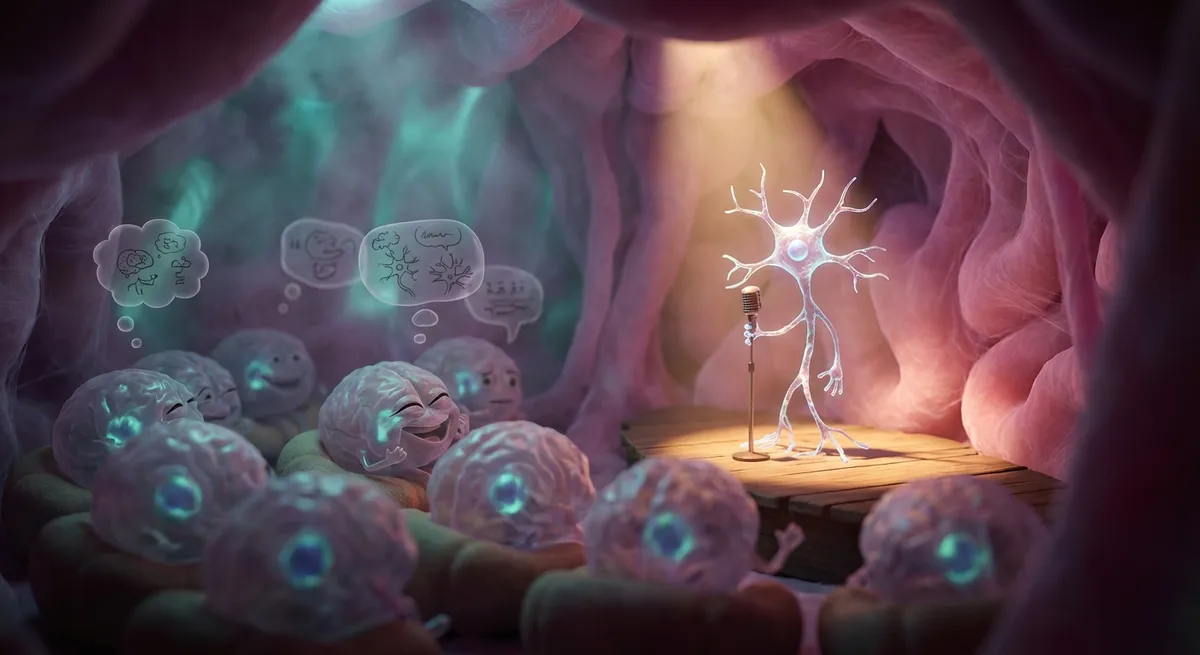
Your brain is doing an open-mic set 24/7 and you didn’t even get a ticket.
The intrusive thoughts? Crowd work.
The way you mispronounce a word you’ve known since childhood? Experimental material.
You might think you’re just existing, but your brain is secretly grinding out a chaotic comedy special. Let’s expose the act, because once you see how ridiculous this all is, you’ll never unsee it—and you’ll definitely want to send this to that one friend whose brain is clearly on tour.
The “Let’s Rehearse Every Cringe Moment Ever” Segment
You’re trying to sleep. Your body: “Time to rest.”
Your brain: “Or—and hear me out—what if we replay that one time you waved back at someone who wasn’t waving at you… in 2014?”
This is your brain’s long-running series: Previously, on Social Embarrassment. No cancellation, no season break, just reruns forever.
What’s wild is that your brain does this on purpose to help you “learn from mistakes.” Psychologists call it rumination; we call it “emotional cyberbullying from inside the house.” It thinks it’s coaching you; it’s actually directing a cringe compilation.
But there’s a reason this feels so absurdly funny once you say it out loud. Everyone’s got the same mental blooper reel. The second you admit, “My brain still replays a conversation from five phones ago,” people instantly relate. Boom—instant shareable content, powered by collective humiliation.
Shareable thought:
“We are all being haunted by the Ghosts of Awkwardness Past and honestly, they’re overbooked.”
The “What If Everything Goes Horribly Wrong?” Improv Show
You’re pouring cereal.
Brain: “What if you accidentally fling the spoon, hit the wall, crack it, destroy the house, get sued, and end up living in a tent?”
Relax, Spielberg. It’s breakfast.
This is called catastrophizing—your brain’s favorite improv game, where the only rule is “Yes, and… make it more dramatic.” It sees a minor situation and immediately pitches a disaster movie.
Evolution-wise, this used to be helpful. Your brain: “What if that rustling in the bushes is a tiger?” You: alive. Now it’s more like, “What if that calendar notification is your entire life falling apart?” And your body just responds with anxiety, which feels exactly like you just got chased by a tiger, even though it’s just an email from Karen.
The funny part? Half these disaster scenarios are so ridiculous they read like bad fanfic:
“What if I trip, fall into my boss, we both get fired somehow, and now I have to join a traveling circus?”
Brain: “YES. REALISTIC.”
Shareable thought:
“My anxiety isn’t realistic, it’s just really committed to its role.”
The “Narrator Voice No One Asked For”
You’re walking down the street, minding your business. Suddenly your thoughts go full documentary:
“Here we see the human, pretending to know where they’re going.”
Why does your brain do this? Because it’s constantly building a story out of random sensory chaos. It’s stitching your day into a narrative, and sometimes that narrative comes with commentary, sarcasm, and a soundtrack. That little inner voice? It’s basically your personal roast master.
Psychologists call it your inner monologue, but let’s be honest: it’s less “calm, rational guide” and more “friend who live-tweets everything.”
Inner you: “We’re going to the gym.”
Brain-narrator: “Against all odds, the creature attempts exercise for the first time since the Late Snack Era.”
This is why your life feels like a show sometimes. Your brain literally frames it like one.
Shareable thought:
“If life is a movie, my brain is that unhinged director yelling, ‘One more take, but make it more embarrassing.’”
The “Background Apps of Chaos” Running All Day
Your brain has tabs open like a browser on a dying laptop:
- Remember to text back
- That song stuck on loop
- Random childhood memory
- Fake argument with someone who is not currently present
- Existential dread
- Did I lock the door? Did I? DID I?
And somehow, you’re also trying to do normal human tasks on top of this mess.
Neuroscience says your brain has something called the default mode network, which kicks in when you’re not focused on a task. You might call it “daydreaming,” but let’s be real: it’s more like “mental blender mode.” It mixes memories, worries, plans, and weird imagination scenes, and hits purée.
So while you’re staring at your phone, your brain is simultaneously:
- Imagining a fake conversation
- Planning what you’d say if you ever became famous
- Replaying a TikTok
- Visualizing yourself starting a new life in another country for no reason
It’s ridiculous. It’s chaotic. It’s also universal. Everyone looks normal on the outside while hosting a 27-tab circus backstage.
Shareable thought:
“Me: ‘I’m tired.’
My brain: ‘From what?’
Also my brain: 14,000 unclosed mental tabs, 3 fake arguments, 2 crises, and 1 imaginary interview with Oprah.”
The “Comedy Special Disguised as Coping”
Here’s the plot twist: your brain makes things funny to help you survive them.
Dark humor in a group chat? That’s collective stress relief.
Laughing at your own anxiety? That’s your mind turning the volume down on terror by remixing it into memes.
Researchers have found that humor can lower stress, ease tension, and help people bounce back from rough stuff. Your brain figured this out way before the scientists showed up with clipboards and said, “So, you made a joke and felt slightly better?” Your brain has been running a pirate mental health program this whole time.
Think about how often you say things like:
- “I cope by making everything a joke.”
- “If I don’t laugh about it, I will scream.”
- “Trauma, but make it content.”
That’s your brain turning raw chaos into something you can hold, share, and joke about with other gremlins online. It’s not just comedy—it’s a survival strategy disguised as a punchline.
Shareable thought:
“My brain: suffers
Also my brain: ‘We should turn this into a bit.’”
Conclusion
Your brain is not a quiet, efficient processor. It’s a chaotic stand-up comedian, an overdramatic director, a stressed-out improv troupe, and a meme generator all crammed into one skull.
It replays your cringe, imagines disasters, narrates your life, runs mental apps in the background, and then tries to make it all funny so you don’t emotionally implode.
And the wildest part? Everyone else’s brain is doing the same nonsense.
So the next time your mind serves up a ridiculous thought—“What if everyone secretly hates my walking style?”—remember: that’s not proof you’re broken. That’s just another joke from the world’s weirdest open-mic night happening inside your head.
You’re not alone; you’re just part of the greatest accidental comedy collab of all time.
Now go send this to someone whose brain is clearly writing a sitcom, and let them know: the show’s been renewed for another season.
Sources
- [Harvard Health: Why We Ruminate and How to Stop](https://www.health.harvard.edu/mind-and-mood/when-ruminating-becomes-a-problem) – Explains why our brains replay negative moments and how rumination works
- [American Psychological Association – Anxiety](https://www.apa.org/topics/anxiety) – Overview of anxiety, catastrophizing, and how our thoughts spiral into worst-case scenarios
- [Cleveland Clinic: Default Mode Network](https://health.clevelandclinic.org/default-mode-network) – Breaks down what the brain’s default mode network is and why your mind wanders
- [Mayo Clinic: Stress Relief from Laughter](https://www.mayoclinic.org/healthy-lifestyle/stress-management/in-depth/stress-relief/art-20044456) – Describes how humor and laughter reduce stress and help us cope
- [Greater Good Science Center, UC Berkeley – The Benefits of Dark Humor](https://greatergood.berkeley.edu/article/item/how_dark_humor_helps_us_cope_with_tragedy) – Discusses how joking about difficult experiences can function as a coping mechanism