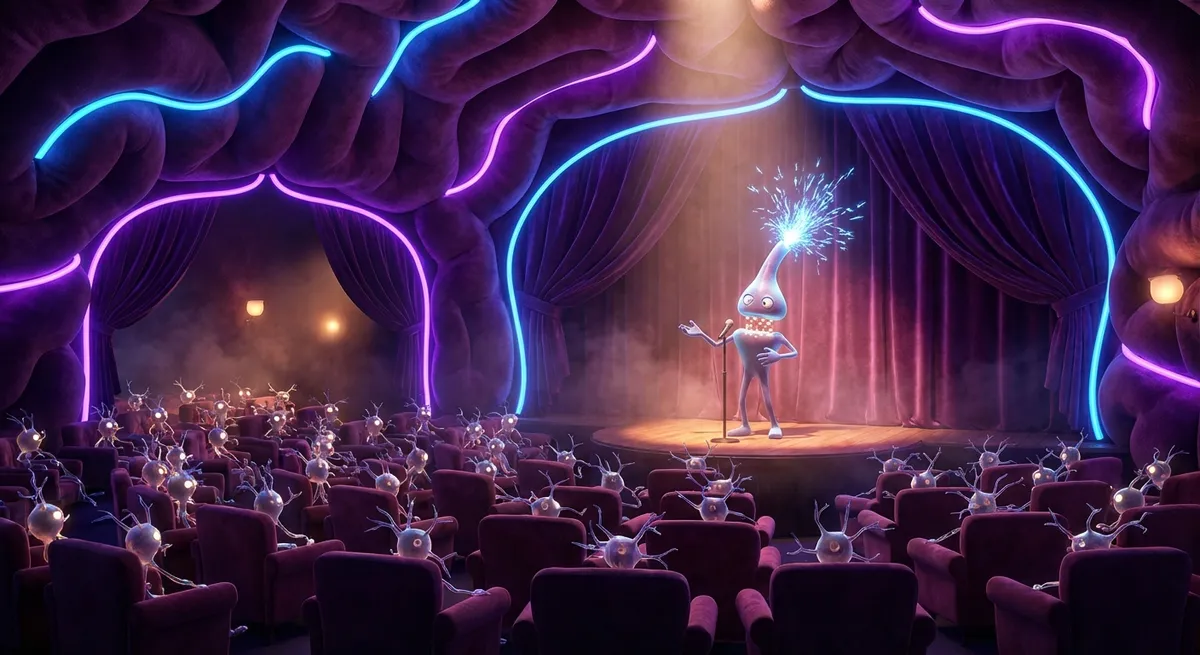
Your brain is secretly the weirdest comedian you know. It writes jokes, edits reality, misremembers entire conversations, and then gaslights you about it. And the wild part? Science says a lot of your “oops” moments are actually how your brain is supposed to work.
Let’s peel back the curtain on the tiny gremlin in your skull and expose the five funniest ways your brain is doing improv 24/7—whether you asked for it or not.
1. The “Did I Lock the Door?” Brain Loop Is a Feature, Not a Bug
You leave the house. You lock the door. You walk away.
Your brain: “Okay, but… what if we didn’t?”
Your feet: already halfway down the street.
That nervous little loop—Did I lock the door? Turn off the stove? Close the fridge?—is your brain trying to be a security guard, but it only got half the training. It’s called prospective memory, and it’s responsible for remembering to do stuff in the future. The problem? Your brain often goes on autopilot while you’re doing boring tasks, so it doesn’t “save the file” properly. Later, it tries to replay the memory and finds… nothing. Just vibes.
So it hits you with a re-run:
“Better go back and check, champ.”
The funniest part: half the time you do go back, stare at the fully locked door like it personally betrayed you, and then walk away with zero additional information. But your brain feels better, so it counts that as a win.
Share value: Everyone knows this feeling. Post this with “Tag someone who’s walked back to check the door like a confused NPC.”
2. Your Memory Is Less ‘Hard Drive’ and More ‘Drama Queen Fanfic’
You think your memory is a perfect archive. It is not. It’s an overworked intern frantically recreating files every time you open them.
When you “remember” an event, your brain isn’t opening a video file—it’s rebuilding the memory from scattered details, emotions, and whatever nonsense you picked up later. That means every time you tell a story, you risk making it spicier, wrong-er, or both.
This is why you and your friend can remember the same night out completely differently:
- You: “You tripped on the curb and yelled ‘I regret gravity.’”
- Them: “No, that was you. I was the responsible one holding the fries.”
Someone is wrong. Possibly both of you. Memories are vulnerable to suggestion, retelling, and the simple human urge to make ourselves look 12% cooler in retrospect.
Your brain, basically: “What if we just… revised history slightly so we looked funnier, hotter, and more correct?”
Everyone: “Sounds good.”
Share value: Perfect for “Send this to your friend with the WRONG version of every story.”
3. You Laugh at Stuff Before You Understand Why (Your Brain’s Laugh Track)
Ever laughed at a joke, then five seconds later went, “Ohhh, I get it now”?
That delay is your brain buffering like a bad internet connection.
Humor scientists (yes, they exist, and their job must be chaos) say jokes work by violating expectations in a safe way. Your brain predicts what’s coming. The punchline swerves left. For a split second, your mental world glitches—then snaps back with, “Oh. That’s actually hilarious.”
Your brain rewards this tiny surprise with a hit of dopamine, like it just discovered a new life hack: “What if… we misread reality, but in a fun way?”
That’s why:
- Dad jokes make you groan but still micro-smile.
- Dark humor makes you go “I should not have laughed at that” while your brain high-fives itself.
- Memes get funnier the more they twist something familiar into something deeply unhinged.
Your brain loves being wrong, as long as it doesn’t die afterward. That’s comedy, baby.
Share value: Caption material: “My brain laughing at the joke before it finishes loading.”
4. Your Inner Monologue Is Basically a Roast You Didn’t Approve
There’s a voice in your head. Sometimes it’s helpful. Sometimes it’s that one chaotic friend who should not be allowed a microphone.
You drop a glass.
Your brain: “Wow. Incredible. Truly a gifted athlete.”
You send a risky text.
Brain, 3 a.m.: “Let’s replay that moment 47 times in HD, shall we?”
Psychologists call this self-talk, and it can be either your hype squad or your worst heckler. The wild twist: your brain uses the same systems to process internal and external speech. So when you drag yourself internally, your brain partially logs it as if someone else said it to you.
You’re roasting yourself… and then emotionally reacting like a stranger attacked you.
However, flip the script a little—repeat things like “Okay, that was awkward, but also I am still a functional organism” often enough—and your brain slowly updates the script. Is it cheesy? Yes. Is your brain weirdly gullible? Also yes.
Share value: Screenshot-bait: “That moment when your brain is your own worst heckler.”
5. Your Brain Schedules Cringe Flashbacks Like Surprise Pop-Up Ads
You’re minding your business, living your life, possibly even thriving, when suddenly:
“Hey, remember that thing you said in 2014 that made everyone go silent?”
Your brain just tosses you a cringe grenade for no reason. You flinch. You cringe. You remember that time you called your teacher “mom,” or laughed at the wrong moment, or waved back at someone who wasn’t waving at you.
Why does your brain do this, besides pure villain energy? It’s part of your brain’s way of learning from social errors—replaying them so you theoretically “don’t do that again.” Helpful in theory, absolutely unhinged in practice.
The good news: everyone else is busy starring in their own Cringe Recap Reel. They do not remember the tiny disaster moments you obsess over. You’re not the main character in their mental blooper reel; they are.
So the next time your brain plays, “Top 10 Most Embarrassing Moments, Unskippable Edition,” remember: this is just your internal editor trying too hard.
Share value: Ideal caption: “If my brain sends me one more cringe flashback from 8 years ago, we’re fighting.”
Conclusion
Your brain is not a sleek, efficient supercomputer. It’s a chaotic improv troupe held together with snacks, anxiety, and half-remembered TikToks. It second-guesses locked doors, rewrites memories, laughs late, roasts you, and ambushes you with ancient cringe—all while pretending it’s being “helpful.”
But that’s the beauty of it: all the ways your brain embarrasses you are also the ways it keeps you curious, social, creative, and occasionally hilarious. You are not broken; you’re just running the standard human comedy script.
So be nice to your internal stand-up gremlin. It’s doing its best. Badly. But also… kind of brilliantly.
Sources
- [American Psychological Association – Memory](https://www.apa.org/topics/memory) – Overview of how human memory works, including reconstruction and inaccuracies
- [Harvard Medical School – Understanding the Stress Response](https://www.health.harvard.edu/staying-healthy/understanding-the-stress-response) – Explains how anxiety and stress affect thoughts, loops, and overthinking
- [Greater Good Science Center (UC Berkeley) – What Makes Things Funny?](https://greatergood.berkeley.edu/article/item/what_makes_things_funny) – Breaks down psychological theories of humor and surprise
- [Cleveland Clinic – What Is Self-Talk?](https://health.clevelandclinic.org/self-talk) – Describes internal dialogue, negative self-talk, and how it impacts mental health
- [National Institutes of Health – Prospective Memory](https://www.ncbi.nlm.nih.gov/pmc/articles/PMC3960345/) – Research on how we remember to do things in the future and why it sometimes fails