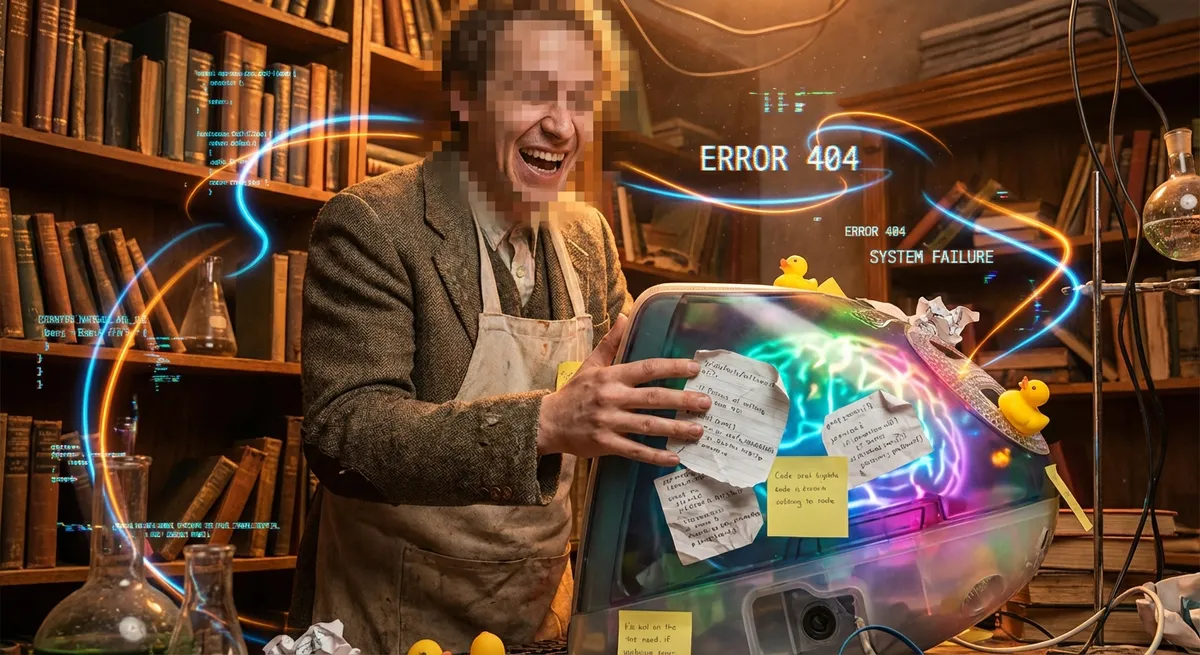
Your brain is simultaneously the coolest thing you own and the most chaotic roommate you’ll ever have. It lies to you, edits your memories, turns random noises into horror movies at 3 a.m., and then forgets where it put your keys.
Welcome to the part of reality where neuroscience reads like a bug report. Here are some delightfully cursed facts about your brain that’ll make you question everything and immediately send this to your group chat.
Your Brain Can “See” Things That Aren’t There (And It Insists It’s Right)
Your brain does not gently suggest reality; it aggressively auto-corrects it.
When you look at the world, your eyes send incomplete, messy data to your brain. Your brain then goes, “Ew, this is unusable,” and fills in the blanks using past experience, assumptions, and vibes. That’s why you fall for optical illusions you know are fake—your brain would rather be confidently wrong than uncertain.
The wild part: brain scans show that when you imagine something vividly (like a pink elephant doing taxes), many of the same visual areas light up as when you actually see it. Your brain’s like, “Close enough, we’ll treat this pretend thing as semi-real.” This is also why phantom phone vibrations feel legit, why you swear you saw your bag move in the corner, and why horror movies ruin dark hallways for weeks.
Reality isn’t always what you see. Sometimes it’s just your brain running bad Photoshop in the background and hitting “Save.”
You Remember Stuff That Never Happened (But With Full Confidence)
Your memory is not a hard drive. It is a chaotic fanfiction writer that keeps doing unauthorized rewrites.
Every time you remember something, your brain reconstructs it from scratch—like opening a document, editing it a little, then hitting save again. Over time, tiny details can shift, disappear, or get straight-up invented. You’ll argue about who said what in an old fight, thinking you’re defending historical truth, when you’re actually citing the director’s cut your brain secretly patched five years later.
There are entire studies showing how easy it is to plant false memories with just suggestion and leading questions. People have “remembered” getting lost in malls as kids or seeing things that never occurred, simply because their brains filled in convincing details. Not because they’re lying—but because their brain loves a good narrative and doesn’t always check sources.
So that one embarrassing thing you did ten years ago that haunts you at 2:47 a.m.?
A) Everyone else’s brain has absolutely edited you out.
B) There’s a non-zero chance your version is… creatively enhanced.
Your Brain Runs On Electricity, Chemistry, And Pure Gossip
Inside your skull is the most intense group chat in the universe.
Your brain cells (neurons) send signals using tiny electrical impulses and chemical messages called neurotransmitters. But here’s the fun twist: these chemical messages have personalities. Dopamine is your “oooh, shiny reward” notification. Serotonin is your “we are stable and not currently losing it” vibe. Norepinephrine is your “there is a problem; scream internally” alert system.
This microscopic chemical drama shapes your mood, focus, motivation, and whether you can answer “What are you thinking about?” with anything other than “Nothing” (which is scientifically valid—your brain literally has default idle-mode networks that wander aimlessly).
Even weirder: your gut and your brain are in a constant group chat too. Your gut microbes help produce some of those feel-good chemicals, which is why stress can wreck your stomach and why your stomach can wreck your mood. You’re basically a walking bio-electrical soap opera, and the season finale is whether you drink water or have coffee for the sixth time.
Your Brain Has A Built-In “Invisible Gorilla” Problem
Your attention system is… selective. Like, “I only respond to drama and snacks” selective.
There’s a famous experiment where people are asked to count how many times a basketball team passes the ball. In the middle of it, a person in a gorilla suit walks through, beats their chest, and leaves. A shocking number of people never see the gorilla. Their eyes saw it—but their attention did not clock in for that shift.
Your brain does this constantly. It filters out mountains of information it deems irrelevant. That’s why you can lose your phone while you’re literally holding it, why you don’t notice your neighbor’s new car until three weeks later, and why you swear things “appeared out of nowhere” on the floor (they did not; your brain just marked them as background texture).
Even sound works like this. You can ignore all the noise in a room—until someone says your name and your brain whips around like “WHO DARE SUMMON ME.” Your perception is not an open live stream; it’s a carefully edited highlight reel. And sometimes, the editor is on break.
Your Brain Is Obsessed With Patterns (Even Fake Ones)
Your brain would rather see meaning in nonsense than admit something is random.
This is why you see faces in clouds, outlets, cars, and probably that one suspicious potato chip. It’s called pareidolia, and it’s your brain’s pattern-recognition system turned up to 400%. Being able to spot faces and threats was super useful when we were out here trying not to get eaten. Now it just makes you feel like your toast is judging you.
The same glitchy system explains why people see shapes in static, hear phantom voices in noise, or think the same number keeps following them. Your brain hates chaotic randomness, so it connects dots—even when there are no dots. It turns coincidence into conspiracy, noise into signals, and weird little moments into “the universe is trying to tell me something.”
Sometimes it’s just your brain playing connect-the-dots with a blank page.
Still, kind of comforting that your mind is trying to give your life lore and side quests.
Conclusion
Your brain is not a calm, logical computer. It’s a messy, over-caffeinated improv troupe trapped in a dark box, using half-finished data and old memories to make up a story that feels consistent enough to live in.
It edits your reality, rewrites your past, ignores gorillas, sees faces in tortilla chips, and runs your emotions on a suspicious cocktail of electricity and soup chemicals. And yet somehow, with all that glitchy chaos, you still manage to text, binge shows, fall in love, doomscroll, and remember exactly one embarrassing thing from 8th grade in stunning 4K detail.
So the next time your brain is being weird, just remember: it’s not broken.
It’s just doing its best with a ridiculous job—and zero days off.
Now go share this with someone else whose brain is also barely holding the loading screen together.
Sources
- [National Institute of Mental Health – Brain Basics](https://www.nimh.nih.gov/health/educational-resources/brain-basics) – Overview of how the brain works, including neurons, neurotransmitters, and brain structure
- [Harvard Medical School – The Science of Memory](https://www.health.harvard.edu/mind-and-mood/the-science-of-memory) – Explains how memory is reconstructed and why it can be unreliable
- [American Psychological Association – The Invisible Gorilla Study](https://www.apa.org/monitor/2011/06/invisible-gorilla) – Details on inattentional blindness and the famous gorilla experiment
- [Scientific American – Pareidolia: Why We See Faces in Objects](https://www.scientificamerican.com/article/pareidolia-why-we-see-faces-in-objects/) – Discusses the brain’s tendency to find patterns and faces where none exist
- [Johns Hopkins Medicine – The Gut-Brain Connection](https://www.hopkinsmedicine.org/health/wellness-and-prevention/the-brain-gut-connection) – Explores how gut health and the brain communicate and affect mood