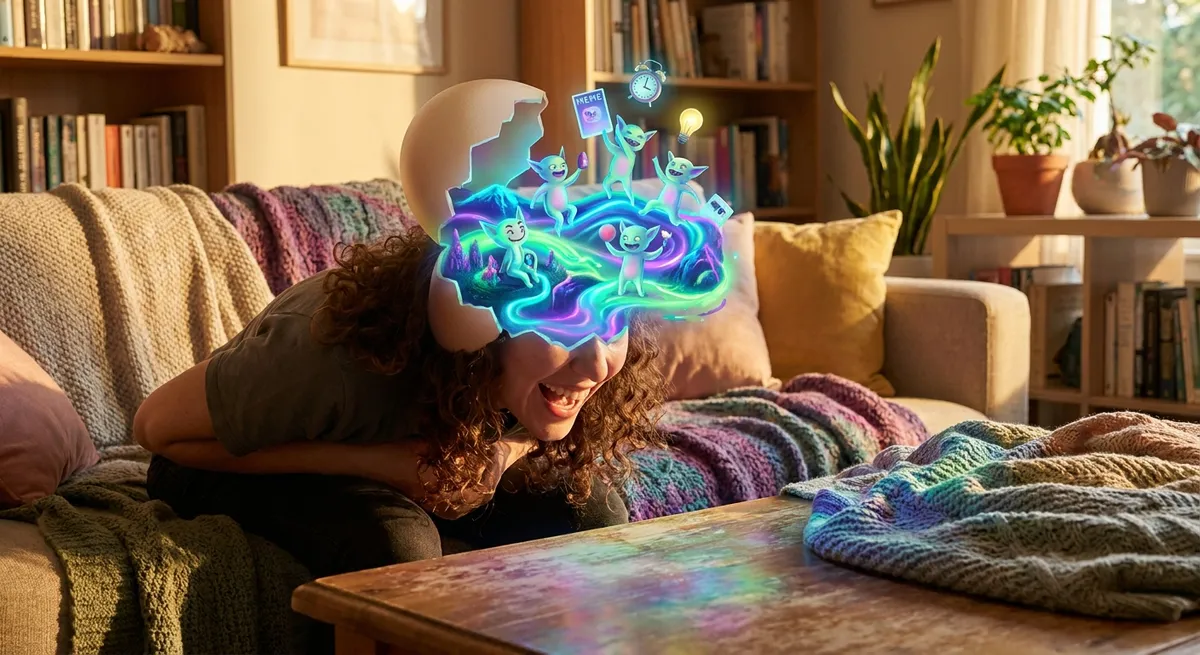
You are accidentally funnier than you think you are. Not because you’re a secret stand-up comedian, but because your brain is a tiny chaos gremlin running improv 24/7 with zero supervision. The reason you make weird comments in group chats, laugh at the worst possible moments, and mentally rehearse arguments from 2013 while showering? That’s comedy, baby. Unpaid, uncredited, and deeply unhinged—yet somehow relatable enough to be extremely shareable.
Let’s break down why your everyday nonsense is low-key comedic excellence (and why the internet eats it up).
Your Brain Auto-Generates “What If” Memes In Real Time
You know that intrusive thought that says “What if you just… yeeted your phone off this bridge” or “What if you barked during this Zoom meeting”? That’s your internal meme generator.
Your brain is constantly running “what if” scenarios, and half of them sound like cursed Twitter posts. Real danger? It calculates calmly. Social situations? It’s like:
- “What if you trip while walking past this group of people and never recover socially?”
- “What if your camera has secretly been on this entire meeting and you’ve been making goblin faces?”
The wild part is: this is normal. Psychologists literally study “spontaneous thoughts,” and a lot of them are absurd, irrational, and chaotic—which is exactly what makes them funny when you say them out loud or turn them into content.
Your mind is a meme factory. You’re just the unpaid social media manager trying to keep up with the posts.
You’re Running A Live Comedy Show Called “Overthinking Everything”
Overthinking is just anxiety doing a full Netflix comedy special in your head.
You replay conversations like:
- “Why did I say ‘you too’ when the waiter said ‘enjoy your meal’?”
- “Did they say ‘see you later’ like… ever again? Or ‘see you later’ like… never talk to me?”
On paper, this sounds tragic. Online, it’s comedy gold. Why? Because everyone does it.
Share a story about a painfully small social mistake and it’ll get:
- 200 comments of “NO BECAUSE THIS IS ME”
- 30 friends tagging other friends like, “this is literally you”
- 1 person writing a full paragraph confession about the time they called their teacher “mom”
Your brain thinks it’s having a private breakdown. The internet thinks you’ve written a tight five-minute stand-up set.
Awkwardness Is Your Superpower (Sadly, Not Flight)
You’re way funnier on accident than on purpose.
On purpose you’re like: “Here’s a witty joke I carefully crafted.”
In reality you’re like:
- Waving back at someone who was waving at the person behind you
- Saying “you too” when the dentist says “take care of your teeth”
- Holding the door open for someone slightly too far away, so now both of you are trapped in a slow-motion politeness sprint
Awkward moments feel like your soul left your body and filed a complaint. But online, this is peak relatability content. People don’t share “perfect” — they share “oh my god I thought I was the only one who does this.”
Your worst “I will think about this forever” moment is someone else’s “sending this to every group chat I’ve ever been in.”
Your Sense Of Humor Is A Weird Soup Of The Entire Internet
Your jokes are not original—and that’s what makes them uniquely you.
Your humor is:
- 30% childhood cartoons
- 25% that one chaotic friend
- 20% TikToks you won’t admit you watched 17 times
- 15% memes from 2014 that still live rent-free in your brain
- 10% raw, unfiltered unhinged energy
Scientists actually study how humor changes with culture and tech, and social media has basically turned humor into an evolving group project. You absorbed styles of jokes the way people absorb accents—by sheer exposure and vibes.
That’s why you:
- Respond to serious texts with reaction gifs
- Add “✨” around words when you’re making fun of something
- Say “love that for us” in situations where nothing is lovable for anyone
You’re a walking remix of every joke the internet has ever told, and your friends recognize it—because they’re remixes too.
Laughter Is Your Brain’s “We Have No Idea What We’re Doing” Button
Under all the chaos, jokes, and memes, your weird humor is your brain trying to not cry 24/7.
Life is a glitchy mess:
News? Terrifying.
Finances? Vibes only.
Plans? Cancelled.
Back pain at 27? Illegal.
So your brain hits the only button it has left: laugh.
There’s actual research showing that humor helps people cope with stress, pain, and scary stuff. That’s why we joke about:
- Being broke
- Being tired
- Being mentally “held together by snacks and denial”
We laugh so we don’t spiral. We make memes so we don’t melt. We post unhinged jokes so someone else can say “same” and suddenly it feels 2% less overwhelming.
Your humor isn’t just a personality trait; it’s a survival mechanism—with punchlines.
Conclusion
If you’ve ever thought, “I’m not funny, I’m just weird,” congratulations: that’s the whole joke.
Your chaotic overthinking, accidental awkwardness, cursed intrusive thoughts, and extremely specific internet brain have combined into a completely unique brand of comedy. You may not be on stage, but every time you share a painfully relatable story, unhinged shower thought, or cursed meme, you’re doing what comedy has always done: making people feel slightly less alone in this mess.
So keep being emotionally unstable but oddly hilarious. Screenshot your brain. Post the chaos. Tag your fellow gremlins.
The world is on fire, but at least we’re laughing in the group chat.
Sources
- American Psychological Association – The science of humor – Explains how humor works in the brain and why we find things funny
- Harvard Medical School – Laughter is the best medicine – Covers health and stress-related benefits of laughing
- Mayo Clinic – Stress relief from laughter – Details how humor and laughter help manage everyday stress
- Greater Good Science Center (UC Berkeley) – How humor can improve your relationships – Explores how shared humor builds social bonds
- BBC Future – Why do we laugh when we know it’s wrong? – Discusses awkward, dark, and inappropriate laughter and what it reveals about us