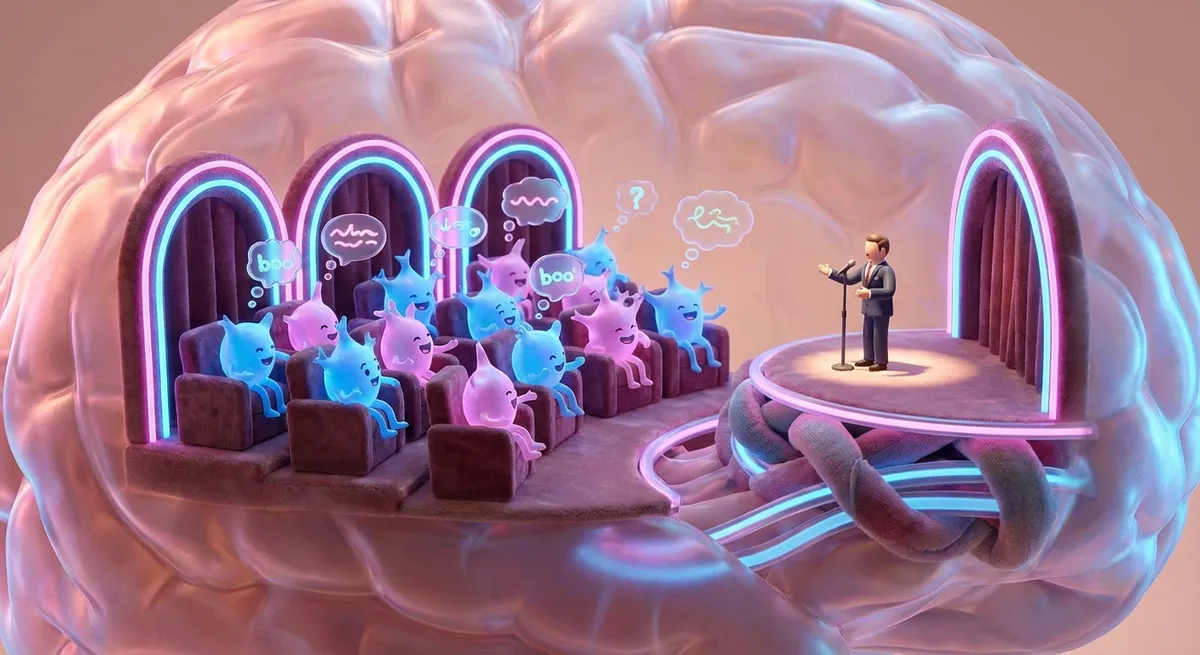
You think you’re normal, but your brain is actually running an unhinged comedy club 24/7. It’s heckling you in the shower, replaying conversations from 2016, and inventing catastrophes because you didn’t reply “lol” fast enough. The wild part? A lot of this chaos is scientifically explainable, which somehow makes it even funnier.
Let’s expose the clown running your thoughts and turn your daily glitches into shareable evidence that none of us are okay—and that’s kind of beautiful.
1. That Fake Argument You Win In The Shower? It’s Brain Fanfiction
You know those Oscar‑worthy arguments you rehearse in the shower where you destroy your imaginary enemy with perfectly timed comebacks you would never say out loud? Yeah, that’s your brain writing fanfiction about your own life.
Psychologists call this mental simulation: your mind runs “what if” scenarios to prepare you for possible social situations. Useful in theory, chaotic in practice. Because instead of “How do I negotiate a raise?” your brain goes, “What if Karen from 3rd period biology shows up after 11 years and insults your shirt?”
Your brain isn’t trying to ruin your day—this is actually part of how you learn, plan, and practice social interactions. Athletes do it to visualize performance. You do it to imagine finally saying, “Actually, that was kinda rude,” to someone who forgot you existed.
Why people share this:
Because somewhere right now, three of your friends are in the shower winning arguments against people they haven’t seen since 2014.
2. Your Laugh Has A Built‑In “Glitch Mode” That Makes You Lose It At The Worst Times
Fun fact: humans laugh way more at dumb stuff than at actual jokes. You’re more likely to break down giggling because your friend mispronounced “quinoa” than at a perfectly crafted stand‑up bit.
Laughter isn’t just about humor; it’s a weird social signal that says, “I’m safe, this is fine, please don’t kill me.” That’s why you:
- Laugh when you’re nervous
- Laugh when someone trips but doesn’t die
- Laugh at funerals (internally, hopefully) and hate yourself for it
Your brain gets overwhelmed, hits the emotional “tilt” button, and laughter just… leaks out. It’s like your psyche is trying to restart the system by making you wheeze.
There’s even something called gelotology—the scientific study of laughter—because apparently researchers watched humanity and went, “Yeah, we need to look into whatever that is.”
Why people share this:
Everyone knows the agony of trying not to laugh during a serious moment and turning it into an ugly silent seizure instead.
3. Group Chats Turn Your Humor Into A Cult Ritual
You’re funnier in group chats than in real life, and it’s not just the editing power of the backspace key. Your brain actually syncs with the people you spend time with—online counts—and that includes your sense of humor.
The more you interact with a group, the more your brains start mirroring each other’s:
- Phrases (“bestie,” “I’m unwell,” “delulu”)
- Reaction formats (all caps? feral keyboard smash? 1000‑year old meme?)
- Timing (who drops the cursed image, who adds the unhinged comment)
Neuroscience calls this social contagion: moods, behaviors, and even jokes spread like brain Wi‑Fi. You’re not just “in on the joke”—you’re literally being rewired to fit the vibe.
This is why:
- Your family group chat is G‑rated chaos
- Your friends group chat belongs in court
- Your work group chat is “haha anyway” followed by bleak existential memes
Why people share this:
It explains why your friends all evolved the same chaotic humor without ever having a meeting about it.
4. Your Brain Thinks Embarrassing Memories Are Collector’s Items
You: “I’d like to sleep now.”
Your brain: “Absolutely, right after we replay that one time in 7th grade when you waved back at someone who wasn’t waving at you.”
Embarrassing memories stick so aggressively because your brain is obsessed with social survival. It treats humiliation the way it treats physical danger: “Never again. Study the tape. Learn the weakness.” That’s why you’ll forget passwords, birthdays, and where you put your keys—but you’ll forever remember calling your teacher “mom.”
Researchers who study memory have found that emotional moments, especially negative social ones, get stored extra vividly. Your brain thinks it’s helping you avoid future cringe. Instead it just runs a 24/7 blooper reel of things no one else remembers.
Plot twist: most people are too busy rewatching their own humiliation compilations to care about yours.
Why people share this:
Everyone wants reassurance that they are not the only one still haunted by something they did in middle school gym class.
5. Your Sense Of Humor Is Basically A Chaos‑Powered Survival Tool
Underneath the memes, unhinged TikToks, and cursed group chat screenshots, humor is your brain’s way of not tapping out emotionally. It’s not just “haha funny”; it’s a coping mechanism with glitter on it.
When things are stressful or painful, your brain can:
- Zoom out and frame it as a joke
- Turn fear into absurdity
- Make you laugh at the thing instead of being crushed by it
Psychologists call this adaptive humor—joking about stressful situations in a way that helps you feel more in control, less doomed, and more connected to others. Dark humor? Often a trauma response in a funny hat.
It doesn’t fix the world. But it does make it bearable. That’s why:
- People make jokes in hospital rooms
- Soldiers, ER staff, and first responders have intense inside jokes
- The group chat goes feral precisely when everyone is secretly Not Okay™
Your inner stand‑up comedian may be messy, dramatic, and wildly inappropriate—but it’s also trying to keep you alive with punchlines.
Why people share this:
It validates the fact that “laughing instead of crying” is not emotional immaturity; it’s literally a built‑in survival feature.
Conclusion
Your brain:
- Writes revenge fanfiction in the shower
- Makes you laugh at the worst possible moments
- Syncs your humor with your weirdest friends
- Hoards your cringe like rare NFTs
- Uses jokes as emotional armor
In other words, you are not broken. You are running a chaotic, scientifically cursed comedy special 24/7—and so is everyone else.
So the next time your brain roasts you at 2 a.m. or makes you choke laughing at something deeply unhinged, remember: this is just the default human settings. Share this with someone whose sense of humor is the only reason they’ve survived this long—and let them know their inner clown is, in fact, doing important work.
Sources
- [American Psychological Association – Mental Imagery](https://www.apa.org/pubs/highlights/peeps/issue-115) – Overview of how mental simulation and imagery affect behavior and planning
- [Mayo Clinic – Stress Relief from Laughter](https://www.mayoclinic.org/healthy-lifestyle/stress-management/in-depth/stress-relief/art-20044456) – Explains physical and psychological effects of laughter on stress and health
- [Scientific American – Why We Laugh](https://www.scientificamerican.com/article/why-do-we-laugh/) – Discusses the science of laughter, social bonding, and nervous laughter
- [Harvard Medical School – The Anatomy of Memory](https://www.health.harvard.edu/mind-and-mood/the-anatomy-of-memory) – Breaks down why emotional memories (including embarrassing ones) tend to stick
- [Psychology Today – Humor as a Defense Mechanism](https://www.psychologytoday.com/us/blog/tech-support/201907/humor-valuable-defense-mechanism) – Describes how humor functions as an adaptive coping strategy in stressful situations