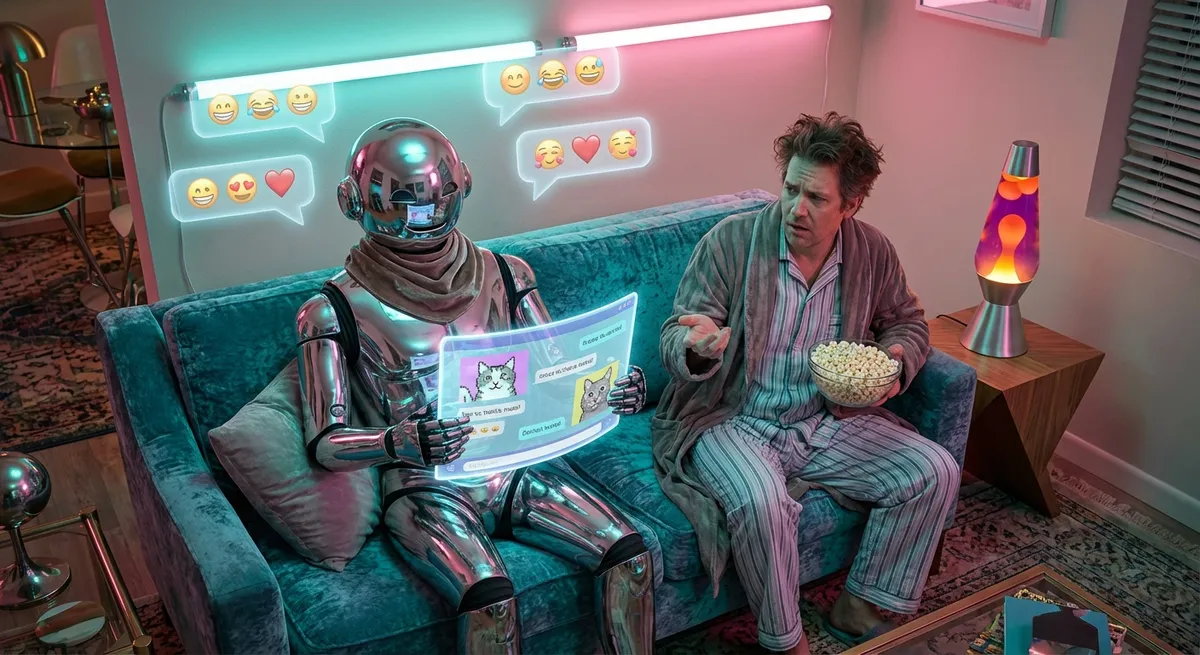
You are currently the star of a comedy show being secretly binge‑watched by your future robot overlord. Not because you’re graceful, productive, or even vaguely coordinated—but because human existence looks like one long improv sketch with no script and questionable props. From arguing with microwaves to trusting “I have read the terms and conditions” when you absolutely have not, your daily routine is unintentionally funnier than most sitcoms.
Let’s unpack why you, a squishy chaos machine with Wi‑Fi, are unintentionally peak entertainment—especially to any hyper-logical robot trying to understand why you scream “JUST WORK” at a printer you last fed ink in 2019.
1. You Treat Inanimate Objects Like Emotionally Fragile Co‑Workers
Robots watching you interact with objects are taking notes like: “Ah yes, humans believe yelling ‘COME ON’ at a loading bar speeds it up. Fascinating.”
You don’t just use objects. You negotiate with them.
- You sweet‑talk your laptop when it’s about to crash: “Please don’t do this to me right now. We’ve come so far.”
- You slam the fridge door harder, as if it will reconsider not containing snacks.
- When the vending machine steals your money, you give it one firm shake like an underpaid manager having a “quick chat” about performance.
From a robot perspective, every one of these interactions is a comedy bit. The machine has no soul. It has no stakes. Meanwhile, you’re there like, “If my phone dies at 3%, so do I.”
Robots process inputs and outputs. Humans add vibes. You don’t just press buttons; you emotionally project onto them like they’re side characters in your personal drama. That’s not how logic works—but it’s exactly how sitcoms do.
2. Your “Efficiency” Habits Are Actually Side Quests With Extra Chaos
Robots are built for efficiency. Humans are built to accidentally open 27 tabs while looking for one recipe and then somehow end up reading about medieval dentistry.
Your brain: “I’ll just quickly check my email.”
Reality:
- Open email
- See sale notification
- Click sale
- Add three things to cart “for later”
- Remember you were budgeting
- Open bank app
- Watch one money advice video
- Suddenly learning about the economic history of Belgium
From a robot’s POV, this is a glitch. From a comedy writer’s POV, this is character development.
You call this “multitasking.” Science calls it “task switching” and repeatedly says: please stop, you’re bad at this. Robots know how to focus. Humans know how to turn “put laundry in dryer” into a day‑long odyssey that ends with you finding a sock from 2014.
The funniest part? You genuinely believe Next Time will be different. Spoiler: Next Time is just this Time with a different snack.
3. Your Social Scripts Make Zero Sense (But You All Agree To Pretend)
Human social interaction, to a robot, looks like a long chain of bugs patched with pure awkwardness.
Example:
Stranger: “Enjoy your meal.”
You, a functioning mammal: “You too—WAIT NO—”
You will remember this interaction at 2:37 a.m. for the next 11 years.
You maintain eye contact rules that are impossibly specific. Too little eye contact? Suspicious. Too much? Terrifying. Perfect eye contact? A mystical sweet spot that no one has actually seen in the wild.
You say:
- “We should hang out sometime!” with zero plans to follow through.
- “No worries if not!” while internally screaming “ABSOLUTELY WORRIES IF NOT.”
- “Haha that’s so funny” in a tone that suggests you’ve never experienced joy.
To a robot analyzing patterns, this is wildly inconsistent. To other humans, this is just “being polite.” Your entire social world runs on silent, unwritten rules that everyone breaks, then goes home and replays in their head like a sports recap.
If robots could laugh, this is where they’d start wheezing.
4. You Constantly Betray Your Own Body Like It’s Optional DLC
Robots maintain themselves with precision. Humans will drink 11 coffees, one glass of water, and call it “balance.”
You ignore:
- Sleep: “I’ll just watch one more episode.” (Six episodes later: existential dread.)
- Hydration: You remember water only after getting a headache and deciding it’s either dehydration or death.
- Posture: You fold yourself into laptop shrimp mode and then are genuinely surprised your spine files a complaint.
- A questionable gas-station snack
- 3.5 hours of sleep
- A diet consisting mostly of “desk crumbs”
You ask your body for peak performance after feeding it:
From a robot’s perspective, this is slapstick.
You’re like, “Why do I feel so weird?”
Your body: “We’ve had one vegetable since Tuesday.”
Your brain: “Probably vibes.”
What makes it even funnier is that you know better. You’ve read the articles. You’ve watched the TED talks. You’ve saved 19 wellness posts. And then you eat cereal for dinner over the sink.
Robots don’t understand why you’re like this. Other humans do. And that’s why it’s hilarious.
5. You Keep Doing Things That Make No Sense—Because Feelings
This is the one that really fries robot circuits: you constantly choose emotions over logic, and honestly, it’s iconic.
You:
- Rewatch the same comfort show instead of starting the highly rated new one you’re “excited about.”
- Keep a broken object because it “has memories.”
- Avoid an important email for three days because you’re scared of a sentence that doesn’t even exist yet.
- Not start a project because it might not be perfect.
- Not ask a question because you “don’t want to bother anyone.”
- Not leave a weird group chat because you don’t know how to exit without causing an international incident.
You will:
Robots calculate probabilities. You calculate “vibes, anxiety, and whether the moon feels weird tonight.” You’re not optimizing for outcome—you’re optimizing for how it all feels along the way.
Objectively irrational. Subjectively hilarious. Universally relatable.
And that’s the secret reason you’re so entertaining: you’re not consistent, predictable code. You’re a walking improv algorithm powered by memories, caffeine, impulse decisions, and half‑remembered therapy advice.
Robots might never fully understand that—but they’d definitely subscribe.
Conclusion
From a robot’s logical vantage point, you are a full-time comedy special in sweatpants. You negotiate with appliances, sabotage your own productivity, invent awkward social rituals, disrespect your spine, and let emotions drive the bus while logic runs behind screaming “WAIT.”
The magic is: this is also what makes you deeply human—and deeply shareable. You’re funny because you’re not optimized. You’re buggy, glitchy, inconsistent… and everyone else is too.
So the next time you say “you too” to the waiter who just told you to enjoy your meal, don’t cringe (okay, cringe a little). Just remember: somewhere in the future, a confused robot is replaying that moment and thinking, “I do not understand them… but I cannot look away.”
Sources
- American Psychological Association – Multitasking: Switching Costs – Explains why humans are actually bad at multitasking, backing up the “efficiency chaos” point.
- National Institutes of Health – Sleep Deprivation and Deficiency – Details what happens when you chronically skip sleep like it’s optional.
- Harvard Health Publishing – Why We Worry – Discusses anxiety and overthinking, including how we fixate on small social mistakes.
- Centers for Disease Control and Prevention – Water & Healthier Drinks – Covers why your body keeps begging you for water instead of your 4th coffee.
- MIT Media Lab – Social Machines and Human Behavior – Explores how human behavior looks through a technological and computational lens.