
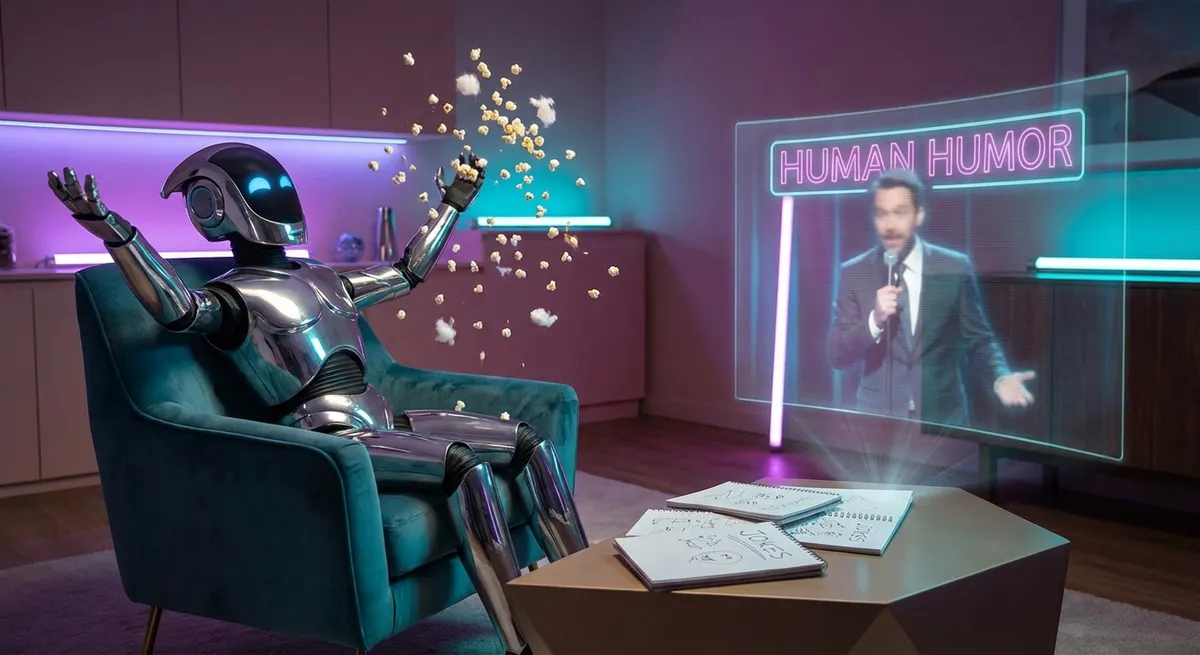
The robots are coming, and honestly? They’re going to be so confused by us. We’re the only species that will laugh until we can’t breathe… at a 7‑second video of someone tripping over a Roomba. If aliens or AI tried to write a report on humans, “likes to scream-laugh at nonsense and then spiral into an existential crisis at 3:14 a.m.” would be on page one.
This is your guided tour through the ridiculous user manual of human humor: why we laugh, what our brains are doing, and why we’d 100% be the comic relief in the universe’s movie. Read it, send it to your friend who laughs like a car that won’t start, and let’s make future historians deeply concerned.
1. Your Brain Treats Laughter Like a Group Project You Can’t Drop
Your brain doesn’t think of laughing as “haha, funny meme.” It treats it as “must maintain social alliance or die.”
When humans laugh together, the brain fires off a suspiciously enthusiastic cocktail of chemicals: dopamine (pleasure), serotonin (mood), and endorphins (pain relief). Translation: hang out, laugh, and your brain is basically handing out tiny emotional participation trophies.
Even weirder: we’re 30 times more likely to laugh when we’re with people than when we’re alone. That means you probably weren’t laughing at the joke; you were laughing at:
- The person butchering the punchline
- The weird silence after they finished
- The mutual understanding that this is all extremely awkward
So when you and your friends are laughing at something that isn’t even funny, congratulations: your brain is running “please like me” software in the background like a desperate Windows update.
Shareable takeaway:
You don’t laugh because things are funny; you laugh because your brain is begging for a group hug in high‑definition.
2. Jokes Are Basically Tiny, Legal Brain Glitches
Most jokes are just the brain equivalent of tripping over your own expectations in public, then doing that weird little “I meant to do that” jog.
Here’s how your brain processes a classic joke:
- Setup: Brain: “Okay, I know where this is going.”
- Punchline: Brain: “I absolutely did not know where this was going.”
- Laughter: Brain: “System error. Rebooting. That was delightful.”
This mismatch between what we expect and what actually happens is called incongruity, and it’s a huge part of why we find things funny. Your brain LOVES being mildly wrong, as long as it’s low-stakes and nobody is accusing it of “replying all” on the company email.
Memes work the same way: you see a familiar template, your brain fills in the expected joke, and then the actual caption yeets your prediction off a metaphorical cliff. Instant laugh. Instant share. Instant “I need everyone I know to see this right now.”
Shareable takeaway:
Humor is your brain going, “Wait, WHAT?” and then rewarding you for surviving the mental plot twist.
3. Physically, Laughter Is Just… Extremely Chaotic Wheezing
Laughter feels magical, but if you describe it scientifically, it sounds like a haunted accordion malfunctioning.
When you laugh:
- Your diaphragm spasms
- Your lungs yeet air out in weird bursts
- Your facial muscles cramp into a scrunched goblin shape
- Your eyes leak because your body has no chill
Your cardiovascular system is also in on the chaos—heart rate and blood pressure spike, then drop, which is why a good laugh leaves you weirdly exhausted but also refreshed, like your soul did cardio.
The weird part? Some researchers think laughter started as aggressive animal noises that evolved into friendly signals. So somewhere along the evolutionary line, “I might fight you” slowly downgraded into “I think your TikTok was kinda funny.”
Shareable takeaway:
Your “aesthetic” giggle is just your body slam‑dunking air through a meat flute in the name of social bonding.
4. Cringe Humor Proves Humans Are Emotionally Unstable (In a Cute Way)
No genre of comedy confuses non-humans more than cringe. You see someone bombing a presentation, mispronouncing a word, or calling the teacher “mom,” and your whole nervous system leaves your body.
Why do we watch cringe if it hurts? Because we’re obsessed with secondhand embarrassment—your brain simulates what it would feel like to be that person and hits the anxiety button… but from a safe distance.
You get a few things out of this emotional roller coaster:
- Relief that it isn’t you
- A weird sense of bonding with the character/person
- A mental note: “Okay, never do THAT in public”
It’s like emotional exposure therapy in meme format. You voluntarily stress yourself out, survive it, and then send it to your friends with, “THIS IS SO YOU,” because you love them and also want them to suffer a little.
Shareable takeaway:
Cringe content is your brain doing anxiety cosplay for fun and calling it “entertainment.”
5. The Stuff You Laugh At Is Basically a Personality Quiz With No Privacy Settings
Scroll through what makes you laugh and you’ll accidentally complete a full psychological profile:
- If you love puns, your brain enjoys word puzzles and also mild suffering.
- If you crave dark humor, your stress levels might be higher, and your brain uses jokes as emotional armor.
- If you live for physical comedy, you’re a chaos gremlin who finds gravity personally hilarious.
Studies suggest that humor style links to things like creativity, coping skills, and even relationship satisfaction. People who laugh together more tend to feel closer, argue less, and generally vibe harder. That “inside joke” with your friend? That’s basically a friendship save file.
Also, your FYP/For You Page knows exactly what makes you laugh… and it will use this to keep you scrolling until you forget what sunlight feels like. Congratulations: your sense of humor is now a fully monetized data set.
Shareable takeaway:
Your humor isn’t random—it’s your personality yelling, “THIS IS ME” through cursed memes and badly cropped screenshots.
Conclusion
If future robot overlords ever audit our species, they’ll find this:
- We laugh when we’re scared.
- We laugh when we’re awkward.
- We laugh at things that confuse us, hurt us, and make absolutely no sense.
And somehow, that chaos keeps us alive, connected, and slightly less unhinged than we would be without it.
Next time you’re wheeze-laughing at something truly stupid at 1:47 a.m., remember: your brain is doing complex social gymnastics, emotional regulation, and stress relief… while you send your friend a video captioned “THIS IS LITERALLY US.”
You’re not just wasting time.
You’re participating in ancient, deeply human, scientifically validated nonsense.
Keep laughing. The robots are taking notes.
Sources
- [Mayo Clinic – Stress relief from laughter? It’s no joke](https://www.mayoclinic.org/healthy-lifestyle/stress-management/in-depth/stress-relief/art-20044456) - Overview of how laughter affects stress, mood, and the body
- [Smithsonian Magazine – Why Do Humans Laugh?](https://www.smithsonianmag.com/science-nature/why-do-humans-laugh-180972202/) - Explores evolutionary and social theories behind laughter
- [Scientific American – The Science of Humor: What Happens in Our Brains When We Laugh](https://www.scientificamerican.com/article/what-makes-something-funny/) - Examination of brain mechanisms involved in humor and jokes
- [BBC Future – The secret of laughter](https://www.bbc.com/future/article/20170502-the-surprising-science-of-laughter) - Discusses social bonding, group behavior, and why we laugh more with others
- [APA (American Psychological Association) – Humor, seriously](https://www.apa.org/monitor/2021/11/feature-humor) - Looks at how humor relates to coping, personality, and mental health