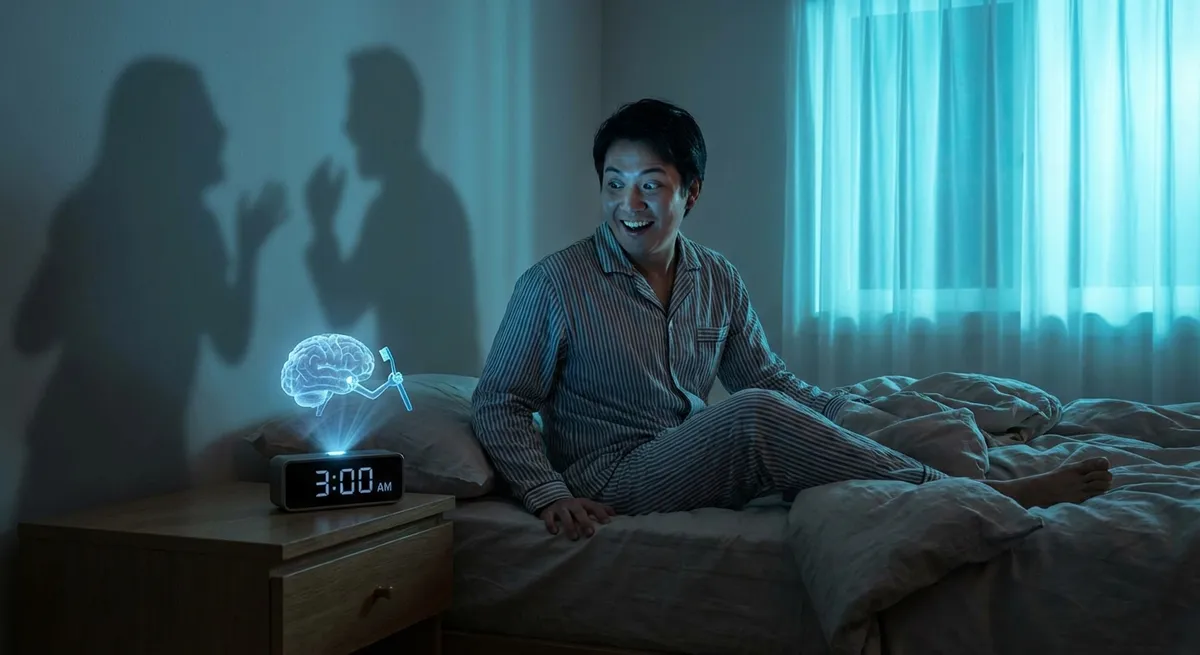
Your brain at 3AM: “What if penguins had anxiety?”
You at 3AM: “We have work in five hours.”
Somewhere between “I should sleep” and “what if pigeons are government drones,” your mind unlocks a secret comedy club. Suddenly you’re replaying every embarrassing thing you’ve done since 2009, imagining fake arguments you absolutely win, and inventing cursed shower thoughts no one asked for.
Let’s unpack why your brain refuses to chill, why everything is accidentally hilarious at night, and why your weird thoughts might actually be elite content.
The Midnight Brain: Now Featuring Bonus Chaos Mode
During the day, your brain is busy pretending to be a functional adult: replying to emails, remembering passwords, and not screaming in meetings. At night, all those distractions vanish—and your mind goes, “Finally. Time to get weird.”
With fewer external inputs (no notifications, no coworkers, no one microwaving fish in the office kitchen), your internal thoughts get the main stage. The serious ones (“Did I pay that bill?”) share a couch with the chaotic ones (“What if clouds are just sky-sheep?”), and suddenly your mental Netflix is all outtakes and bloopers.
On top of that, your emotional filter gets a little looser. Stuff that felt mildly awkward at 3PM becomes a full-blown IMAX replay at 3AM. The drama is higher, the stakes feel bigger, and the absurdity is…honestly kind of hilarious if you catch it from the right angle.
Your brain is basically the friend who says, “We should go home,” and then orders three more drinks and starts a karaoke duet with a stranger.
Point 1: Your Embarrassing Memories Are Doing a Comeback Tour
You: trying to sleep.
Your brain: “Remember that time you called your teacher ‘mom’ in 7th grade?”
There’s actually a name for this: spontaneous memory recall. Your brain loves to randomly yank old files out of the mental archive, especially when things are quiet. And it doesn’t pick the wholesome memories (“remember that time we helped someone?”); it picks the social disasters.
The funny part? Half the time, the thing that haunts you at 3AM is something no one else even remembers—or, worse, they do remember but thought it was endearing and moved on in 0.4 seconds.
If you catch yourself spiraling, try this: reframe it like a story you’d tell a friend. Add unnecessary dramatic flair. Overcommit. “I didn’t just trip in public. I invented a new falling technique never before seen by humankind.” Turning it into comedy doesn’t erase it—but it does stop it from owning you.
Shareable translation: everyone has a personal blooper reel. You’re not uniquely cringe; you’re just in the extended edition.
Point 2: Your Inner Monologue Is Basically Rogue Improv Theater
At 3AM, your brain becomes a one-person improv team performing a show titled: “We Do Not Control Our Thoughts, Please Do Not Sue Us.”
You’re suddenly:
- Rewriting arguments you lost in the shower but now crush
- Imagining fake interviews where you’re mysteriously famous
- Practicing what you’d say if you ever accidentally met your idol in Target
- Narrating your life like a nature documentary:
“Here we see the human, once again, not drinking water.”
What feels like nonsense is your brain running scenarios, solving problems, and playing out “what ifs.” But because you’re exhausted, the logic filter is wobbly. That’s why you end up thinking things like, “If I run fast enough, can I time travel a little?”
Try this trick: if your brain is determined to monologue, turn it into a bit. Pretend your thoughts are being read by a dramatic audiobook narrator or David Attenborough. Suddenly it’s less, “Why am I like this?” and more, “This content is accidentally kind of fire.”
Point 3: Sleep-Deprived Humor Hits Different (And Science Low‑Key Agrees)
If you’ve ever stayed up way too late with friends, you know there’s a point where everything becomes funny. Someone mispronounces a word? Hysterical. Chair squeaks weirdly? Comedy gold. Someone breathes slightly wrong? You’re wheezing.
Sleep loss messes with emotional regulation and cognitive control, which means your responses get extra. Your brain can’t be bothered to fully process things, so it reacts faster and louder. The result: your sense of humor goes feral.
This is why the dumbest jokes slap the hardest at 2:47AM. You’re not broken; your brain is just running on low battery and high chaos. It’s like your internal editor clocked out and said, “Yeah, laugh at that salad for no reason. You’ve earned it.”
Is it ideal for productivity? Absolutely not. Is it incredible for unhinged group chats and iconic inside jokes you’ll reference for years? Absolutely yes.
Point 4: Your Weird Shower Thoughts Are Low‑Key Philosophy
Those bizarre late‑night thoughts—“If we say ‘heads up’ but mean ‘duck,’ do words even mean anything?”—aren’t just nonsense. They’re a chaotic overlap between:
- Pattern recognition (your brain trying to make sense of everything)
- Abstract thinking (connecting random ideas like a conspiracy board)
- Existential dread (hello, old friend)
You’re basically doing philosophy in meme format.
Classic “shower thoughts” walk the line between profound and stupid:
- “We feel weird aging, but so does our toothbrush.”
- “Technically, your belly button is your old mouth‑hole.”
- “Your future self is a stranger you’re currently building a life for.”
Are these cursed? Yes. Are they also weirdly deep? Also yes.
The magic is that they’re shareable. They make people pause, laugh, then message a friend: “My brain just broke, read this.” If your brain is going to torment you at 3AM, you might as well get viral content out of it.
Point 5: Laughing at Your Brain Is Secretly a Power Move
You can’t always stop the late-night overthinking, but you can change how you react to it. And one of the most underrated coping skills? Humor.
When you jokingly narrate your panic like a sitcom, or meme-ify your intrusive thoughts, you’re not ignoring your feelings—you’re taking back control. You’re saying, “Yes, brain, I hear you, but also you are being extremely dramatic right now and we need to calm down.”
Research actually backs this up: humor can reduce stress, help you process difficult emotions, and make social sharing way easier. It’s a lot simpler to DM someone, “My 3AM brain just asked if my dog thinks I’m his weird roommate,” than “I’m spiraling about my entire identity.” But the emotional door still cracks open.
In other words, laughing at your unhinged thoughts doesn’t mean you’re not taking your mental health seriously. It means you’re giving yourself a softer landing while your brain insists on doing parkour.
Conclusion
Your 3AM brain is not broken; it’s just off-duty and unsupervised.
It replays your most awkward memories, runs fake arguments, invents cursed shower thoughts, and laughs at things that absolutely would not be funny in daylight. Underneath all that chaos, it’s just your mind trying to process life—with the emotional equivalent of a glitchy Wi‑Fi connection.
So the next time your brain decides to premiere a new internal stand‑up special at 3:12AM, try this:
- Notice the chaos
- Turn some of it into a bit
- Save the best lines for your group chat in the morning
You’re not alone. Half the internet is lying awake somewhere, also wondering if pigeons have side hustles.
And honestly? That’s kind of comforting.
Sources
- [National Institute of Neurological Disorders and Stroke – Brain Basics: Understanding Sleep](https://www.ninds.nih.gov/health-information/public-education/brain-basics/brain-basics-understanding-sleep) – Overview of what the brain is doing during different sleep stages
- [Harvard Medical School – Sleep, Memory, and Learning](https://healthysleep.med.harvard.edu/healthy/matters/benefits-of-sleep/learning-memory) – Explains how sleep and memory replay are connected
- [American Psychological Association – The Health Benefits of Humor and Laughter](https://www.apa.org/topics/mental-health/humor) – Discusses how humor helps with stress and emotional regulation
- [Cleveland Clinic – Overthinking at Night: Why It Happens and How to Stop](https://health.clevelandclinic.org/overthinking-at-night) – Breaks down why thoughts ramp up at night and offers coping strategies
- [Psychology Today – Why Embarrassing Memories Haunt You](https://www.psychologytoday.com/us/blog/mind-my-business/201911/why-embarrassing-memories-haunt-you) – Explores why cringe memories resurface and how to reframe them