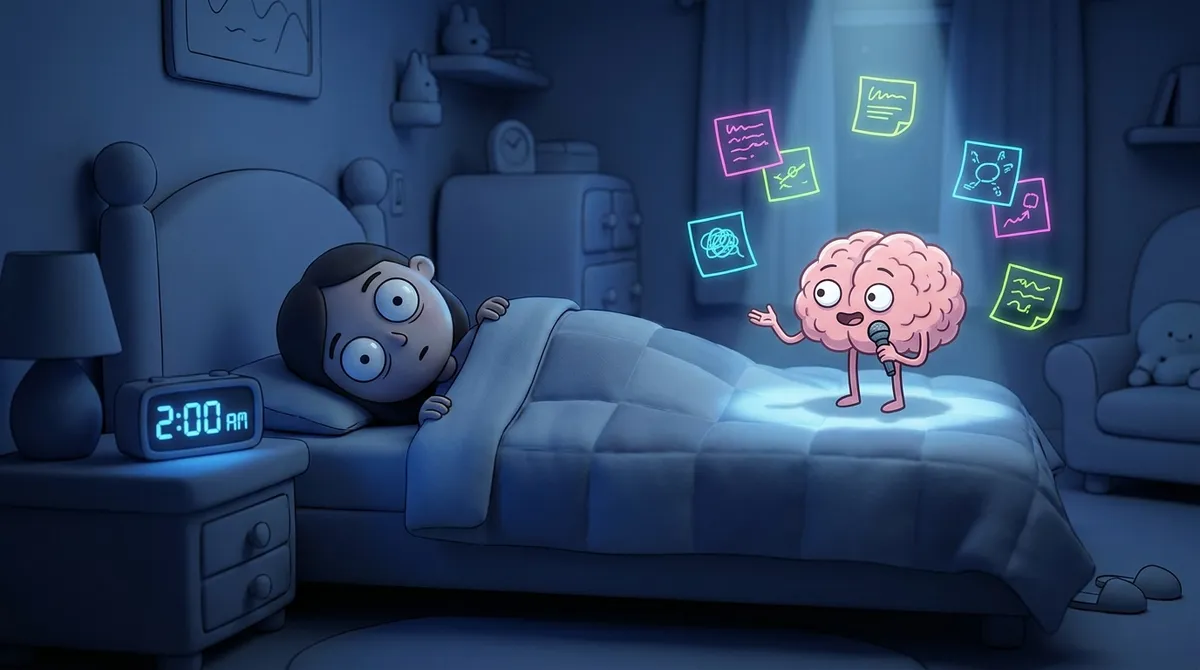
You know that moment when you’re finally lying in bed, the room is quiet, and your brain says, “Cool, time to replay every embarrassing thing we’ve ever done… with bonus commentary”? Congratulations, your mind has entered Late‑Night Comedy Mode.
This is your unofficial tour of the weird, funny ways your brain misbehaves—and why those glitches are oddly comforting. Shareable warning: you will absolutely recognize yourself in at least one of these, and then feel compelled to tag three friends as witnesses.
The Shower: Where You Win Every Argument You Lost In Real Life
Your daily life: “Oh, okay. Yeah. Sure. No problem.”
Your shower life: “Listen here, Deborah, in 2009 I was being POLITE. If I had unleashed the full PowerPoint presentation with charts and citations, you would have wept.”
The shower is basically a simulation room where your brain loads old arguments, outfits you with perfect comebacks, and lets you win fake debates against people who are currently just buying groceries in peace.
Scientifically speaking, when you’re doing something repetitive like showering, your brain slips into “default mode network” territory—basically, a background tab where it starts sorting memories, rehearsing social situations, and running “what if” scenarios. Emotionally speaking, you’re starring in an imaginary courtroom drama where you finally destroy Todd from accounting with one bulletproof sentence.
Why this is shareable: Everyone has delivered a fake Oscar speech to the bathroom tiles. Admitting you fight invisible haters while holding shampoo is universal, humiliating, and therefore perfect meme fuel.
The Group Chat: Where You Rewrite One Text 23 Times and Still Panic
There is no anxiety quite like asking yourself, “Is this ‘lol’ too aggressive?”
You type: “Sure!”
Backspace.
“Yeah that works!”
Backspace.
“Okay cool :)”
Backspace.
“k”
Backspace, because that’s how wars start.
Your brain treats group chats like a high‑stakes diplomatic summit where a single emoji can collapse 10 years of friendship. You’re not “just texting”; you are carefully curating a personality. Are you fun? Calm? Mysterious? Do you overuse the skull emoji? How many exclamation marks before you sound like you drink iced coffee for breakfast, lunch, and dinner?
Meanwhile, your friends are sending chaotic messages like, “WHO ATE MY CHEESE STICKS” with zero punctuation and no emotional concern whatsoever.
Why this is shareable: Everyone has that one friend who types like a human golden retriever and another who texts like a Victorian ghost. Drop this in the group chat to expose all of you at once.
The Grocery Store: Where You Forget How To Walk Like a Normal Human
Nothing breaks your confidence like suddenly realizing you don’t know what to do with your limbs in public.
You’re totally fine—until you see an employee restocking cereal. Instantly, your brain panics:
“Are we walking weird? Wait, are we breathing wrong? Are we using too much arm? What is the correct speed for a person who definitely isn’t stealing grapes?”
You start over‑correcting your walk like a glitchy video game character:
Step. Swing arms. Not that much. Smile. Not that much. Look at items. Not too intensely, you’re not in love with the yogurt.
This is social self‑awareness turning up to 100. Psychologists call it the “spotlight effect”: you imagine everyone is watching your every move, when in reality they’re mostly thinking, “Did I already pass the pasta aisle three times or am I in a loop?”
Why this is shareable: Everyone has experienced that “I forgot how to be a person at Target” moment. Perfect for calling out your friend who pretends they’re chill but visibly malfunctions every time someone says, “Need help finding anything?”
The Couch Spiral: When “One More Episode” Turns Into a Lifestyle Choice
There is a special kind of delusion that only appears when a streaming platform asks, “Next episode?” and you tell yourself, “Just one more, I have self‑control.”
Your brain at 7 p.m.: “We’ll watch one and then be productive.”
Your brain at 2 a.m.: “We live here now. These characters are our real family. That email can wait until the heat death of the universe.”
This is your reward system doing the absolute most. Your brain LOVES quick dopamine hits from cliffhangers, plot twists, and the seductive promise of “play next.” It’s like a tiny gremlin in your head whispering, “Sleep is temporary, but finding out who stole the diamond is forever.”
You could be folding laundry, getting your life together, or learning something life‑changing. Instead, you’re emotionally destroyed over fictional people who don’t know you exist.
Why this is shareable: Everyone knows that one person who says, “I don’t really watch TV,” and then disappears for 48 hours to finish three seasons of something they “accidentally started.” Tag them with love and mild judgment.
The Imaginary Interview: Where You Explain Your Completely Average Life Like You’re Famous
You’re doing nothing special—maybe loading the dishwasher, maybe staring at a wall—when your brain decides it’s time for a full‑length pretend celebrity interview.
“Thanks for having me on the show, Jimmy.”
“So, tell us—how did you become this iconic?”
“Well, Jimmy, it all started when I microwaved leftover pasta at 2 a.m. and had a vision.”
Suddenly, you’re telling an invisible talk‑show host about your “creative process,” your “daily routine,” and the time you “almost gave up but didn’t, because of THE FANS” (known in reality as your two friends and your one very supportive group chat).
This fantasy is part ego, part self‑soothing. Your brain is basically workshopping the story of your life in real time, turning your messiest moments into a dramatic, inspiring narrative where you come off cool, wise, and surprisingly funny.
Why this is shareable: Everyone has rehearsed a fake interview about their nonexistent hit album or bestselling novel. Dropping this online is an instant way to expose the fact that we’re all secretly main‑charactering in our heads.
Conclusion
Your brain is a chaotic little improv troupe: overthinking texts, winning shower arguments, glitch‑walking through stores, bargaining with Netflix, and accepting imaginary awards for achievements you haven’t even attempted yet.
Underneath the comedy, there’s something oddly comforting: if your mind is doing all this nonsense, you’re deeply, profoundly normal. Every time you feel like a weirdo, remember: someone else is out there rehashing a 7‑year‑old argument while pretending the shampoo bottle is their lawyer.
So go ahead—share this, tag your overthinking friend, your binge‑watch gremlin friend, your “I rehearse conversations in advance” friend… or just admit that you are all three.
The brain is wild. Luckily, it’s also hilarious.
Sources
- Harvard Medical School – Why we dwell on the past – Explains why our brains replay old conversations and memories
- Scientific American – The Brain’s Default Mode Network – Overview of the “default mode” your brain enters during rest or routine tasks
- APA (American Psychological Association) – The spotlight effect – Describes why we think others notice us more than they actually do
- National Institute on Drug Abuse – Dopamine, motivation and reward – Background on the dopamine reward system and why we seek “one more episode”
- Psychology Today – The appeal of binge-watching – Discusses why binge‑watching feels so satisfying and hard to stop