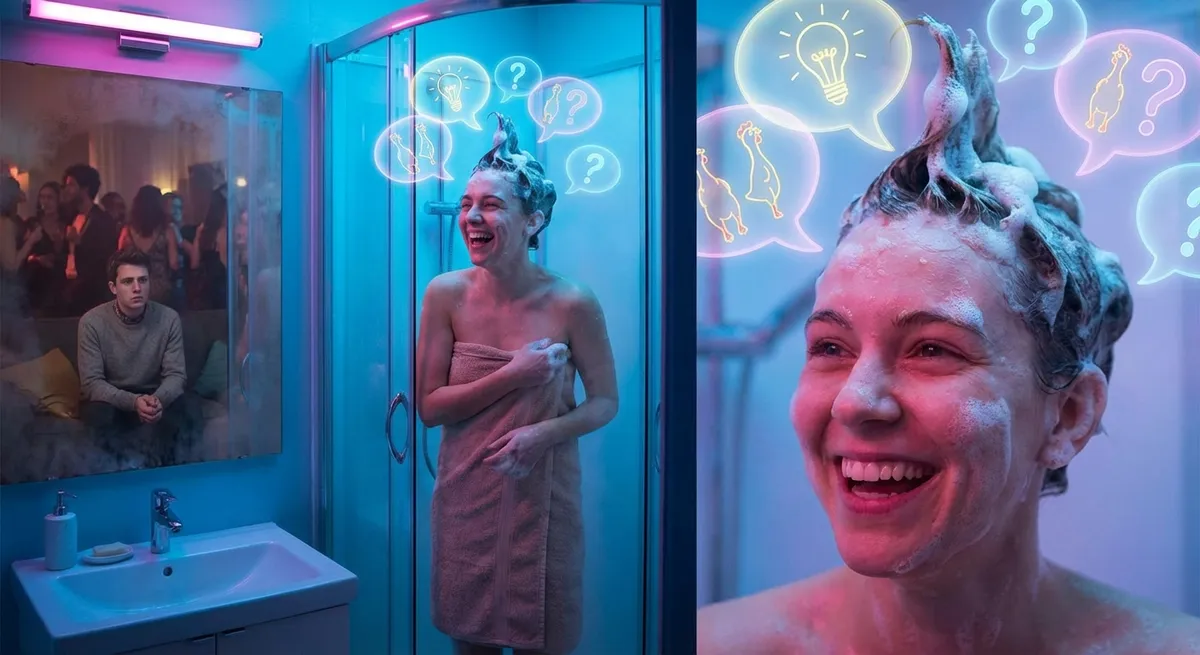
Your shower self? Comedy icon. Your real-life self? Buffering.
Somewhere between the shampoo and the existential crisis, your brain turns into a late-night TV writer with a full staff of imaginary interns. But the second you step out and try that joke on an actual human being, your punchline dies faster than your houseplant.
Let’s expose what’s going on in that weird little skull of yours—and why your “private comedy mode” is secretly elite.
The Shower Is Basically Airplane Mode For Your Brain
Your brain in public: 472 tabs open, 6 are playing audio, 3 are just anxiety.
Your brain in the shower: one tab, no notifications, just vibes and hot water.
Neuroscientists call this the “default mode network”—the part of your brain that kicks in when you’re not focused on anything specific. That’s when random memories, ideas, and cursed thoughts bubble up like bad Wi-Fi.
The result? Your brain finally has the processing power to connect:
“Thing that happened in 3rd grade” + “Meme you saw last night” + “Weird shampoo label copy” = joke.
You’re not suddenly smarter in the shower—you’re just not being emotionally DDoS’d by emails, Slack pings, and the horror of remembering you said “You too” to the waiter who told you to enjoy your meal.
Shareable thought:
“The shower is just offline mode for my brain, and that’s where all the good updates download.”
Your Imaginary Audience Thinks You’re Hilarious (Because It’s You)
In your head, people laugh at your jokes. They clap. They nod thoughtfully. They say, “That’s actually so insightful, wow.”
Out here? They react with the emotional intensity of a loading screen.
When you’re alone, you’re performing for an audience of one—and that audience already knows your references, timing, trauma, and inside jokes. You don’t have to explain context, or worry about being misunderstood. You’re playing on home turf.
So you go for weirder jokes. Darker jokes. Overly specific jokes like:
“If procrastination was an Olympic sport, I’d still wait until the last second to compete.”
No one’s going to cancel you, side-eye you, or say, “I don’t get it.”
The only possible response is you laughing at yourself, which, bonus, your brain reads as a reward.
Shareable thought:
“My problem isn’t that I’m not funny. It’s that my best audience is me, in my own head, on tour in an empty apartment.”
Low-Stakes = High Comedy Power
Trying to be funny in front of people is like trying to unlock your phone while someone watches: suddenly you forget your own name, birthday, and fingers.
Pressure ruins timing. Your brain starts running diagnostics instead of jokes:
- “Was that offensive?”
- “Did they understand the reference?”
- “Why did I just pronounce ‘restaurant’ like it has 19 syllables?”
In private, none of that exists. You’re not scared of bombing because there is no bomb. There’s just you, doing a one-person show no one bought tickets to.
When the stakes are microscopic, your creativity skyrockets. You’ll try dumb wordplays, experimental accents, and niche bits like pretending your toaster is a tiny, overworked dragon.
That fearless, low-stakes energy? That’s the engine of actual good comedy.
Shareable thought:
“If we could bottle the confidence we have alone in our rooms, humanity would ascend to a higher meme-based plane of existence.”
Your Brain Is a Chaos Gremlin That Loves Randomness
Comedy isn’t just “haha funny”; it’s mostly “wait, what?” followed by “oh, okay, that’s why.”
The science version: humor often comes from violating expectations and then resolving the surprise. Your brain is wired to enjoy that little whiplash, like:
Expectation: “He’s going to say something normal.”
Reality: “I would like to unsubscribe from being perceived.”
In your day-to-day life, you’re too busy being functional to chase random thoughts. But in low-effort moments—shower, walking, zoning out while pretending to listen in a Zoom call—your brain finally starts free-associating.
Suddenly:
- Your boss’s annoying email tone = sounds like a medieval town crier.
- Your cat knocking things off a table = tiny God of Chaos demanding tribute.
- Your life plan = Windows update stuck at 7% for six years.
Randomness + pattern recognition = joke fuel.
Your brain loves turning nonsense into “oh wait, that actually tracks.”
Shareable thought:
“My brain during work: 404 humor not found.
My brain during a random walk: ‘What if clouds are just the sky buffering?’”
You’re Accidentally Practicing Your Comedy Reps All Day
You’re low-key running mental stand-up sets constantly:
- Replaying arguments and adding the perfect comeback you didn’t say
- Imagining what you should have texted 2 hours later
- Making up fake interviews where you’re charming, deep, and suspiciously well-lit
That’s rehearsal.
The more often your brain runs through fake scenarios, the better it gets at punchlines, comebacks, and timing—even if the only audience is the shampoo bottle and that one spider in the corner who now knows too much.
By the time you do crack a joke out loud, it might be the 7th draft without you realizing. Your inner monologue is basically a writer’s room that never clocks out.
The issue isn’t that you’re not funny. It’s that your funniest self lives in a time zone called “Five Minutes Too Late.”
Shareable thought:
“I’m not socially awkward—I’m just on a delay. My best jokes drop in the post-game analysis.”
Conclusion
You, reading this, are probably much funnier than your social track record suggests.
Your comedy superpowers show up:
- When you’re alone
- When you’re not trying
- When there’s zero pressure
- When your brain is bored enough to be weird
So next time you roast yourself for not being “the funny one” in the group, remember: you are funny—your brain just prefers limited release, underground venues, and surprise shows in the shower.
If this called you out even a little, you know what to do:
Send it to the friend who always says, “Wait, I just thought of something way funnier I should have said earlier.”
Sources
- [American Psychological Association – The Mind of the Joke](https://www.apa.org/monitor/2010/11/humor) – Overview of psychological research on why we find things funny and how humor works in the brain
- [Scientific American – The Unleashed Mind: Why Creative People Are Eccentric](https://www.scientificamerican.com/article/the-unleashed-mind-why-creative-people-are-eccentric/) – Explores how creativity thrives during mind-wandering and low-focus states
- [Harvard Business Review – Why Your Brain Needs Idle Time](https://hbr.org/2013/07/why-your-brain-needs-more-down) – Discusses default mode network and how unfocused time boosts insight and ideas
- [BBC Future – Why We Have Our Best Ideas in the Shower](https://www.bbc.com/future/article/20130726-why-we-have-ideas-in-the-shower) – Breaks down the science behind “shower thoughts” and relaxed creativity
- [University of Pennsylvania – Humor and the Brain](https://www.med.upenn.edu/cbica/humor-and-brain.html) – Looks at how the brain processes jokes and the neural basis of humor