You know that weird phenomenon where you become a comedy genius in the shower, but the second you dry off, your jokes have the charisma of a wet sock? Yeah, your brain is playing games. Humor isn’t just “being funny” — it’s your brain doing parkour while wearing clown shoes. Let’s peel back the banana peel and look at what’s actually going on when we laugh, cringe, and misquote memes from 2017 like they’re still relevant.
Below are five brain-twisting truths about funny that will either (a) make you feel smart, (b) make you feel seen, or (c) make you send this to your group chat with “omg this is us.”
Your Brain Treats Laughter Like a Tiny Group High-Five
Your brain doesn’t just “enjoy” a good joke; it literally rewards you like a dog that finally sat on command.
When you laugh, your brain releases dopamine — the “you did something good, here’s a cookie” chemical. It also lights up areas associated with social bonding. That’s why an okay joke with your friends is funnier than a Netflix special you watch alone at 2 a.m. while eating cereal straight from the box.
Your brain basically goes: “We laughed together? Congrats, you’re in the tribe. You shall not be exiled to the Awkward Table.” That’s also why inside jokes hit 3x harder — they say, “We share data other humans do not. We are a micro-cult now.”
And yes, this is why that one coworker who keeps sending the same minion meme in the family group chat is technically attempting social bonding. It’s terrible. But it’s science.
Shareable takeaway: Laughing with people is your brain’s way of saying, “I like you enough to show you my weird.”
Cringe Humor Hurts Because Your Brain Thinks It’s Happening To You
When you watch someone bomb a joke so hard the room temperature drops 10 degrees, why does your entire soul fold in on itself?
Because your brain is rude.
Thanks to something called empathy and another thing called mirror neurons, your brain partially simulates what other people are experiencing. When someone embarrasses themselves, your brain fires like it’s YOUR social credit score plummeting in real time.
This is why:
- Secondhand embarrassment videos are both addictive and physically painful
- That memory of something dumb you did in 8th grade still ambushes you in the shower
- You replay every joke you made at a party like a sports commentator analyzing a disastrous game
But here’s the twist: this same system helps you understand humor. Jokes often play with “what should happen” vs. “what did happen.” Your brain is constantly predicting, then glitching when you get the unexpected punchline.
So yes, your overthinking and your sense of humor run on the same hardware. Congratulations, your anxiety and comedy are coworkers.
Shareable takeaway: Cringe hurts because your brain keeps accidentally putting YOU in the scene like it’s method acting.
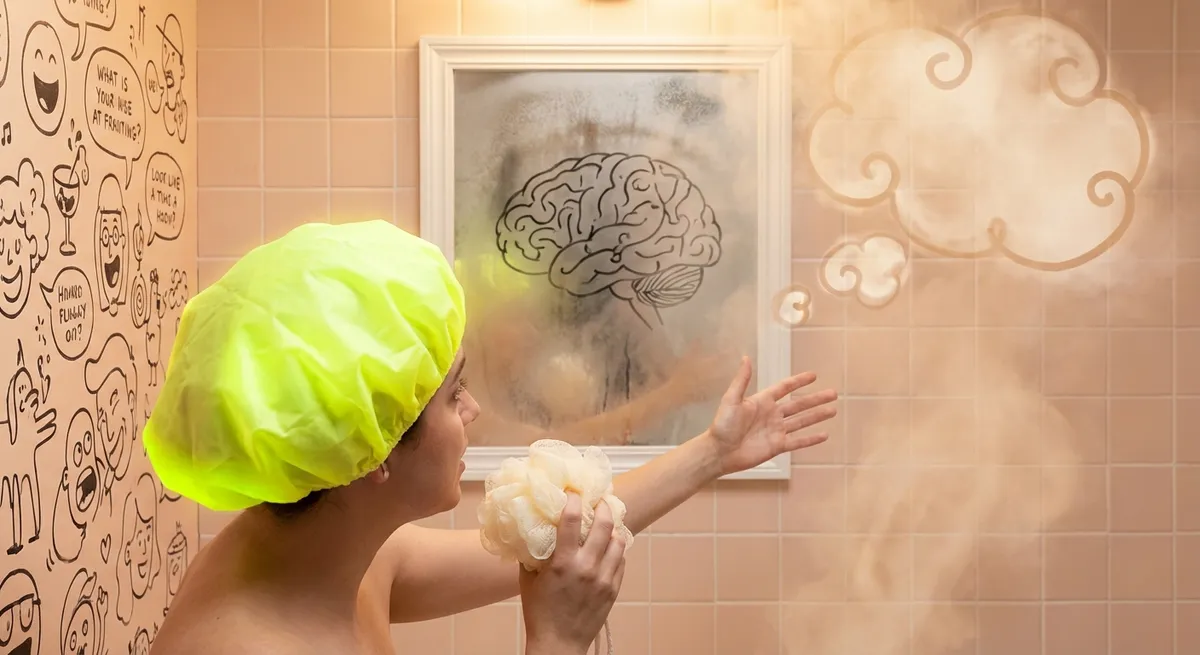
You’re Funnier When You’re A Little Distracted (Hello, Shower Thoughts)
Your best jokes never happen when you’re trying to be funny. They happen when you’re:
- In the shower
- On the toilet
- Staring at the ceiling instead of replying to texts
- Power-walking like an NPC between errands
This is not a coincidence. When your brain is slightly zoned out, a network called the default mode network kicks in — this is basically your brain’s “background creativity mode.” It’s where random connections form between ideas, which is the entire backbone of humor.
Jokes are just:
“Two ideas that shouldn’t go together… now holding hands.”
In the shower, you’re relaxed, not doomscrolling, and not forcing it. Your brain finally gets enough breathing room to serve up, “What if pigeons think humans are the government?” And you’re like, “Wow. Comedy gold.”
The tragedy is that you then try to repeat the joke later like, “So I had this thought… about… birds and, haha… government… uh…” and your brain blue-screens.
Shareable takeaway: Your funniest self is the version of you doing absolutely nothing productive. Tell your boss it’s neuroscience.
Memes Age Faster Than Bananas Because Humor Has Patch Notes
What was hilarious on the internet five years ago now feels like watching cave drawings. Humor evolves at light speed because it’s deeply tied to culture, context, and “you had to be there.”
What was once peak comedy:
- “Arrow to the knee”
- Rage comics
- Vine references your younger cousin doesn’t even recognize
- That one TikTok sound you cannot hear anymore without twitching
But here’s the wild part: scientists actually study jokes, memes, and comedic timing the way tech companies study user behavior. Humor tracks what we care about, what we fear, and how we cope with chaos. Memes are basically cultural MRI scans.
If you ever feel out of touch with “what’s funny now,” it’s not just age — it’s that humor is speedrunning evolution. What you laughed at last year might not land this year because the cultural operating system got an update while you were just trying to make rent.
Shareable takeaway: Memes are just temporary tattoos on the timeline. Funny is always under construction.
Your Sense Of Humor Is a Social Filter (And That’s Good News)
“Sense of humor” isn’t just a dating app checkbox; it’s a compatibility test your brain runs nonstop.
When you laugh at the same stuff:
- You’re revealing similar values, experiences, and boundaries
- You’re signalling what you find acceptable to joke about
- You’re showing how you cope with stress (crying vs. roasting everything vs. both)
Liking the same humor doesn’t just feel good — studies show it can strengthen relationships, reduce conflict, and act like social glue. You’re not just laughing at something, you’re laughing with someone. That tiny “lol” is your brain voting: “Yes, this human can stay.”
On the flip side, if someone’s jokes consistently make you go, “Yikes, jail,” your brain is correctly clocking a mismatch in values. That discomfort is data.
So when you send a meme and someone responds with “THIS IS SO ME,” it’s not just validation — it’s two brains high-fiving through a JPEG.
Shareable takeaway: Your humor is basically a Wi-Fi password. The right people will connect instantly. The wrong ones will time out.
Conclusion
Humor isn’t just a random talent some people are born with; it’s your brain juggling emotion, memory, prediction, and social survival — while tripping over imaginary Legos.
The next time you:
- Laugh so hard you wheeze
- Cringe so hard you want a witness protection program
- Think of a genius joke in the shower and forget it instantly
- Bond with someone over a meme in 0.3 seconds
Remember: your brain is doing Olympic-level gymnastics just to let you experience “haha.” That’s weird. That’s impressive. That’s kind of beautiful.
Now go send this to someone who laughs at the same cursed stuff you do. Your neurons demand it.
Sources
- [Smithsonian Magazine – The Science of Laughter](https://www.smithsonianmag.com/science-nature/what-laughing-does-body-and-brain-180959221/) – Overview of how laughter affects the brain and body
- [Harvard Medical School – The Health Benefits of Humor and Laughter](https://www.health.harvard.edu/healthbeat/give-your-body-and-your-mind-a-burst-of-humor) – Explains psychological and physical effects of humor
- [Scientific American – Why Your Brain Needs Idle Time](https://www.scientificamerican.com/article/mental-downtime/) – Discusses the default mode network and creativity during “zoned out” moments
- [Greater Good Science Center (UC Berkeley) – How Laughter Brings Us Together](https://greatergood.berkeley.edu/article/item/how_laughter_brings_us_together) – Details how shared laughter builds social bonds
- [BBC Future – The Complicated Truth About Cringe](https://www.bbc.com/future/article/20221111-the-psychology-of-cringe) – Explores why secondhand embarrassment and cringe feel so intense