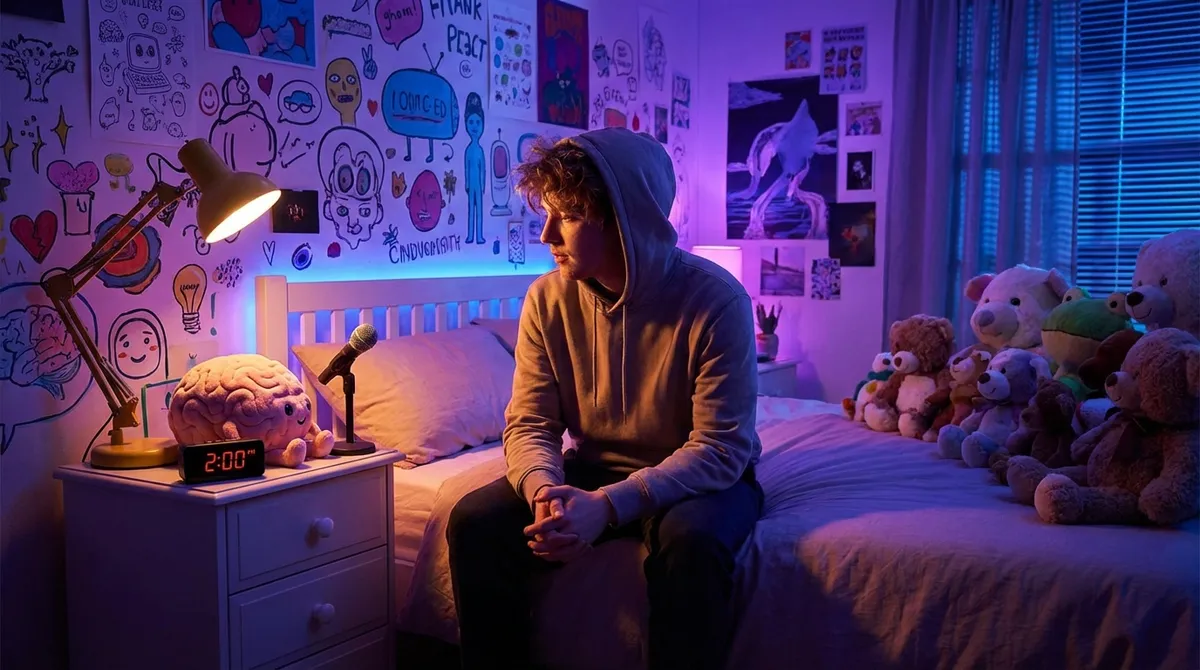
You know that moment: it’s 2 a.m., you’re supposed to be asleep, and suddenly your brain is like, “What if pigeons think humans are on parole?” Congratulations, your mind has clocked in for the night shift at the Comedy Club You Never Asked For.
This is your unofficial guide to the chaotic, deeply unserious side of human brains—and why your weirdest thoughts are also your funniest, sharable, and accidentally relatable content.
Your Inner Narrator Is Doing Improv Without Permission
Somewhere between “I should go to bed early” and “why do we have toes,” your inner voice turns into a sleep-deprived improv actor with zero supervision.
Your brain loves patterns and stories, so when nothing’s happening—no emails, no notifications, no responsibilities—it just… starts making stuff up. That shower argument you won in 2018? That’s your brain workshopping new material. That sudden memory of something embarrassing you did in 7th grade? That’s an unsolicited rerun with director’s commentary.
The wild part: this nonsense is actually your creativity stretching. Psychologists suggest that mind-wandering helps with problem solving and idea generation. You’re not just lying awake spiraling; you’re technically in a brainstorming session where the theme is “What if my cat pays taxes?”
Your brain at 2 a.m. isn’t broken. It’s just unsupervised—and weirdly good at comedy.
The “What If” Glitch That Turns Anxiety Into Sitcom Plots
You know how your brain loves to hit you with “What if you trip in front of everyone?” right before you walk into a room? That’s your built-in security system… with a flair for drama.
The same mental mechanism that helps humans imagine danger also casually invents worst-case scenarios that sound like rejected Netflix pilots:
- “What if I wave back at someone who wasn’t waving at me?”
- “What if I accidentally like a photo from 2013?”
- “What if I call my teacher ‘mom’ in a meeting… as an adult?”
Anxiety thoughts are basically fanfiction starring you, but written by a writer’s room that is severely over-caffeinated.
Here’s the twist: when you catch those scenarios, label them as over-the-top, and laugh at them, you’re actually doing a real mental health move. CBT therapists literally teach people to notice and challenge absurd thoughts. You roasting your own brain is low-key a coping strategy.
You’re not just cringing at your imaginary disasters—you’re editing the script.
The Universe Gave Us Miscommunication So We’d Have Stories
Some of the best unintentional comedy comes from the moments where your mouth and your brain are clearly on different Wi‑Fi networks.
Examples your brain refuses to let you forget:
- Saying “You too” to the waiter who said “Enjoy your meal.”
- Calling your teacher “mom,” “dad,” or worse, using your pet’s name.
- The Zoom era classic: being very sure you’re muted. You are not.
Human communication is extremely advanced, but also held together by guesswork and vibes. We read facial expressions, tone of voice, and body language—and then hope we didn’t wildly misinterpret all of it like a raccoon trying to use a smartphone.
Neurologically, we’re wired to detect social mistakes because it helps us survive in groups. Emotionally, that means your brain will send you a push notification about something awkward you did eight years ago while you’re just trying to enjoy a sandwich.
The silver lining: every social glitch becomes a story your friends want to hear. Your embarrassment is their entertainment. It’s the social circle economy.
Group Laughter Is Basically a Multiplayer Brain Hack
Laughing alone at your phone = fun. Laughing with other people until you can’t breathe = full system upgrade.
When you laugh with a group, your brain releases feel-good chemicals (endorphins), lowers stress hormones, and helps you bond faster than a team-building workshop with trust falls and name tags. Your body doesn’t care if you’re laughing at an expertly crafted joke, an unhinged meme, or someone saying “no worries if not” in the least chill email ever written.
That’s why the most random stuff goes viral:
- A goose attacking a camera like it’s on a personal mission.
- A badly translated sign that reads like a cry for help.
- A stock photo of people high-fiving with the intensity of a Marvel battle.
You share it, your friends share it, and suddenly we’re all collectively losing it over the same four-second video. That’s not just entertainment—that’s social glue.
Your group chat isn’t just procrastination. It’s a DIY mental health support network powered by unhinged TikToks and badly timed screenshots.
Your Cringe Memories Are Secretly Comedy Gold
Your brain loves to rerun your most awkward moments in 4K Ultra HD:
- That time you said “You too” when the dentist said, “See you in six months.”
- That karaoke performance where you confidently sang the wrong chorus. Twice.
- That joke nobody laughed at, but your brain did—relentlessly—for years.
Here’s the plot twist: what used to be pure mortification almost always becomes funny with time. Psychologists call this “benign violation”—when something was wrong or awkward, but now feels safe to laugh at. The danger has passed; only the comedy remains.
The exact memory that makes you want to teleport into the sun? That’s the story that will absolutely destroy at brunch. It’s sharable, relatable, and better than half the stuff on streaming platforms.
Your cringe archive is just your future comedy special in draft mode.
Conclusion
Your brain is a chaotic, overdramatic, semi-feral little creature that:
- Writes disaster fanfic about your life
- Replays your worst moments like they’re Oscar-winning cinema
- Turns silent moments into open-mic nights
- And still somehow helps you connect, cope, and create
The next time your brain serves you a weird 2 a.m. thought like, “Do fish know they’re wet?”, don’t fight it. Screenshot the nonsense (mentally or literally), send it to someone who gets it, and let the group chat do its sacred work.
You’re not just overthinking—you’re accidentally generating premium comedy content.
Sources
- [American Psychological Association – The benefits of laughter](https://www.apa.org/monitor/2016/12/humor-health) - Explains how humor and laughter affect stress, mood, and social connection
- [Mayo Clinic – Stress relief from laughter? It’s no joke](https://www.mayoclinic.org/healthy-lifestyle/stress-management/in-depth/stress-relief/art-20044456) - Breaks down the physical and mental health effects of laughing
- [Harvard Business Review – The secret to people who love their jobs](https://hbr.org/2014/11/the-secret-to-people-who-love-their-jobs) - Includes discussion on play, fun, and humor as powerful social and workplace tools
- [NIH / NCBI – Humor, laughter, and those funny feelings](https://www.ncbi.nlm.nih.gov/pmc/articles/PMC6124999/) - Research review on how humor and laughter are processed in the brain
- [Greater Good Science Center – How laughter brings us together](https://greatergood.berkeley.edu/article/item/how_laughter_brings_us_together) - Explores how shared laughter strengthens social bonds and group cohesion