
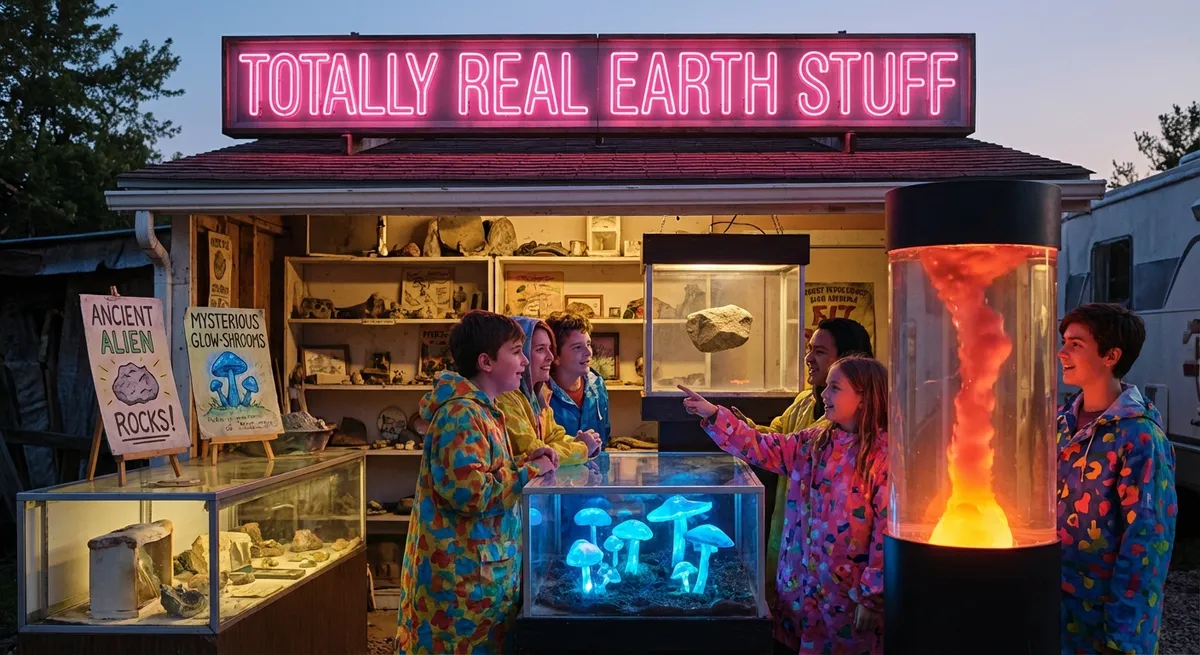
Somewhere between “the ocean is deep” and “taxes are confusing” lies the truly cursed category of knowledge: stuff that sounds made up, but science swears it’s real. These are the facts you read, blink twice at, then immediately send to three friends with, “HOW IS THIS LEGAL.”
Welcome to that rabbit hole.
The Planet That Officially Rains Glass (Sideways)
Imagine a world where the weather report is like, “Today’s forecast: glitter apocalypse.”
Meet exoplanet HD 189733b, a delightful hell-sphere where it literally rains glass. Sideways. At thousands of miles per hour.
This planet is a gas giant, orbiting so close to its star that its atmosphere is a chaotic mess of scorching heat and violent winds. The air is loaded with tiny particles of silicate (aka glass ingredients), and at just the right temperatures, those particles condense and fall like glass rain. And because the winds scream around the planet at insane speeds, it doesn’t even fall straight down. It whips horizontally like nature’s most aggressive exfoliation treatment.
So somewhere out there, there is a world that is basically a blender made of sky, and we casually call it “an exoplanet” like it’s not the universe’s rage room.
Share this with someone who complains about “bad weather.”
There’s A Fungus That Can Turn Ants Into Full-On Zombie Minions
If you thought zombies were just for Netflix and people who don’t moisturize, biology would like a word.
Enter Ophiocordyceps unilateralis, a real fungus that infects ants and hijacks their tiny bug brains. Once infected, the ant stops living its normal ant life and instead climbs up vegetation, locks its jaws onto a leaf or twig, and… just stays there. This “death grip” position is perfect for the fungus, which then grows out of the ant’s body like nature’s most disrespectful umbrella and releases spores onto other ants below.
The fungus doesn’t just kill the ant. It puppets it into the ideal place to spread itself, like some horrifying micro-manager that literally lives in your skull.
So yes, zombies exist. They’re just small, crunchy, and deeply controlled by mushroom software.
Tag your most “easily influenced” friend, lovingly.
You’re Currently Sharing Your Body With Trillions Of Tiny Roommates
You are not a person. You are a very complicated Airbnb for microbes.
Your body hosts trillions of bacteria, viruses, and fungi—collectively known as your microbiome. There are more microbial cells on and in you than there are actual human cells. You are, statistically, mostly not you. Just a walking, talking ecosystem with a Wi-Fi password.
These microscopic roommates help you digest food, train your immune system, and may even influence your mood and behavior. Some studies suggest your gut bacteria can affect anxiety, cravings, and how your brain processes certain signals. So when you suddenly want three tacos and a nap, that might not be “you.” That might be Steve, the bacterium, making executive decisions.
You are a flesh apartment full of microscopic drama and no one is paying rent.
Send this to someone who says “I’m not like other people.”
Correct: they’re about 50% bacteria.
The Ocean Has A Layer Where Sound Gets Trapped Like An Auditory Basement
The ocean isn’t just deep and mysterious—it’s weirdly good at long-distance audio.
There’s a part of the ocean called the SOFAR channel (short for “Sound Fixing and Ranging”), where sound can travel ridiculously far—like, across entire oceans. Think of it as the ocean’s built-in hallway for sound, where the temperature and pressure are just right so sound waves get refracted back into this layer instead of escaping upward or downward.
Military submarines use this layer to send and detect sounds over massive distances, and scientists have recorded things like whale songs and mysterious booms traveling for hundreds, even thousands of kilometers. It’s basically the sea’s group chat, but with better reach and dramatically fewer memes.
So yes, whales might be vibing to each other’s live concerts from across the ocean, and we’re here arguing over Bluetooth pairing.
Share this with someone who refuses to use headphones in public.
Lightning Can Make “Ghost Mushrooms” Glow In The Dark (Sort Of)
Nature looked at glow sticks and said, “Cute. Watch this.”
Bioluminescent mushrooms are a thing. Certain fungi, like Omphalotus nidiformis in Australia (aka the “ghost fungus”), can glow in the dark thanks to chemical reactions in their cells. They create an eerie green light that looks like someone installed a haunted nightlight in the forest.
Now toss in lightning: when storms hit, they can knock down trees and damage wood, creating perfect real estate for these glowing fungi to grow. You end up with forest scenes that look like an indie horror game—fallen branches softly glowing, like nature activated “spooky mode.”
The wild part: scientists think bioluminescence in fungi may help attract insects, who then help spread spores, turning the night sky into a fungal marketing campaign.
Tag the friend who would 100% go on a midnight “haunted mushroom hike” for the vibes.
Conclusion
The universe is out here doing DLC-level nonsense—glass rain, zombie ants, glowing mushrooms—and we’re just struggling to remember our passwords.
The fun part? Every time you think, “Okay, that has to be the weirdest thing,” science politely clears its throat and says, “About that…”
So the next time life feels boring, remember:
- Space is throwing sideways glass.
- Mushrooms are running ant horror stories.
- You’re a shared apartment for microbes.
- The ocean has a secret sound tunnel.
- Forests can literally glow like a low-budget fantasy movie.
You are living in the strangest possible timeline. Please share responsibly.
Sources
- [NASA Exoplanet Exploration – HD 189733b](https://exoplanets.nasa.gov/exoplanet-catalog/1863/hd-189733-b/) - NASA overview of the glass-rain exoplanet and its extreme weather
- [Smithsonian Magazine – The Zombie Ant Fungus](https://www.smithsonianmag.com/science-nature/zombie-ant-fungus-180974547/) - Explains how Ophiocordyceps turns ants into “zombies”
- [Harvard T.H. Chan School of Public Health – Microbiome](https://www.hsph.harvard.edu/nutritionsource/microbiome/) - Detailed breakdown of the human microbiome and its effects on health
- [NOAA – The SOFAR Channel](https://oceanexplorer.noaa.gov/facts/sofar.html) - Describes how sound travels through the SOFAR channel in the ocean
- [PNAS – Bioluminescence in Fungi](https://www.pnas.org/doi/10.1073/pnas.0913089107) - Research article on how and why certain mushrooms glow in the dark