You know those people who wake up at 5 a.m., drink lemon water, journal, run a casual marathon, and answer emails with “Per my last message…” like they’re the CEO of Time Management?
Yeah. This is not that.
This is for the rest of us: the people whose “morning routine” is mostly screaming internally and bargaining with the snooze button like it’s a hostage negotiator.
Welcome to tiny, slightly chaotic life hacks that are actually doable, mildly unhinged, and somehow… work.
The “Future Goblin You” Hack (Trick Yourself With Stupidly Easy Setups)
Stop trying to be disciplined. You are not a productivity robot; you are a raccoon with Wi‑Fi.
Instead, design your environment so Future You has no choice but to cooperate:
- Put your gym clothes in the bathroom, so you literally have to move them to use the sink. You will be personally attacked by your own leggings until you put them on.
- Leave a full water bottle on your pillow every morning before you leave. At night, you must yeet it to the side or drink it. Either way, hydration is happening.
- Store “annoying but necessary” things exactly where you rage about them. Always need scissors at the Amazon box graveyard by your door? Scissors now live there. They have moved out of the kitchen. Accept this.
- For tasks you hate (calling the dentist, dealing with customer service), keep a sticky note on your desk that just says: “Annoying Call = Permission To Scroll After.” Bribery works. You are both the parent and the feral child.
You’re not building habits; you’re building ambushes for your own laziness. And they’re surprisingly effective.
The “Two-Minute Chaos Sweep” (Minimal Effort, Maximum Illusion Of Having It Together)
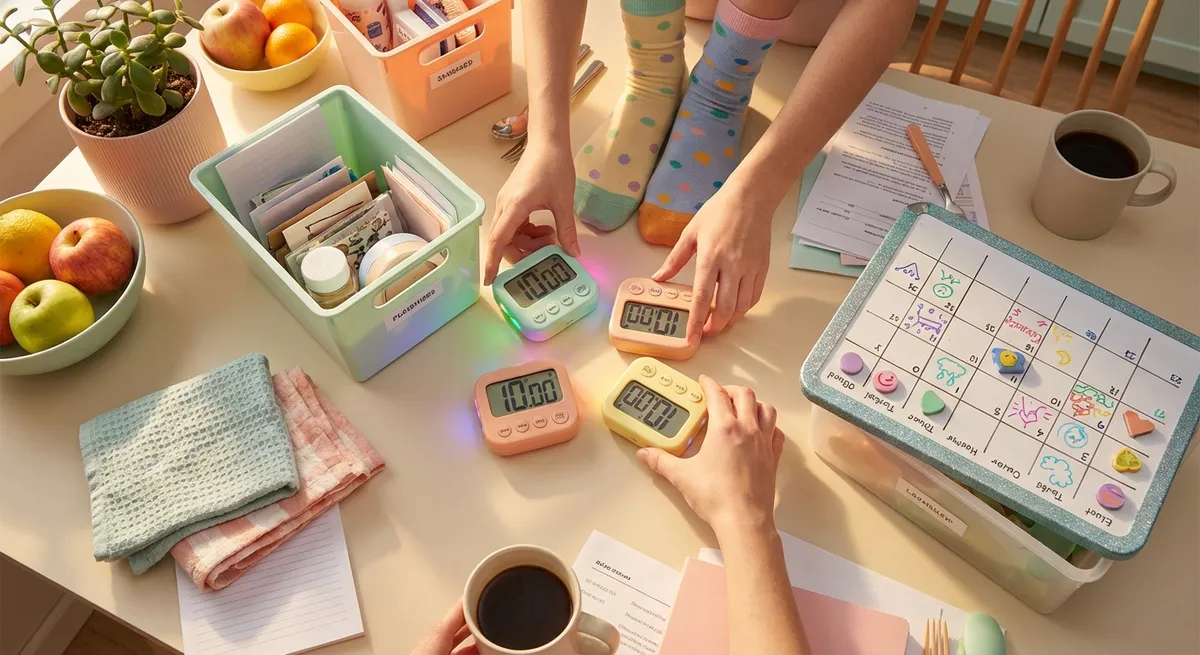
Trick people (and yourself) into thinking your life is in order with a daily two-minute chaos sweep. You set a timer. You do not go past the timer. That’s the rule. We are not accidentally deep-cleaning the garage at 11:47 p.m. again.
What you do in those two minutes:
- Grab any visible trash in the room you’re in and throw it away. Crusty receipts, snack wrappers, that one envelope you’ve been emotionally avoiding because it “looks official.”
- Return exactly three items to where they should live. Keys, charger, rogue cup, random shoe that’s been in the hallway for 9 business days.
- Wipe one surface that’s borderline embarrassing. Desk, counter, nightstand of shame. One swipe, not an exorcism.
The magic: two minutes is short enough that your brain doesn’t start a union, but long enough that your space slowly stops looking like “crime scene of a tornado.” Do this once a day and in a week your room will be 40% less chaotic, and you won’t even remember trying.
Bonus: extremely shareable before/after pics with the caption:
“Did I get my life together? No. But my desk no longer reflects my internal turmoil and that’s character development.”
The “NPC Script” For Social Stuff You Keep Messing Up
If your brain crashes like Windows 98 every time someone says, “So, how’ve you been?” this one’s for you.
Pre-write NPC dialogue (a.k.a. default scripts) for common human interactions so you don’t have to improvise your way into social disaster.
Examples:
- When someone asks, “How are you?”
Default line: “Running on caffeine and vibes, how about you?”
Light, funny, human. No oversharing your entire life spiral at the grocery store.
- When you forgot to reply to a text for 4 business days and three emotional breakdowns:
“My phone became a chaos vortex and I just escaped. Anyway—” continue as if you did not vanish into the void.
- When dodging a plan you don’t have energy for:
“That sounds fun but this week is a bit overloaded for me—can we rain check?”
Boom. Boundary set. No fake excuses about “helping your cousin move” again.
- When networking or meeting new people:
“So what chaos are you working on these days?”
It’s weird but in a good way. People laugh and actually answer.
Write 3–5 scripts in your notes app and treat them like cheat codes you can copy-paste. Your anxiety doesn’t need to freestyle every conversation.
The “Brain Lag Bookmark” (Stop Losing Your Place In Life)
You know when you’re in the middle of something, then get distracted, and suddenly you’re standing in the kitchen holding a spoon like, “What was I doing?” Same.
Enter: Brain Lag Bookmarks — tiny notes that tell Future You what the heck was happening.
How to use them:
- When you stop a task, write a one-line note: “Halfway through emailing boss, need to attach PDF + check date.”
- Leave it right on your keyboard, on top of your journal, or as the first line in a doc: “Next: finish section on potatoes being suspiciously versatile.”
- For chores: “Laundry: clothes are in washer, need to dry by 8.” Put this on the door, your phone, or directly on your soul.
This helps because your working memory is not a hard drive; it’s a goldfish with anxiety. When you come back, instead of reloading the entire mental file, you just read the bookmark and hit play again.
Bonus chaos upgrade: use the most dramatic phrasing possible.
“YOU WERE DOING: TAXES. DO NOT FLEE AGAIN.”
Ridiculous, but effective.
The “Low Battery Mode” Plan (Pre-Approved Lazy Version Of Your Day)
Some days your brain wakes up, checks its internal battery, and it’s like: “Best I can do is 13% and one (1) functioning neuron.” Cool. That doesn’t mean the whole day has to be a write-off.
Create a Low Battery Mode version of your life where everything is set to “bare minimum but still counts.”
Examples:
- Movement: No 45-minute workout. Low Battery Mode = walk around the block once while listening to a podcast where two strangers yell about movies you haven’t seen.
- Food: Not a perfect meal. Low Battery Mode = something that grew from the ground + something with protein + something that makes you happy. Carrots, eggs, and a cookie? Balanced, scientifically (don’t quote me).
- Hygiene: Full routine is dead. Low Battery Mode = brush teeth, deodorant, face wipe. You are no longer a swamp creature. Victory.
- Work/Study: No “crush the to-do list” nonsense. Low Battery Mode = pick one thing you’ll be weirdly proud of finishing and do just that.
Having this plan pre-decided means when your energy is trash, you don’t have to negotiate with yourself. You just flip to “Power Saver” and move on.
Also incredibly shareable as a post:
“Welcome to Low Battery Mode. I brushed my teeth, answered one email, did not vanish into the forest, and that’s enough today.”
Conclusion
You do not need a 47-step morning routine, a color-coded fridge, or a bullet journal that looks like an art exhibit.
You just need:
- A few petty traps for your own bad habits
- Two minutes of weaponized tidying
- Social scripts so your brain doesn’t blue-screen mid-conversation
- A note that reminds you what you were doing before your attention span combusted
- And a Low Battery Mode that lets you exist on your worst days without fully disintegrating
You’re not “getting your life together.” You’re just upgrading from “absolute chaos” to “functional chaos,” which is way more realistic—and way more shareable.
Now go set a two-minute timer, move one object, and then aggressively brag about it on social media like you just rebuilt society from scratch.
Sources
- [American Psychological Association – Willpower and Self-Control](https://www.apa.org/helpcenter/willpower) – Explains why relying purely on willpower is fragile and how environment design can help
- [Harvard Business Review – Building Better Habits](https://hbr.org/2019/08/to-build-good-habits-start-by-understanding-your-behavior) – Breaks down how small behavioral tweaks and cues support consistent habits
- [NPR – Why Clutter Feels Overwhelming](https://www.npr.org/sections/health-shots/2019/12/31/791639823/why-decluttering-is-so-hard-and-how-to-make-it-easier) – Discusses the impact of clutter on stress and simple ways to reduce it
- [Mayo Clinic – Stress Management and Self-Care Basics](https://www.mayoclinic.org/healthy-lifestyle/stress-management/in-depth/stress-relief/art-20044464) – Covers practical, small daily actions that improve mental well-being
- [Cleveland Clinic – Decision Fatigue Explained](https://health.clevelandclinic.org/decision-fatigue) – Describes how pre-deciding routines (like Low Battery Mode) reduces mental overload