
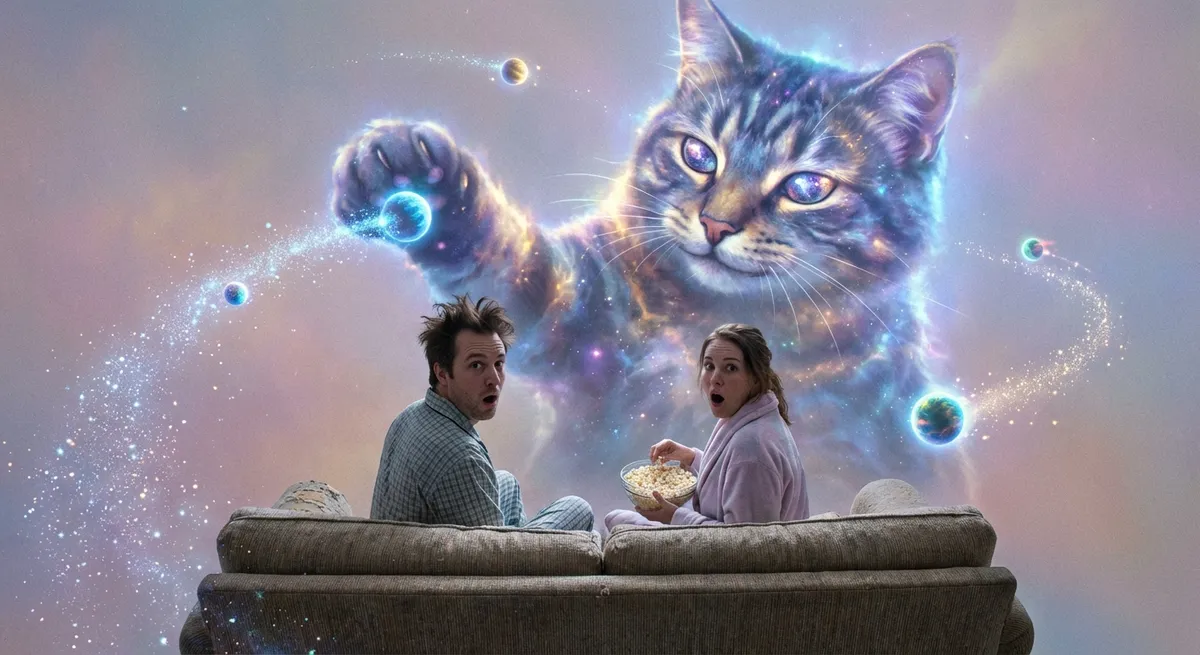
Some facts are majestic. Black holes, galaxies, the speed of light—very “documentary voiceover.”
Then there are the other facts. The ones that feel like the universe is subtweeting you specifically. The ones you read and think, “Why does this sound like an oddly targeted insult?”
Welcome to the petty side of reality: 5 deeply weird facts that feel like they’re calling you out, your life choices, and your browser history.
1. Your Phone Is Dirtier Than A Toilet Seat (Yes, Your Phone. That One.)
Let’s start with the emotional damage: your phone is, statistically, disgusting.
Multiple studies have found that smartphones can carry more bacteria than toilet seats. Toilet seats, it turns out, get cleaned. Your phone? It gets dropped on the floor, taken to the bathroom, thrown on your bed, pressed to your face, and occasionally licked by a passing pet who has no respect for personal boundaries.
And still, we stare at it for hours, press it against our cheeks, and then say things like, “I don’t really get sick that often” as if we are not regularly holding a pocket-sized germ festival.
Add in the fact that we touch our phones hundreds to thousands of times a day, and you’ve essentially been in a committed relationship with a tiny, glowing Petri dish.
On the bright side, if you’ve survived this long, your immune system is probably out here bench-pressing twice its body weight.
2. Bananas Are Radioactive And So, Apparently, Are You
Bananas: friendly, yellow, portable, emotionally supportive snack.
Also: mildly radioactive.
Bananas contain potassium, and a small percentage of that is potassium-40, a naturally occurring radioactive isotope. Eat a banana, and you technically increase your radiation exposure. Is it dangerous? No. You’d have to eat millions of bananas in a short time to be in trouble—at which point your biggest issue is not radiation, it’s life choices.
Radiation scientists even joke about a “banana equivalent dose,” which is exactly what it sounds like: measuring radiation in how many bananas-worth you’ve absorbed. Nuclear safety report? Very serious. Example? “This is about ten thousand bananas of radiation.” Somehow reassuring, somehow not.
But here’s the weirdest twist: you are also slightly radioactive. Your body contains carbon-14 and potassium-40 too. You, reading this, are a softly glowing meat lantern of atomic decay.
You’re not just a person—you’re a snack that fights back, scientifically.
3. Lobsters Technically Don’t Age Out… They Just Eventually Malfunction
Lobsters are the chaotic-neutral cryptids of the seafood world.
Unlike humans, who slowly crumble like expired bread, lobsters don’t appear to age in the normal way. They don’t get weaker with time; they keep growing, can stay fertile, and show no obvious signs of aging. Inside them is an enzyme called telomerase that helps repair DNA and keep cells from breaking down like they do in us.
This sounds immortal and majestic until you realize the universe cannot allow anything to be too cool.
The catch: as lobsters get bigger, it takes more and more energy to molt—shedding their old shell and growing a new one. At some point, it becomes so exhausting and risky that they die from molting issues, disease, or just existing as an overachieving sea bug for too long.
So lobsters are basically the friend who refuses to slow down, works three jobs, goes to the gym twice a day, and then one day just collapses because the “hustle” caught up.
Immortality: not actually a vibe. More like a glitch the universe patches via exhaustion.
4. Octopuses Can Taste With Their Arms And Honestly That’s A Lot
Octopuses are already suspicious. Too many brains (they have a central brain and neuron-packed arms), too good at puzzles, and they escape aquariums like it’s a prison break movie.
But also: their arms can taste.
Each sucker on an octopus’s arm has chemoreceptors that let it “taste” what it’s touching. Imagine picking up a potato chip and instantly knowing the brand, flavor, factory location, and whether it’s worth your time—through your fingertips.
Even more chaotic: their arms are semi-autonomous. They can move, explore, and react with a lot of local control, like eight little independent interns attached to your body, constantly touching stuff and sending extremely detailed sensory reports.
Meanwhile, you’ve absolutely put your AirPods through the washing machine twice and forgot where you parked last week.
Octopuses: “I can open jars, mimic textures, solve mazes, taste with my arms.”
Humans: “I turned the microwave on for 3 minutes instead of 30 seconds and now my food is the surface of the sun.”
5. Tardigrades Can Survive Space, Boiling, Freezing… But You? No.
Tardigrades, also known as water bears or moist stress beans, are microscopic creatures that look like someone rendered a baked potato in 3D and gave it legs.
They can:
- Survive in outer space
- Withstand temperatures from just above absolute zero to well above boiling
- Handle insane pressures
- Chill through radiation levels that would absolutely delete you from existence
When things get bad, tardigrades go into a dried-out form called a tun, basically hitting the “save game, exit to main menu” button on life until conditions improve. Then they rehydrate and keep going like nothing happened.
Meanwhile, you drink slightly old coffee and your entire day is ruined.
Scientists have literally fired tardigrades out of guns, frozen them, dehydrated them, exposed them to the vacuum of space—and they still come back like, “That was wild, what’s for lunch?”
You: one bad night of sleep and you’re useless.
Tardigrade: survived planetary-level catastrophe in a mud puddle and is ready for round two.
Conclusion
Reality is out here doing stand-up comedy with the laws of physics and biology:
- Your phone is a germ rave.
- Your snack is radioactive.
- Lobsters are almost immortal but die of being too extra.
- Octopuses are eight-armed flavor detectives.
- Tardigrades are tiny apocalypse-proof potatoes.
And yet, you are the one stressing over whether you used the right emoji in that text.
If this made you feel personally attacked in a strangely educational way, congratulations—you’ve just experienced the correct response. Now go clean your phone, eat a banana, respect the octopus, and emotionally accept that a microscopic water bear could out-survive you in every scenario.
Then send this to a friend so they can be equally disturbed and entertained. Sharing is caring. And also, slightly radioactive.
Sources
- [BBC Future – How dirty is your phone?](https://www.bbc.com/future/article/20160225-how-dirty-is-your-phone) – Explains bacterial contamination on smartphones compared to common surfaces
- [U.S. Nuclear Regulatory Commission – Fact Sheet on Background Radiation](https://www.nrc.gov/reading-rm/doc-collections/fact-sheets/background-radiation.html) – Covers banana equivalent dose and everyday radiation exposure
- [Smithsonian Magazine – Are Lobsters Immortal?](https://www.smithsonianmag.com/smart-news/are-lobsters-immortal-162393563/) – Discusses lobster aging, telomerase, and why they don’t actually live forever
- [Scientific American – Ask the Experts: Octopus Arms](https://www.scientificamerican.com/article/how-do-octopus-arms-work/) – Details how octopus arms function, including sensory and neural capabilities
- [NASA – Tardigrades in Space](https://www.nasa.gov/feature/goddard/2015/tardigrades-survive-boiling-ice-and-radiation) – Describes tardigrades’ extreme survival abilities, including tests in space and harsh environments