
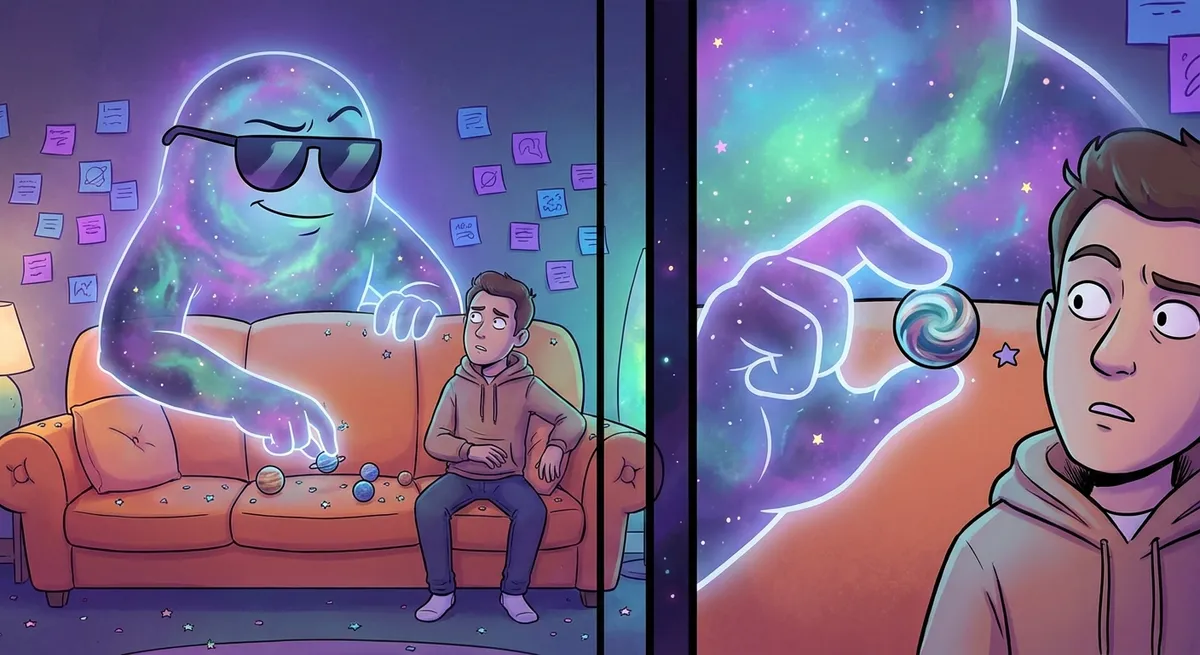
Some facts are like the universe leaning in to whisper, “Hey. You. Yes, specifically you. Watch this.” This is not a normal “fun facts” list. This is the strangely targeted, oddly specific, “why does this feel like a subtweet from reality” edition.
Here are five deeply shareable, screenshot-worthy facts that will make you question everything, including why you’re still drinking that third reheated coffee.
1. Your Brain Can Invent Fake Memories And Then Defend Them Like a Lawyer
Your brain is basically that one friend who’s “pretty sure” they remember what happened, but is actually just improv-ing with confidence.
Psychologists have repeatedly shown that people can be nudged into remembering things that never actually occurred—wrong details, imaginary objects, even entire fake events. Once the memory forms, your brain goes, “Yup. That’s canon now,” and will argue with actual evidence like it’s on a courtroom drama.
This is why siblings have completely different versions of the same childhood, and everyone is somehow convinced they were the one who “never caused trouble.”
Worse, your brain doesn’t even feel guilty. It uses the same regions to recall true memories and false ones, so even neuro-imaging can’t easily tell which of your mental flashbacks are Premium Truth and which are “creative fanfiction of your own life.”
So yes, you might be misremembering that ex as “not that bad.” That’s not growth. That’s your brain running a PR campaign.
2. Bananas Are Radioactive And Nobody Checked Before We Decided They’re a Snack
Bananas: innocent-looking, bright yellow, secretly glowing with the power of mild radioactivity.
They contain potassium-40, a naturally occurring radioactive isotope. It’s harmless in the quantities we eat—but technically, if someone measured your exposure in “banana equivalent doses,” they could track how radioactive your day was based on how hard you went at the fruit bowl.
Nuclear science people literally use the “banana equivalent dose” as an informal, slightly chaotic way to compare tiny amounts of radiation. As in:
- “This thing is about a few bananas’ worth” = “You’re fine, please relax.”
- “This is not in banana units anymore” = maybe don’t lick that.
You would need to eat millions of bananas in one sitting for it to be dangerous—which, realistically, means your cause of death is “life choices” long before “radiation poisoning.”
The universe really said, “Let’s make the snack slightly nuclear, just for drama.”
3. There’s A Point In Flight Where A Plane Is Literally Falling Gracefully
Every time you’re on a plane and it’s cruising smoothly through the sky, you are participating in a very polite, very organized fall.
Planes stay in the air thanks to lift: the wings push air downward, the air pushes back up, and physics goes, “Fine, I’ll allow it.” But in a lot of flight situations—especially gliding—what’s actually happening is controlled falling. The plane trades altitude for forward motion, like a very aerodynamic raccoon jumping off a roof and somehow sticking the landing.
If the engines fail, a commercial plane doesn’t just plummet like a cartoon anvil. Modern aircraft are designed to glide for many miles, losing height slowly while still moving forward. Pilots train specifically to handle this kind of “Okay, so we’re a flying brick now—cool, cool, cool” scenario.
So yes, your vacation is partly powered by gravity, aerodynamics, and the pilot’s ability to negotiate with the sky.
You are not “flying.” You are “falling with paperwork and snacks.”
4. Octopuses Have Three Hearts And Still Ghost Everyone
Octopuses are so weird they seem made up by a writer who got bored of regular animals.
They have:
- Three hearts
- Blue blood (because copper, not iron)
- A brain that spreads through their arms like Wi-Fi
- The emotional energy of “mysterious kid who changed schools mid-year”
Two of their hearts pump blood to the gills; the third pumps it to the rest of the body. When they swim, the main heart literally stops beating, which is part of why they prefer to crawl—swimming is exhausting, emotionally and cardiologically.
They’re also absurdly smart: they open jars, solve puzzles, escape tanks, and have been caught rearranging aquarium equipment for their own amusement. Some have even been observed squirting water at lights to short-circuit them. That’s not just intelligence; that’s office-prank-level spite.
And after all that drama, most octopus species live only one to two years.
Three hearts. Genius-level brains. Vengeful energy. Two-year lifespan.
They are the burnout-prone gifted kids of the ocean.
5. The Moon Is Slowly Leaving Us, Like A Very Polite Breakup
The Moon is not loyal. The Moon is drifting away at about 3.8 centimeters (1.5 inches) per year. That’s roughly the growth rate of a passive-aggressive resentment.
Billions of years ago, the Moon was much closer, the tides were wilder, and nights were probably less “romantic glow” and more “apocalyptic floodlight.” Over time, Earth’s rotation has slowed down and the Moon has been gradually pulling away, like, “It’s not you, it’s orbital mechanics.”
In the far future, our days will get longer, and solar eclipses will eventually stop being dramatic full blackouts and become “slightly underwhelming celestial hat moments,” because the Moon will look too small to fully cover the Sun.
So somewhere out there in cosmic couples therapy, the Moon is calmly explaining: “I still care about you. I just need… space.”
Literally.
Conclusion
Reality is not just strange—it’s petty, theatrical, and kind of hilarious:
- Your memories might be improv.
- Your snack is gently radioactive.
- Your flight is a coordinated fall.
- Octopuses are three-hearted chaos goblins.
- The Moon is slow-fading you.
The universe didn’t have to be this extra, and yet, here we are.
If any of these facts made you go “Wait, WHAT,” that’s your cue to send this to someone else so they can question their bananas, planes, brains, emotions, and the Moon in peace.
Sources
- [American Psychological Association – False memories](https://www.apa.org/monitor/2015/03/false-memories) – Overview of how and why false memories form in the brain
- [U.S. Nuclear Regulatory Commission – Fact Sheet on Natural Background Radiation](https://www.nrc.gov/docs/ML1234/ML12342A051.pdf) – Includes discussion of everyday radiation sources, including foods like bananas
- [NASA – How Do Airplanes Fly?](https://www.nasa.gov/aeronautics/how-do-airplanes-fly/) – Explains the basics of lift, drag, and how aircraft stay in the air
- [Smithsonian Ocean – Octopus Facts](https://ocean.si.edu/ocean-life/invertebrates/common-octopus) – Details on octopus biology, intelligence, and behavior
- [NASA – The Moon is Drifting Away from the Earth](https://solarsystem.nasa.gov/moons/earths-moon/in-depth/) – Describes the Moon’s gradual recession and its effects on Earth over time