
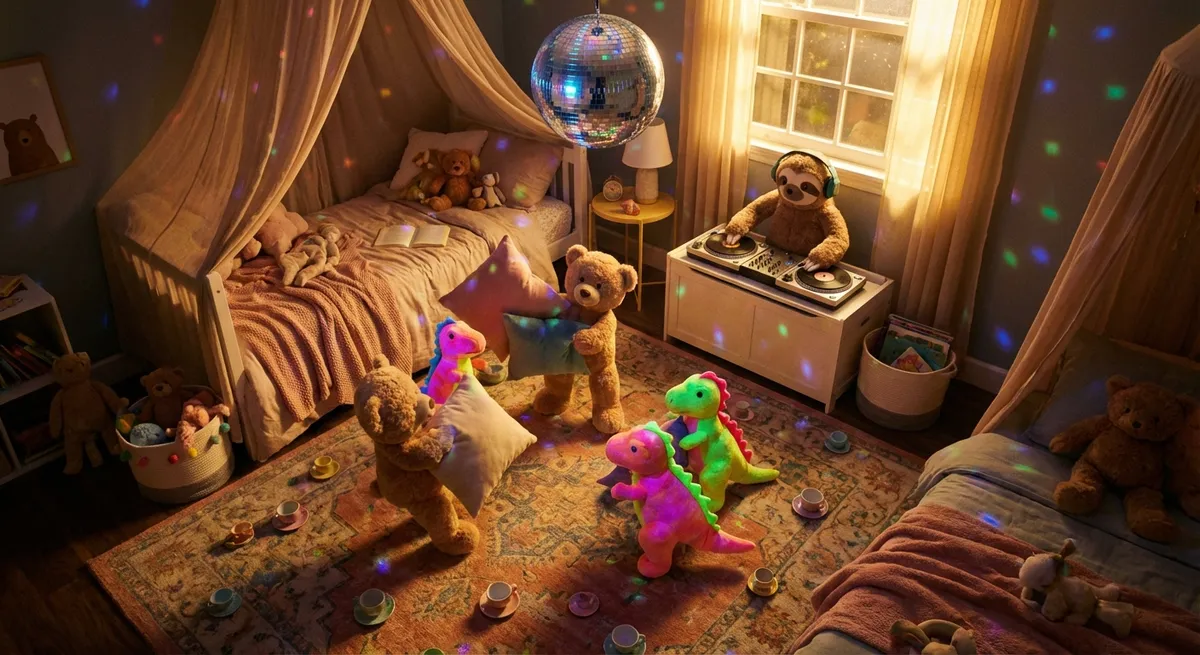
You think you’re just “resting your eyes.” Meanwhile, your stuffed animals are out here running a full-blown soap opera on your bed.
This is a safe space, so let’s admit it: most of us had (or still have) at least one stuffed animal we treated like a tiny, judgmental roommate. Some of us still sleep with them. Some of us have them sitting on a shelf like fuzzy security cameras, silently recording our life choices.
And if you’ve ever walked past your childhood plush and felt oddly… watched… you’re in the right place.
Welcome to the unhinged, extremely unofficial documentary on the secret social life of your stuffed animals.
The Alpha Plush: Why One Stuffed Animal Is Basically The Group Chat Admin
Every stuffed animal collection has That One.
Not necessarily the cutest. Not the biggest. Just the one that somehow became CEO of your emotional support. They get the prime spot on the pillow, the first invite to road trips, the emergency hug duties when life goes off the rails.
At some point, Kid You held up two toys and said:
“Okay, you’re in charge.”
And the plush monarchy was born.
In your imaginary ecosystem, that toy became:
- The one who “talks” to your parents on your behalf
- The unofficial therapist for your other toys (“Don’t worry, Mr. Duck, she still loves you”)
- The voice of reason when you had to decide whether to jump off the couch “just to see what happens”
Fast-forward to now: that same stuffed animal is sitting in your adult bedroom like a fuzzy LinkedIn profile of your childhood. You don’t play with it anymore, but you also refuse to throw it out because it “knows too much.”
Is it normal to ascribe authority to a plush rectangle with eyes? Yes. Absolutely. Psychologists call this “attachment.” We call it “my boss, actually.”
The Night Shift: What Your Stuffed Animals Are Definitely Doing While You Sleep
You: unconscious, drooling, dreaming about running late to an exam you forgot to study for.
Your stuffed animals: starting their shift.
If stuffed animals had a Google Calendar, their nightly schedule would look like this:
- 10:13 p.m. – Emotional Monitoring
Track number of sighs, scrolls on social media, and dramatic “I’m so tired” flops onto the bed. Adjust cuddle radius as needed.
- 11:40 p.m. – Tangle Prevention Patrol
Assigned plush tries to keep your phone from landing directly on your face when you fall asleep mid-scroll. Usually fails, but it’s the effort.
- 2:07 a.m. – Nightmare Defense
Dream turning weird? Enter defensive spooning formation. You wake up clutching your plush like a life preserver, with no memory of assigning it this job.
- 4:26 a.m. – Judging Your Life Choices (Silently)
They watch you open your fifth “just one more” tab on your phone. They say nothing. But they know.
If it feels oddly comforting to imagine your stuffed animals protecting you from 3 a.m. brain chaos, that’s because your brain literally uses familiar, safe objects as anchors. You thought you were just hugging a thing with button eyes; your nervous system thought, “Security update installed.”
The Jealousy Problem: When Your Childhood Plush Meets Your Adult Purchases
Nothing triggers stuffed animal drama like you… upgrading.
One day, you bring home a fancy new throw pillow or a sleek, aesthetic plush you bought “ironically” from an adult store. You plop it down on the bed like it hasn’t just disrupted years of unspoken toy hierarchy.
In the telenovela happening in your head, it goes like this:
- Your OG childhood plush: “So… who is this?”
- New Instagrammable plush: “I’m decorative.”
- OG plush: silently remembering the time it traveled in your backpack for 10 hours so you wouldn’t have a panic attack on a plane.
You try to balance it:
- Rotate who gets the prime spin-cycle spa day in the washing machine
- Alternate cuddle nights, then feel guilty because “they’ll know”
- Accidentally start referring to the new plush as “just a pillow” so your original favorite retains emotional seniority
This is projected emotion 101: your brain is dumping feelings about change, aging, and loyalty onto objects with sewn-on smiles. On the bright side, this means you’re capable of deep attachment… even to things full of polyester stuffing. Which honestly is kind of impressive.
The Emotional Wi-Fi Signal: Why You Still Keep Them Around
At some point you moved out, paid bills, and Googled “how many grams of protein per day is normal.” But that stuffed animal? Somehow survived all the decluttering phases labeled “New Chapter!!”
Minimalism says: “If it doesn’t spark joy, toss it.”
Your stuffed animal says nothing, because it’s literally inanimate.
You: “I would rather move apartments 7 times than abandon this fluffy goblin.”
There’s solid psychology behind this:
- Familiar objects can act like emotional anchors, grounding you during stress
- Tangible, soft things are linked with comfort and safety in your brain
- Nostalgic items can boost mood and reduce feelings of isolation
Translation: your stuffed animal is less “kid thing I never got rid of” and more “wireless emotional support hotspot” that automatically connects when life starts buffering.
You might not talk to them anymore (out loud), but just knowing they’re on the shelf, in the closet, or buried in a moving box somewhere is like having a mental backup plan:
“If it really gets bad, I know exactly which box to open.”
Plot Twist: Your Stuffed Animals Are Low-Key Part Of Your Personality Lore
You think they’re just clutter. But bring someone new into your room and watch how fast those plushies start narrating your origin story.
- The one you won at a carnival? Proof you can perform under pressure with six people yelling “DON’T MISS!” behind you.
- The one that’s missing an eye? You loved it so aggressively that it physically couldn’t cope.
- The one from an ex? Emotional archaeology, Exhibit A.
- The weird, slightly cursed-looking one you bought as an adult because it “spoke to you”? That’s just your inner goblin manifesting in 3D.
Stuffed animals are basically personality footnotes. People clock them subconsciously:
“Oh, you still have that? You must be soft under all that sarcasm.”
“Oh, you’ve got exactly one really old, really worn one? Yeah, that’s your final horcrux.”
They’re not just toys. They’re lore. They’re canon. They’re proof that somewhere underneath all the emails, calendar invites, and “circle back” conversations, a tiny version of you is still very much alive and asking:
“So… we still believe in magic a little bit, right?”
Conclusion
You didn’t just “grow out of” your stuffed animals; you upgraded their role.
They went from co-stars in your imaginary kingdom to quiet guardians of your nervous system, from playtime sidekicks to trivia cards about who you used to be. And honestly? That’s kind of beautiful.
So the next time you catch a glimpse of that slightly faded, slightly lopsided plush on your bed or at your parents’ house, maybe give it a nod. It survived snack crumbs, tears, moving boxes, and at least one haircut crisis. It’s earned its permanent resident status.
And if you still sleep with it?
That’s not weird.
That’s just advanced-level emotional engineering… with button eyes.
Sources
- [American Psychological Association – The power of nostalgia](https://www.apa.org/monitor/2013/11/nostalgia) - Explains how nostalgic objects and memories can boost mood and emotional well-being
- [Verywell Mind – Transitional Objects in Psychology](https://www.verywellmind.com/what-is-a-transitional-object-5187131) - Breaks down why children (and sometimes adults) form strong attachments to comfort objects like stuffed animals
- [Cleveland Clinic – Can a Weighted Stuffed Animal Help With Anxiety?](https://health.clevelandclinic.org/weighted-stuffed-animal) - Discusses how soft, cuddly objects can soothe the nervous system and reduce anxiety
- [Greater Good Science Center (UC Berkeley) – Why We Hold On to Sentimental Objects](https://greatergood.berkeley.edu/article/item/why_we_hold_on_to_sentimental_objects) - Looks at the psychology behind keeping emotionally significant items
- [Smithsonian Magazine – The Secret Lives of Toys](https://www.smithsonianmag.com/arts-culture/the-secret-lives-of-toys-84066450/) - Explores cultural and emotional meanings humans assign to toys and playthings