
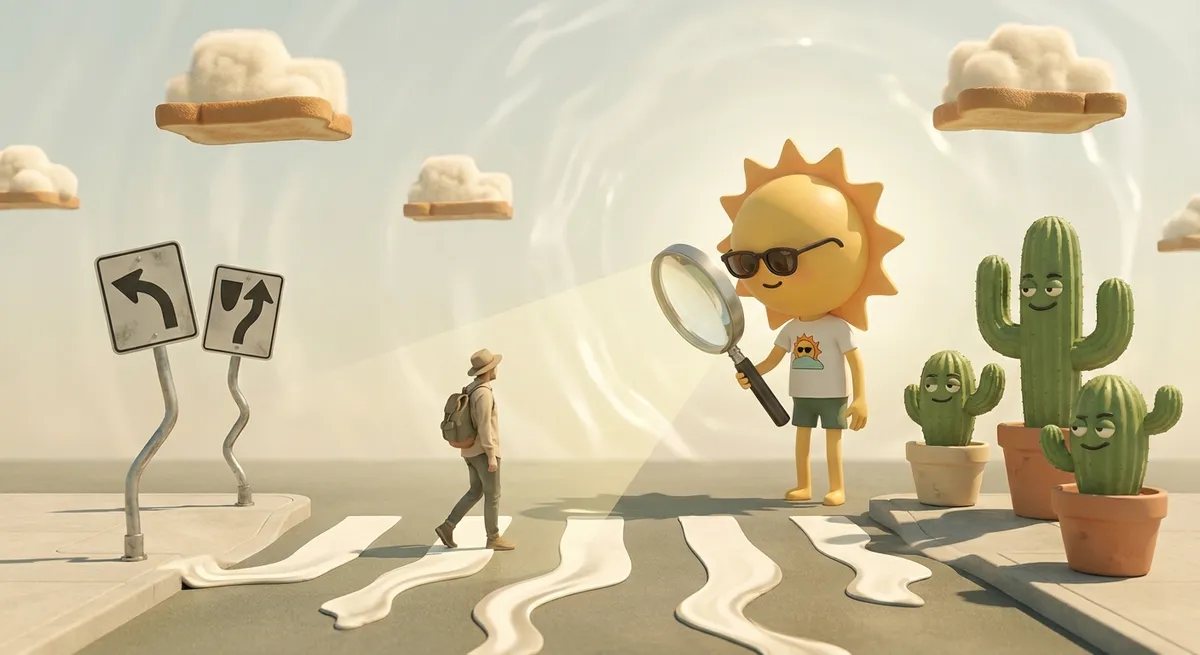
Somewhere between “gravity exists” and “taxes are due,” the universe sprinkled in a bunch of absolutely unnecessary weirdness—purely for the drama. These are the facts that sound fake, feel personal, and will absolutely hijack your next group chat.
Here are five gloriously unhinged bits of reality that prove the planet is low‑key trolling us.
The Moon Is Slowly Leaving You on Read
The Moon is breaking up with Earth. Slowly. Dramatically. Like a toxic situationship that takes billions of years to end.
Because of tidal interactions (yes, the same thing that causes tides and your beach photos), the Moon is drifting away from Earth at about 3.8 centimeters per year. That’s roughly the speed your motivation moves when someone says “team-building exercise.”
We know this because scientists literally lasered the Moon using reflectors left by Apollo astronauts. They fire lasers from Earth, time how long it takes the light to bounce back, and calculate the distance. Which sounds like something a lovesick ex would do: “How far away are you now? Oh. Farther.”
Don’t panic, though. The Moon won’t ghost us completely for billions of years. But every year, night skies get very slightly less dramatic, like the universe is slowly turning down the brightness on the only lamp we didn’t pay for.
Shareable takeaway: The Moon is physically, provably distancing itself from us and honestly? Mood.
Bananas Are Radioactive and No One Stopped Selling Them
Bananas: delicious, convenient, mildly radioactive.
Because they contain potassium—specifically a tiny amount of naturally occurring radioactive potassium-40—bananas emit a teeny bit of radiation. Not enough to do anything, unless your life goal is “become a nuclear power plant made of smoothies.”
Radiation is measured in sieverts, but people jokingly invented the “banana equivalent dose” to explain tiny doses in banana units. Eat a banana? You just consumed about 0.1 microsieverts. Fly on a plane? That’s like eating dozens of bananas in sky fruit energy.
Before you start side‑eyeing your fruit bowl, your body and the environment are full of natural radiation. Bananas are just the drama queen of produce because we decided to use them as a unit of measurement. Apples are somewhere sobbing, wishing they were iconic enough to be used in physics jokes.
Shareable takeaway: You’re technically a slightly radioactive banana‑powered organism and somehow that’s the least weird thing about being alive.
Octopus Brains Are Basically in Their Arms (So Yes, They’re Judging You)
Octopuses are so weird they feel like someone let an alien species sneak into the animal lineup and didn’t do background checks.
First of all, they have three hearts. One heart pumps blood around the body; the other two handle the gills. So your “I gave you my whole heart” line means nothing to an octopus—they’re out here with a backup for their backup.
Second, their nervous system is chaos in a trench coat. About two-thirds of their neurons are in their arms, not their head. Each arm can independently explore, react, and solve problems, which means an octopus tentacle can be investigating a jar, doing the equivalent of a Rubik’s cube, while the rest of the octopus is busy plotting an escape from the aquarium.
They can recognize individual humans, remember who annoyed them, and have been known to squirt water at people they dislike. So yes, an animal that is essentially a wet, sentient anxiety blob with suction cups might be holding a grudge against you.
Shareable takeaway: There’s a creature with three hearts and eight semi‑independent arms that can remember your face and might hate you personally—and it lives in the ocean like that’s normal.
Your Stomach Dissolves You, So It Constantly Rebuilds Itself
Your own body is so dramatic it has to protect itself… from itself.
The acid in your stomach is strong enough—chemically speaking—to dissolve metal under the right conditions. It’s mostly hydrochloric acid, the same stuff used in industrial processes. On paper, that’s horrifying. In practice, your body’s like: “Chill, I’ve got this.”
The lining of your stomach is constantly regenerating, replacing cells roughly every few days so they don’t get completely obliterated by the acid bath they live in. It’s basically a tiny, ongoing home makeover show inside you: “Welcome back to Extreme Internal Renovation: Digestive Edition.”
Mucus layers, bicarbonate secretion, and rapid cell turnover all team up to keep the acid on “food destroy” mode and not “oops, I melted myself.” When that system goes wrong? Hello ulcers, my old friend.
Shareable takeaway: Your stomach is powerful enough to melt your lunch and technically you, but it survives by speed‑running self‑care on a cellular level every few days.
Trees Secretly Gossip Through an Underground “Wood Wide Web”
Plants are not the silent, peaceful background characters you think they are. They are absolutely talking behind your back. And by “talking,” we mean chemically snitching underground.
Many trees and plants connect through networks of fungi attached to their roots, called mycorrhizal networks. Through these, they can share nutrients, send chemical signals, and even warn each other about threats like insects. It’s literally been dubbed the “Wood Wide Web,” because nature loves a pun apparently.
Older “mother trees” have been observed funneling extra nutrients and resources to younger ones, like woodland grandmas sending care packages. Some trees under insect attack will send out signals that trigger nearby trees to boost their defenses, basically yelling, “Heads up, something’s chewing on me!”
Meanwhile you’re out here naming one plant “Greg” and forgetting to water him on day three, while an entire underground plant internet is busy coordinating defense strategies and resource sharing like leaf‑covered masterminds.
Shareable takeaway: Forests are low‑key running a secret underground social network, while your houseplant is still trying to survive your personality.
Conclusion
Reality did not have to go this hard, and yet it did:
- The Moon is slowly pulling a long‑term fade.
- Bananas are casually radioactive.
- Octopuses are arm‑based brain spiders with opinions.
- Your stomach is a self‑rebuilding acid cauldron.
- Trees are plugged into a fungal group chat.
Next time life feels boring, remember: you live on a planet where fruit is a radiation meme, the ocean contains eight‑armed grudge holders, and the forest is whispering about you.
Now go send this to a friend and ruin their ability to ever look at a banana, an octopus, or a tree the same way again.
Sources
- [NASA: The Moon Is Moving Away From Earth](https://solarsystem.nasa.gov/moons/earths-moon/in-depth/) - Explains lunar recession, how we measure the Moon’s distance, and long-term effects.
- [U.S. Nuclear Regulatory Commission: Fact Sheet on Potassium Iodide and Radioactive Potassium](https://www.nrc.gov/about-nrc/radiation/protects-you/potassium-iodide.html) - Covers natural radioactivity from potassium, including in foods like bananas.
- [Smithsonian Magazine: How Smart Are Octopuses?](https://www.smithsonianmag.com/science-nature/how-smart-are-octopuses-72847219/) - Discusses octopus intelligence, nervous systems, and behavior toward humans.
- [Johns Hopkins Medicine: The Digestive System](https://www.hopkinsmedicine.org/health/conditions-and-diseases/anatomy-of-the-digestive-system) - Details stomach acid, the gastric lining, and how the stomach protects itself.
- [University of British Columbia – Suzanne Simard’s Research on the “Wood Wide Web”](https://forestry.ubc.ca/faculty-profile/suzanne-simard/) - Summarizes research on mycorrhizal networks, tree communication, and resource sharing.