
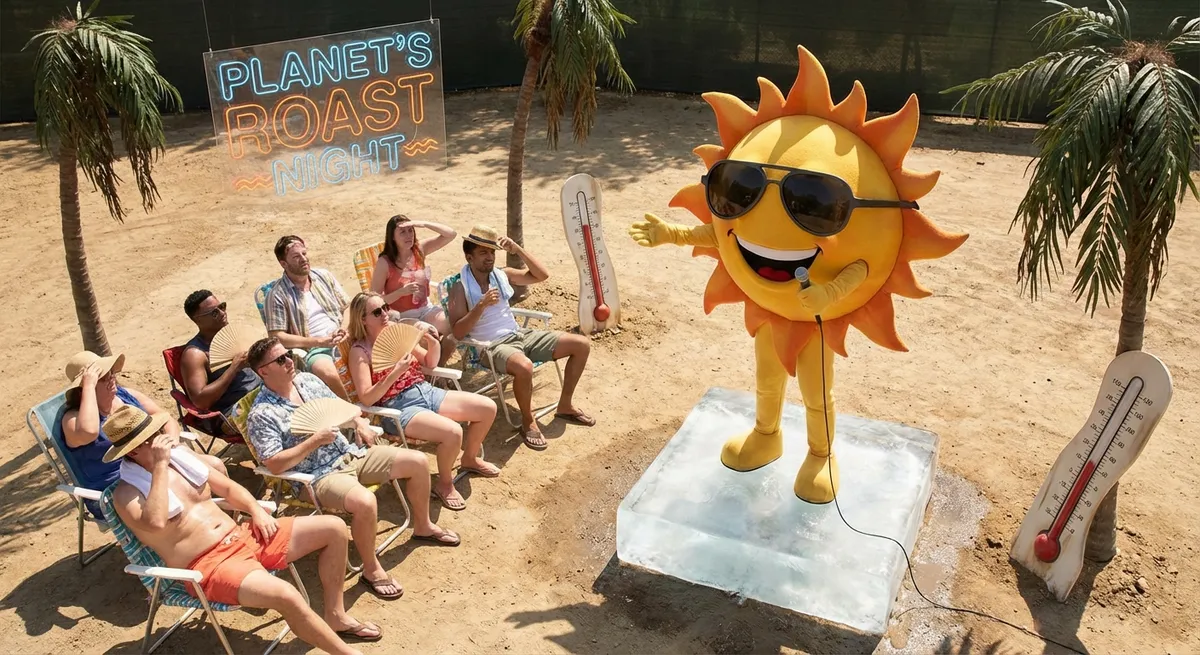
Earth is absolutely that friend who acts normal in public, then drops the wildest stories at 3 a.m. under bad LED lighting. You think you know how reality works, and then you find out there’s an animal that can basically “Nope” death, a rock that hums like it’s in a lo‑fi playlist, and a cloud of space alcohol just…vibing above us.
Here’s a collection of strangely specific, scientifically real facts that feel less like “nature” and more like the universe doing improv. Screenshot material incoming.
The Animal That Basically Hits “Save Game” On Its Life
Some animals hibernate. Respectable. Cozy. Very cottagecore.
Then there’s the tardigrade, a microscopic chaos gremlin that looked at the rules of biology and chose “unsubscribe.”
Tardigrades (aka water bears or moss piglets, because apparently scientists were feeling whimsical that day) can survive being:
- Frozen close to absolute zero
- Boiled above the temperature of your shower overthinking session
- Blasted with ridiculous levels of radiation
- Launched into outer space without a tiny space suit
When things get bad, they curl up into a dried-out ball called a “tun,” slow their metabolism to nearly zero, and just…wait. For years. Decades, even. Then when water returns, they rehydrate and stroll back into life like, “Miss me?”
You: falls apart if your phone hits 5% battery.
Tardigrades: takes a 30-year nap in vacuum-level nothingness and wakes up fine.
Someone get them a skincare line, because that resilience is a brand.
There’s A Literal Space Cloud Full Of Alcohol (But You Still Can’t Get A Drink)
If you’ve ever thought, “This universe is kind of unhinged,” allow me to introduce: the giant space booze cloud.
Near the center of our galaxy, astronomers discovered a massive cloud of gas called Sagittarius B2. Embedded in it? Ethyl alcohol. The same kind of alcohol in your margarita, just…cosmic and undrinkable.
Important notes:
- It’s about 1000 times the diameter of our entire solar system.
- It contains enough alcohol (spread thinly through space) to make, in theory, a lot of drinks.
- Unfortunately, it’s also mixed with toxic chemicals, freezing cold, and light-years away, so not exactly bar material.
Imagine telling someone:
“Yeah, there’s a galactic-scale booze mist orbiting the Milky Way’s center, but I still have to pay $18 for a cocktail with three ice cubes and a decorative leaf.”
The universe clearly has priorities. They’re just not ours.
The “Singing” Sand Dunes That Sound Like Earth Has A Soundtrack
You’re walking through the desert. It’s quiet. It’s peaceful. Suddenly, the sand starts humming a low, eerie note like the planet just booted up its own theme song.
Some desert dunes actually sing or boom—a deep, vibrating sound that can last for minutes. The noise isn’t wind whistling or your brain glitching; it’s caused by sand grains sliding down the dunes in just the right way.
Here’s the weird part:
- Only certain dunes do this.
- The pitch depends on the size of the grains.
- It sounds like a distant engine, chanting monks, or a sci‑fi sound effect.
Medieval people heard this and probably went, “Ah yes, demons.”
Modern scientists heard it and went, “We should spend years studying this sand karaoke.”
This is the only time in history where “the ground is humming” is not a sign you should immediately leave.
Bananas Are Radioactive And We’re All Just Cool With It
Bananas are the most chaotic “healthy snack” of all time.
They’re full of potassium, which your body needs to not be a fainting Victorian character. But a small portion of that potassium is radioactive. Like, real physics-lab radioactive.
Facts you can now ruin conversations with:
- Bananas contain potassium-40, a naturally radioactive isotope.
- Eating one banana gives you a tiny dose of radiation (way too small to hurt you).
- Scientists literally use the “Banana Equivalent Dose” as a fun way to compare how harmless some radiation exposures are.
Imagine explaining this to someone who already doesn’t trust salad:
“Don’t worry about the x-ray, it’s only like…a few hundred bananas.”
“WHY WOULD YOU SAY IT LIKE THAT?”
To be clear, you’d have to eat absurd amounts of bananas for radiation to matter. At that point, your bigger problem is becoming 90% banana.
There’s A Jellyfish That Said “Aging? No Thanks.”
While we’re out here buying retinol and googling “how much sleep fixes my entire life,” there’s a jellyfish just casually…reversing its age.
Turritopsis dohrnii, dramatically nicknamed the “immortal jellyfish,” can basically hit the biological reset button. When it gets injured, stressed, or old, it doesn’t just die. It reverts its adult cells back into a younger, earlier form—like a sea creature midlife crisis, but scientifically valid.
Then it grows up again. And can do this over and over.
Meanwhile:
Humans: “Maybe if I drink water and touch grass, I’ll feel 22 again.”
Immortal jellyfish: “I am 22 again. For the fifth time.”
It’s not actually invincible (it can still be eaten or destroyed), but on a cellular level, it dodges the usual “one-way trip” rule of aging. Somewhere in the ocean, a jellyfish is casually breaking the death mechanic while we lose our minds over fine lines.
Conclusion
Reality is out here doing stand‑up comedy while pretending to be a serious science documentary. We’ve got:
- A microscopic “nope” beast that time-skips danger
- A galaxy-level liquor cloud we can’t drink
- Sand dunes with better vocal range than most of us
- Fruit that is technically radioactive but still your doctor’s fave
- A jellyfish casually replaying its life like a Netflix series
The universe doesn’t just run on physics and chemistry—it runs on chaotic, oddly specific features that feel like someone patched them in for fun.
Next time life feels boring, remember: somewhere, a dune is singing, a jellyfish is rebooting, and a tardigrade is taking a century-long nap in the void. You’re living in the weirdest possible timeline. Use that as an excuse to be at least 10% weirder.
Sources
- [NASA – Tardigrades in Space](https://www.nasa.gov/mission_pages/station/research/news/tardigrades) – Overview of experiments studying how tardigrades survive extreme space environments
- [European Southern Observatory – Giant Cloud of Alcohol in Space](https://www.eso.org/public/news/eso0133/) – Details on the discovery of ethyl alcohol in the Sagittarius B2 molecular cloud
- [Scientific American – Why Some Sand Dunes Sing](https://www.scientificamerican.com/article/why-do-some-sand-dunes-sing/) – Explanation of the physics behind booming and singing dunes
- [U.S. Nuclear Regulatory Commission – The “Banana Equivalent Dose”](https://www.nrc.gov/reading-rm/doc-collections/fact-sheets/faq-radiation-protection.html) – Discussion of natural background radiation and the banana dose analogy
- [National Institutes of Health – Immortal Jellyfish Research](https://pubmed.ncbi.nlm.nih.gov/18845162/) – Scientific paper on the life cycle reversal of Turritopsis dohrnii