
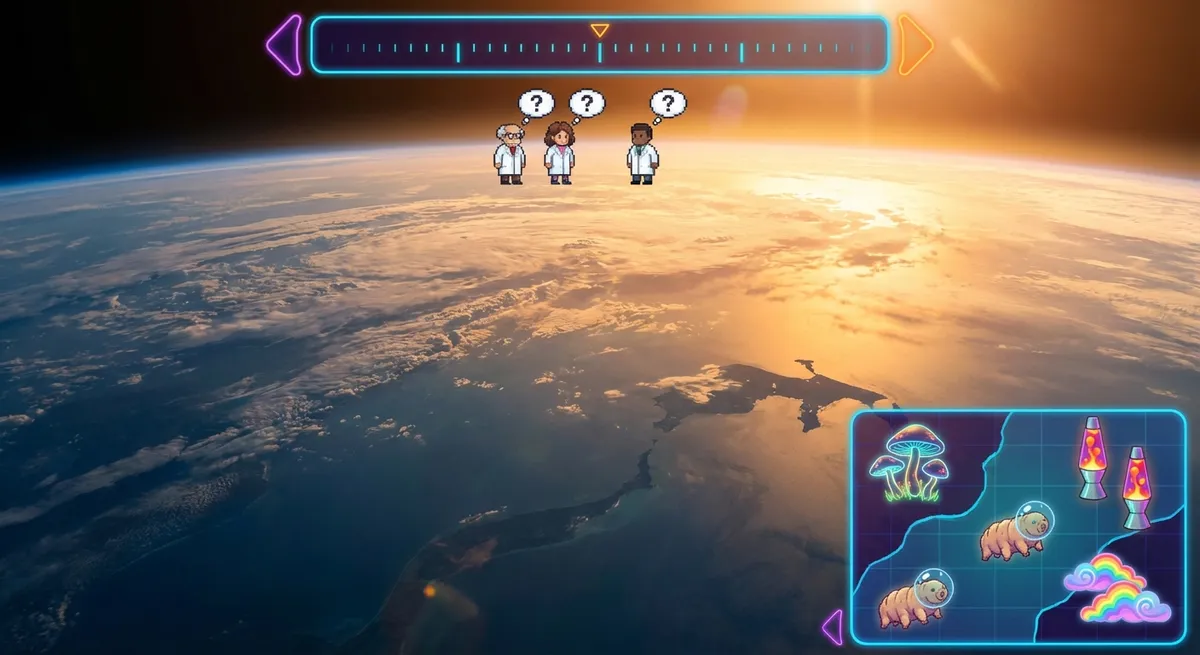
Every now and then, Earth behaves like a bored game developer tossing in random bonus levels just to see if we’re paying attention. You think you understand how the planet works, and then suddenly: glow-in-the-dark animals, upside‑down storms, and a literal rain of fish.
Here are five deeply un-serious, 100% real facts that feel like the universe is just messing with the patch notes again. Screenshot your favorites. Argue in the group chat. Pretend you “totally already knew that.”
1. There’s a Place Where It Rains Fish and Everyone Acts Like That’s Normal
Somewhere in Honduras, there’s a town that looks at fish falling from the sky and goes, “Ah yes, Tuesday.”
In the city of Yoro, locals celebrate “Lluvia de Peces”—the Rain of Fish. During certain heavy storms, small fish reportedly end up all over the streets afterward, and people just grab buckets like it’s a seafood Black Friday sale. One leading theory: powerful storms and waterspouts scoop fish up from nearby bodies of water and politely yeet them onto land.
Imagine explaining this to someone who’s never heard of it:
“Yeah, so we don’t have Uber Eats, but we do have cloud sushi.”
No matter the exact mechanism, the fact remains: somewhere on Earth, meteorology occasionally turns into a buy-one-thunderstorm-get-fish-free deal. If you’re ever complaining about your weather app being wrong, just remember—at least it didn’t forget to mention the 80% chance of sardines.
2. There’s a Jellyfish That Basically Hits Ctrl+Z on Aging
Meet Turritopsis dohrnii, the “immortal jellyfish,” living proof that nature occasionally rage-quits the concept of death.
Most animals:
- Are born
- Grow up
- Pay taxes (emotionally, at least)
- Eventually die
- Gets stressed, injured, or old
- Says “Nope”
- Reverts its cells back to a younger stage
- Starts life over like a sea creature New Game Plus
This jellyfish:
It doesn’t just heal—it reverses its life cycle, turning back into a baby polyp and growing up again. In theory, it can do this indefinitely, unless it’s eaten or, I don’t know, crushed by someone’s vacation snorkel.
Human skincare routine: twenty‑step serums and a face roller that squeaks.
Immortal jellyfish skincare routine: “What if I just become a child again?”
This thing is out here casually violating the terms and conditions of biology while we get winded going up the stairs.
3. There’s a Real Lake That Explodes and It’s Not Even a Supervillain Lair
If a random lake in Cameroon suddenly burped out a cloud of gas that suffocated thousands of people and animals, you’d assume that’s the backstory for a horror movie, right? Nope. That’s Lake Nyos, and it really happened in 1986.
Lake Nyos sits atop volcanic ground and slowly fills with carbon dioxide from below. Normally, that gas stays dissolved in the deep water like soda in a bottle. But once in a while, conditions shift, the lake destabilizes, and all that CO₂ rushes to the surface in a massive, invisible cloud.
Result: the lake doesn’t explode like a bomb—it explodes like a shaken soda bottle of pure suffocation. The gas rolls across the land, displaces oxygen, and anything breathing nearby just… doesn’t.
Science’s response was basically:
“Oh. That’s horrifying. Let’s put giant straws in it.”
Engineers installed long pipes that vent gas from the lake in a controlled way, so it can’t build up to disaster levels again. Humanity: 1. Murder-lake: temporarily 0.
So yes, we live on a planet where silent lake explosions are a weather hazard. Sleep tight.
4. Mushrooms Can Talk to Each Other in Something Like a Tiny Forest Wi‑Fi
Underneath forests, there’s a secret communication network that sounds like fantasy lore but is just… ecology being extra.
Fungi send out threadlike structures called mycelium that weave through the soil, connecting to tree roots. Through this network, trees and plants can share nutrients, warn each other of pests, and apparently live out a low-key group chat.
Scientists have nicknamed it the “wood wide web.”
Actual trees:
- “Hey, I’m getting chewed on by bugs over here, heads up.”
- “I’ve got extra sugar, anyone need some?”
- “Shade’s rough on my side, send help.”
- “Who ate my leftovers?”
- “Why is my Wi‑Fi slow?”
- “Look at my dog.”
Your group chat:
Some studies even suggest fungi might use patterns of electrical signals like a vocabulary—rudimentary, but still wild—across their networks. Meanwhile, humans invented social media and used it mostly for arguing about pineapple on pizza.
The forest has better communication than most office Slack channels. Let that sink in the next time a mushroom pops up in your yard like, “Yeah, I know things.”
5. The Sun Sometimes Yeets Space Weather at Us Like an Angry Lightbulb
Our local star: warm, glowy, source of life.
Also our local menace: occasionally throws solar tantrums that can mess with satellites, GPS, power grids, and—if it’s feeling spicy—maybe your future TikTok upload.
The Sun has solar flares and coronal mass ejections (CMEs) where it blasts out intense radiation and charged particles into space. When those hit Earth’s magnetic field, we get stunning auroras… and potential technological chaos.
In 1859, a massive solar storm called the Carrington Event lit up the night sky so brightly that people thought dawn was breaking at 1 a.m. Telegraph systems sparked, operators got shocked, and some devices kept working even after they were unplugged.
Translation: the Sun basically said, “What if I turn the entire planet’s wiring into a cursed science fair project?”
Today, we’ve got way more tech in orbit and on the ground, so major solar storms are kind of the cosmic equivalent of, “What if the Wi‑Fi dies… globally?” Space agencies track these events so we’re not blindsided by a solar “surprise, it’s offline now” moment.
So yes, your weather forecast technically includes “sunny with a chance of electromagnetic doom,” but they usually shorten it to “clear skies.”
Conclusion
Earth is not a chill planet. It’s a chaotic sandbox where:
- Fish fall from the sky
- Jellyfish reject the idea of aging
- Lakes spontaneously burp lethal clouds
- Forests run on fungal fiber-optic networks
- And the Sun occasionally threatens the Wi‑Fi
Next time life feels predictable, remember: you live on a rock where fish rain, mushrooms gossip, and the star outside sometimes rage-pings the entire planet.
Now go drop one of these facts into a conversation and walk away like you just spoiled the plot twist of reality.
Sources
- [BBC – Honduras’ Mysterious Rain of Fish](https://www.bbc.com/news/magazine-28565943) – Overview of the “Lluvia de Peces” phenomenon in Yoro, Honduras
- [National Geographic – Immortal Jellyfish](https://www.nationalgeographic.com/animals/article/immortal-jellyfish) – Explains how Turritopsis dohrnii can revert to a younger life stage
- [U.S. Geological Survey – Lake Nyos Disaster](https://www.usgs.gov/centers/casc/science/lake-nyos-carbon-dioxide-disaster) – Scientific breakdown of the 1986 limnic eruption at Lake Nyos
- [Smithsonian Magazine – The Wood Wide Web](https://www.smithsonianmag.com/science-nature/the-whispering-trees-180968084/) – Discussion of fungal networks and tree communication
- [NASA – Solar Flares and Space Weather](https://www.nasa.gov/mission_pages/sunearth/spaceweather/index.html) – How solar storms and flares affect Earth and our technology