
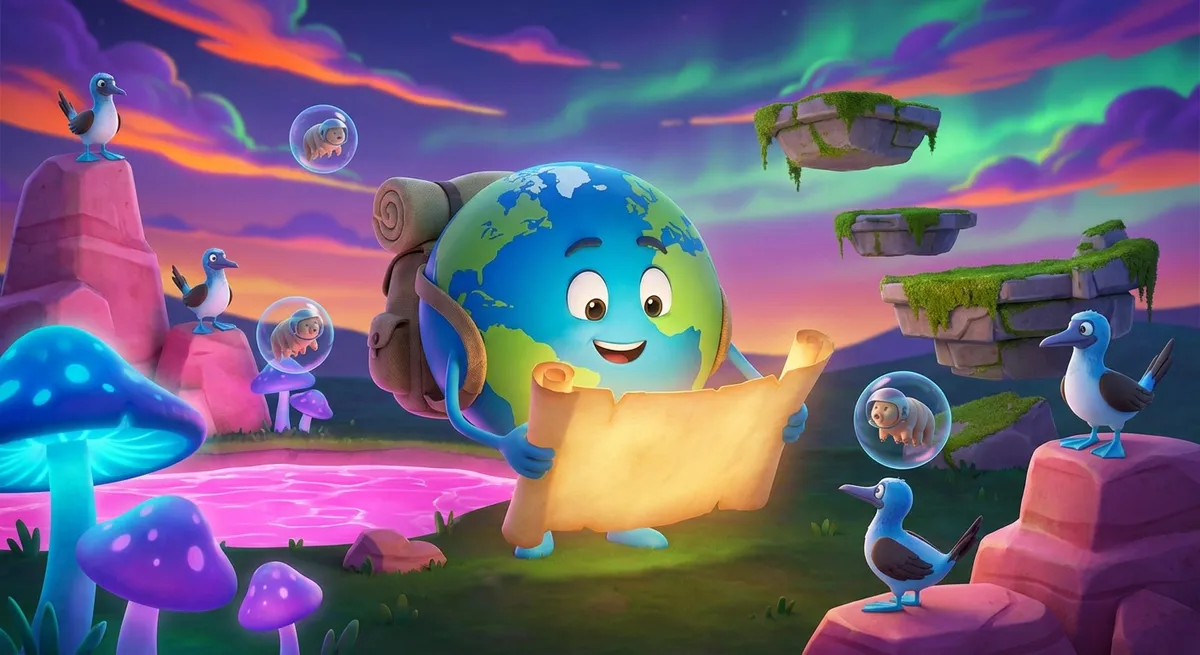
You think you’re just living on a regular planet, paying bills and losing socks in the laundry. Meanwhile, Earth is out here running secret side quests like an overachieving video game NPC. From immortal jelly blobs to space‑drunk astronauts, reality is quietly unhinged—and science is just calmly taking notes.
Let’s expose some of the weirdest real facts that sound fake, but absolutely are not. Screenshot bait? Yes. Party story fuel? Also yes.
Earth Has a “Boom” Fish That Can Literally Shake Submarines
The loudest animal on Earth (by body size) is… a tiny shrimp that snaps.
The pistol shrimp (also called the snapping shrimp) has one oversized claw it slams shut so fast it creates a bubble that briefly reaches temperatures close to the surface of the sun. The bubble collapses with a shockwave loud enough to mess with submarine sonar and stun or kill nearby prey. This thing is basically a tiny underwater sniper with a built‑in sound cannon.
It’s not the loudest animal overall (blue whales still hold the belt), but for its size, the pistol shrimp is wildly overpowered. If humans had this ratio of noise ability, you could clap your hands and knock over a truck.
Some navies and submarine crews have literally had to factor shrimp noise into their underwater listening systems. Imagine being a trained military engineer and your professional enemy is… a furious little “pop” goblin with claws.
This is your reminder that somewhere in the ocean, a shrimp is unknowingly flexing on global military tech.
There’s a Jellyfish That Said “No Thanks” to the Concept of Aging
While you’re out here trying to remember if you drank water today, Turritopsis dohrnii—a jellyfish about the size of your pinky nail—has basically discovered the “restart” button of life.
When this jellyfish gets injured, stressed, or old, it can revert its cells back to an earlier life stage (like hitting “new game” without deleting your save file) and grow up all over again. It doesn’t just slow aging; it literally cycles backward, then forward, infinitely… at least in theory.
Scientists call it “biological immortality,” which sounds like a Marvel plot, but it’s an actual research topic in aging and regenerative medicine. No, this does not mean scientists will make you immortal tomorrow. It does mean that somewhere in the ocean, a soft, brainless blob is doing a better job at long‑term planning than most of us.
Humans: “Agh, another birthday, my back hurts.”
Immortal jelly: “I’ll simply become young again and start fresh, thanks.”
You Are Part Mushroom: The Fungal Wi‑Fi Under Your Feet
Under forests, there’s a massive underground network of fungal threads connecting trees to each other, often nicknamed the “wood‑wide web.” Trees use this system—called mycorrhizal networks—to exchange nutrients, send chemical signals, and sometimes even sabotage rival plants.
Yes, trees have a group chat.
Older “mother trees” have been observed sending extra resources to younger ones through these fungal highways, like botanical grandparents secretly slipping cash to their favorite grandkids. Some trees even send chemical “warning signals” when pests attack, helping neighbors prepare defenses.
It gets weirder: humans share a notable portion of DNA with fungi, and we’ve used fungi to make bread, alcohol, cheese, antibiotics, and more. So not only are mushrooms acting as plant internet, they’re also in your pizza, your medicine cabinet, and your bloodstream (hi, penicillin).
You: “I’m an individual.”
Fungi: “You’re on the network, buddy.”
Space Has a Flavor, and It’s… Not What You’d Hope
Astronauts have reported that space smells a bit like seared steak, burnt metal, welding fumes, or gunpowder—especially on their suits and equipment after spacewalks. That smell comes from high‑energy vibrations in atoms and molecules created in space, which then react with air once they’re back inside the spacecraft.
Also, microgravity wrecks your sinuses and taste buds. Blood shifts toward your head, your nose clogs, and suddenly your favorite snacks taste like cardboard. To compensate, astronauts go hard on spicy sauces and strong flavors. One NASA astronaut said the crew sometimes fights over the last bottle of Sriracha like it’s priceless space treasure.
So:
• Space smells like a mechanic’s lunch break.
• Your nose doesn’t work right.
• You end up drinking powdered coffee while floating in a metal tube.
Every sci‑fi movie: majestic, silent, romantic stars.
Real space: hot steak fumes, clogged noses, and floating chili packets.
Bananas Are Radioactive and That’s Somehow Fine
Your favorite banana is quietly beaming out radiation—but in a chill way.
Bananas contain potassium, and a small fraction of that is the naturally radioactive isotope potassium‑40. It’s so consistent that scientists jokingly use the “banana equivalent dose” as a fun way to explain tiny amounts of radiation exposure.
Eat a banana, and your radiation goes up a bit… then your body just balances it out like the champion it is. You are constantly surrounded by background radiation from the air, ground, building materials, your own body, and the universe in general. The banana is the least of your problems.
To get a dangerous dose from bananas, you’d have to eat millions of them in a short time. At that point, the real threat is not radiation—it’s being the main character of the world’s most unhinged medical report.
Doctor: “What happened?”
You: “I misunderstood a meme.”
Yet again, science proves that reality is weird but mostly harmless… unless you’re allergic.
Conclusion
You’re not just living on Earth; you’re on a chaotic, scientifically verified comedy special.
Somewhere below you, fungi are running a forest LAN party. Above you, astronauts are snorting space dust and begging for hot sauce. In the ocean, a shrimp has a built‑in sound weapon and a jellyfish has unlocked the respawn mechanic of life. Meanwhile, your lunch is lightly radioactive and that’s normal.
Next time life feels boring, remember: the planet is absolutely not normal. You’re just used to it.
Now go show off your new “I can ruin silence at parties with facts” powers. The group chat needs to know about the shrimp with the sun‑temperature bubble.
Sources
- [Woods Hole Oceanographic Institution – Snapping Shrimp](https://www.whoi.edu/oceanus/feature/snapping-shrimp/) – Explains how pistol/snapper shrimp generate powerful snapping sounds and their impact on underwater acoustics.
- [National Geographic – Immortal Jellyfish](https://www.nationalgeographic.com/animals/invertebrates/facts/immortal-jellyfish) – Overview of Turritopsis dohrnii and its unique ability to revert to a juvenile state.
- [Smithsonian Magazine – The “Wood-Wide Web”](https://www.smithsonianmag.com/science-nature/the-whispering-trees-180968084/) – Discusses mycorrhizal networks and how trees communicate and share resources through fungi.
- [NASA – Living in Space: Food and Nutrition](https://www.nasa.gov/humans-in-space/food-in-space/) – Details how astronauts eat in space, including taste changes and food preferences.
- [U.S. Nuclear Regulatory Commission – Fact Sheet on Background Radiation](https://www.nrc.gov/reading-rm/doc-collections/fact-sheets/background-radiation.html) – Covers everyday sources of radiation, including the “banana equivalent dose” concept.