
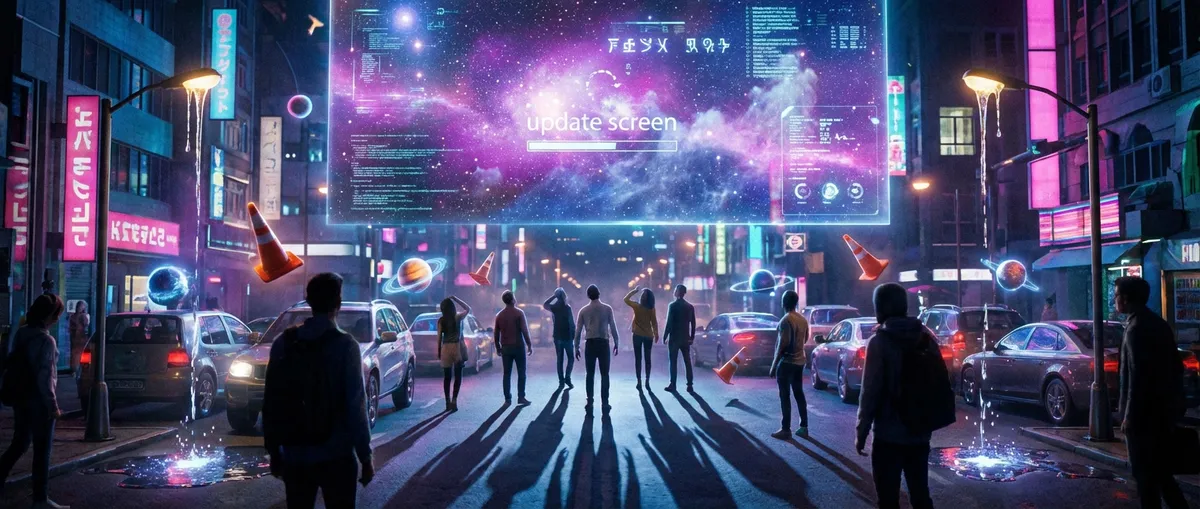
If the universe had a “recent updates” screen like a video game, it would be absolute chaos. “Version 13.7 Billion: added screaming goats, removed common sense from humans, nerfed sleep.” Somehow, our world is both majestic and deeply weird at the same time—like a National Geographic documentary directed by a raccoon.
So let’s scroll through some of reality’s hidden patch notes: bizarre facts that sound fake, feel illegal, and will absolutely make you say, “No way,” before immediately sending them to the group chat.
The Ocean Is Hiding a Mountain Range Bigger Than the Andes
The ocean is basically Earth’s “do not disturb” folder, and under all that water is a secret we’re barely emotionally prepared for: there’s a mountain range down there bigger than anything on land.
Earth’s longest mountain chain isn’t the Himalayas or the Andes. It’s the mid-ocean ridge system, a continuous underwater range that snakes around the planet for over 65,000 kilometers (about 40,000 miles). That is “if this were in a fantasy novel, the editor would cut it” levels of dramatic.
Even better:
- Parts of it are taller than the Alps.
- It’s literally where new seafloor is born as magma rises and cools.
- And we’ve mapped more of Mars and the Moon than we have of our own seafloor.
So yes, humans: we built Wi-Fi, invented TikTok filters, and can get pizza in under 30 minutes, but we still don’t fully know what’s going on in the 70% of the planet that is just “wet mystery.”
Shareable summary: There is a secret mountain range wrapping around Earth that we basically never see because it’s underwater and we are land-loving cowards.
Bananas Are Radioactive, And So Are You (But It’s Fine, Probably)
Bananas are the ultimate chaotic good fruit. Portable, healthy, shaped like a smile, and also… slightly radioactive.
Bananas contain potassium, and a tiny fraction of that is potassium-40, a naturally occurring radioactive isotope. It’s such a thing that scientists sometimes joke about “banana equivalent doses” to explain radiation levels to people. Eat one banana and congrats, you’ve just ingested a tiny (harmless) amount of radiation.
But before you cancel all banana bread:
- You’d have to eat millions of bananas in a short time for it to be a problem.
- Your own body is naturally radioactive too, thanks to potassium and carbon-14.
- The radiation from a banana is so small it’s basically scientific comedy.
Still, you now have full permission to say, “I’m literally glowing with health,” and technically not be lying.
Shareable summary: Bananas set off radiation detectors more than your ex did, and we’re all just low-key radioactive meat-skeletons walking around like that’s normal.
Tardigrades Are Basically Tiny Immortal Goblins
If Earth had to pick a final boss, it would not be humans. It would be the tardigrade—also known as the water bear, or in scientific terms, “absolutely unkillable nonsense.”
These microscopic creatures can:
- Survive being frozen close to absolute zero.
- Chill in boiling temperatures above 300°F (150°C).
- Handle extreme radiation that would obliterate most life.
- Survive the vacuum of space like it’s a mildly annoying breeze.
When things get rough, tardigrades basically hit the world’s most dramatic “sleep mode” button. They dry out, curl into a tiny ball called a tun, shut down almost all biological activity, and wait. For decades. Then when conditions improve, they rehydrate and carry on like, “Anyway, where were we?”
Meanwhile, humans drink one (1) iced coffee too fast and get brain freeze so intense we reconsider our life choices.
Shareable summary: There’s a microscopic creature out there that can outlive radiation, space, boiling water, and time itself, and it looks like a plump vacuum bag with legs.
You’re Technically Seeing Into The Past Every Second
Your whole life is a live stream with a delay.
Light doesn’t travel instantly; it just moves very fast—about 299,792 kilometers per second (186,000 miles per second). That means everything you see is a tiny bit old by the time it hits your eyeballs.
Some examples of reality being late to its own party:
- The Sun you see in the sky? That’s how it looked about 8 minutes ago.
- The Moon is about 1.3 seconds in the past.
- If you look at someone 3 meters away, you’re seeing them as they were about 10 nanoseconds ago.
- Looking at distant galaxies in telescopes? You’re seeing light that left millions or even billions of years ago.
So yes, you have literally never seen “the present.” You are always watching a delayed broadcast of reality, like the universe is constantly buffering.
Shareable summary: Existence is basically one giant “this event is happening on a tape delay” warning, and you are permanently running a few nanoseconds behind the live version of your own life.
There’s A Place On Earth Where Gravity Is Wrong On Purpose
Gravity is supposed to be that one reliable thing in life. Dropped your phone? It falls. Trip over nothing? You fall. Emotionally attached to someone who’s bad for you? You fall. Gravity is consistent.
Except in one place: Hudson Bay, Canada. There, gravity is ever so slightly weaker.
Two main reasons scientists give for this extremely rude glitch in physics:
- An ancient ice sheet once sat on that region, so heavy it squished the Earth’s crust down. The ice melted, but the land is still slowly springing back up, like a memory foam mattress in geological slow motion.
- Mass inside the Earth moved around, changing how much gravitational pull that region has.
The difference isn’t enough for you to float (sorry), but it is measurable. If you ever feel lighter there, it’s not just your self-esteem healing—it’s the planet literally pulling on you less.
Shareable summary: There’s a real place on Earth where gravity is slightly weaker, and it’s not your friend’s apartment with the broken scale.
Conclusion
The universe didn’t have to be this weird. It could’ve been simple. Boring, even. But no—instead, we got radioactive smoothies, immortal dust bears, secret underwater mountain ranges, delayed reality, and wobbly gravity zones.
It all feels less like a serious physical universe and more like a chaotic sandbox game where someone kept turning on experimental features just to see what would happen.
Next time life feels too normal, remember:
You’re a slightly radioactive organism, standing on a spinning rock, above a hidden mountain range, in delayed time, under inconsistent gravity, while microscopic space goblins outlive you.
And somehow, we’re worried about unread emails.
Sources
- [NOAA Ocean Exploration – Mid-Ocean Ridge](https://oceanexplorer.noaa.gov/facts/mid-ocean-ridge.html) - Overview of the mid-ocean ridge system and its global scale
- [U.S. Nuclear Regulatory Commission – Radiation and Bananas](https://www.nrc.gov/reading-rm/doc-collections/fact-sheets/banana-fact.html) - Explanation of banana equivalent dose and natural radioactivity
- [NASA – Tardigrades: Survivors of Extreme Space Conditions](https://astrobiology.nasa.gov/news/tardigrades-in-space/) - How tardigrades survive extreme environments, including space
- [NASA Space Place – What Is a Light-Year?](https://spaceplace.nasa.gov/light-year/en/) - How light travel time means we see distant objects in the past
- [NASA Earth Observatory – Gravity Anomalies in Hudson Bay](https://earthobservatory.nasa.gov/images/1878/gravity-lows-in-canadas-hudson-bay) - Explanation of weaker gravity regions in Hudson Bay and their causes