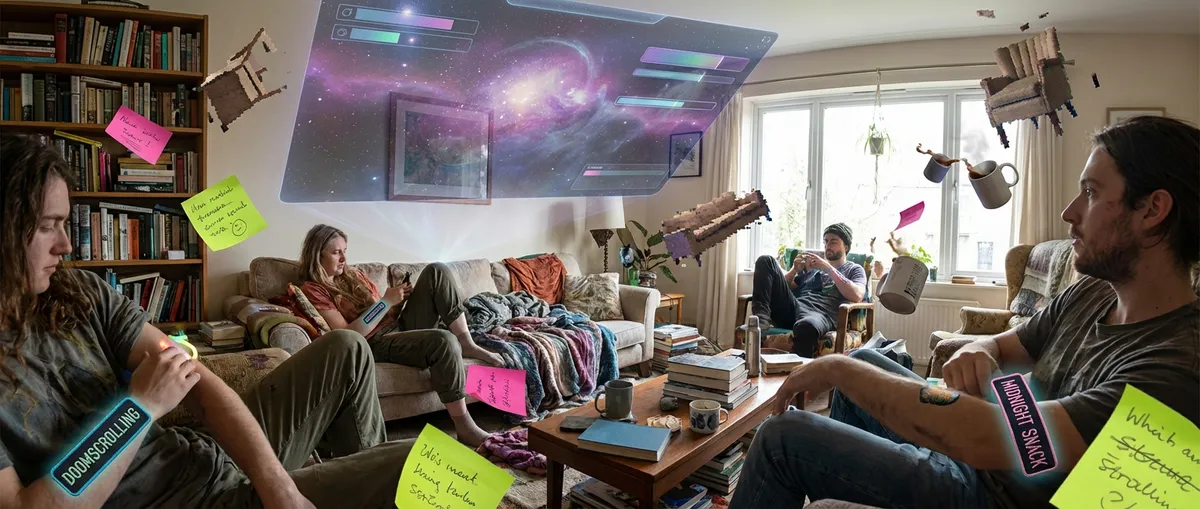
Congratulations, you are a functioning human… allegedly. But if you zoom out for, like, four seconds, our daily behavior looks less like “intelligent life” and more like a buggy beta test for a species that never read the manual.
Here are five completely real, totally verified-by-science facts about humans that make our entire existence feel like a cosmic inside joke. Read them, question everything, then send this to a friend who also does #5 daily.
1. Your Brain Is Censoring Reality Like a Lazy Editor
Your eyeballs technically see your nose all the time… your brain just rage-quits that visual because it’s “not important.”
Your brain edits out your nose, fills in your blind spot with made-up content, and auto-stabilizes your vision every time your eyes jerk around (which is constantly). The world you “see” is less live-stream, more heavily edited highlight reel. You’re basically walking around inside your own Photoshop project.
And it gets more chaotic:
- You only clearly see a tiny spot in the center of your vision; the rest is upscaled guesswork.
- Your brain smooths motion so reality doesn’t look like a laggy video call.
- Some people literally don’t realize they have a blind spot until someone makes them do the test. (You’re Googling it later. You know you are.)
So when someone says, “I know what I saw,” technically the answer is: no, you know what your brain decided to render.
2. Your Skeleton Is Just Hiding in Your Meat Suit (Very Casually)
You are, at this exact moment, wearing a skeleton. On the inside. Like a horror movie with a gym membership.
Your bones aren’t static, either. They’re being constantly broken down and rebuilt. Your skeleton renovates itself approximately every decade, like it’s flipping your body on a metaphysical HGTV show. Inside you:
- Old bone cells are demolished and replaced by new ones.
- Weightlifting or impact exercise sends your bones the message: “Level up, bestie.”
- Even your teeth—those tiny mouth rocks you treat with coffee abuse—are considered part of your skeletal system, just permanently exposed.
So that TikTok trend where people suddenly remember they have a skeleton and get existential? Scientifically justified. You’re not just a person. You’re a self-remodeling bone mech piloted by anxiety and vibes.
3. You’re Biologically Wired to Be a Tiny Solar Panel
You: “I’m tired.”
Your body: “Touch grass and stare at the flaming sky orb, coward.”
Sunlight doesn’t just help you make vitamin D. It also:
- Regulates your internal clock so you don’t feel jet-lagged in your own house.
- Boosts serotonin, the “I’m not losing it today” molecule.
- Helps melatonin production at night, so you can stop doomscrolling at 2:47 a.m. (the official Hour of Bad Decisions).
Humans evolved assuming we’d be outside a lot, touching rocks and inventing spears—not hunched over laptops in LED caves. Your brain still thinks “bright sun = daytime = do things” and “dark = bedtime = stop refreshing notifications.”
You are, scientifically speaking, a slightly confused houseplant with Wi‑Fi access.
4. Your Memory Is Basically Fan Fiction About Your Own Life
You don’t remember events. You remember your last memory of those events, which means your brain is quietly editing your past like a messy showrunner retconning Season 1.
Every time you recall something—your first crush, that one horrifying presentation, the moment you tripped in public and pretended it was “on purpose”—your brain:
- Reconstructs the memory from scattered data.
- Mixes in current emotions and assumptions.
- Re-saves the updated version, now with bonus inaccuracies.
This is why:
- Two people can swear opposite things happened at the same event.
- You’re embarrassingly sure your version is right.
- Both of you can be wrong at the same time.
Your life story is less “documentary” and more “loosely inspired by true events.”
5. Your Body Decides When to Betray You with the Sneak Yawn Chain
Yawning is one of the weirdest flexes your body has. You do it when you’re tired, bored, anxious, or just saw someone else dare to yawn in your line of sight.
Scientists still don’t fully agree on why we yawn, but the leading ideas are delightfully chaotic:
- It might cool down your brain, like hitting the reset button on an overheating laptop.
- It may help regulate arousal and alertness—your body’s way of going, “Rebooting… please wait.”
- It’s contagious because your social brain is wired to sync up with others, so you subconsciously mirror their state.
Also:
- Contagious yawning is linked to empathy—people who are more sensitive to others are more likely to catch a yawn.
- You can trigger a yawn just by reading about yawning.
- You’re probably fighting one off right now. (Don’t resist. Science demands it.)
So when your friend yawns during your story, maybe they’re not bored. Maybe their brain is just overheating from your chaotic energy.
Conclusion
Humans walk around acting like we’re logical, rational, fully in control. Meanwhile:
- Our brain is live-editing reality,
- Our skeleton is secretly under construction,
- Our mood depends on whether we’ve been recently microwaved by sunlight,
- Our past is a collaborative fiction project,
- And we’re all catching drive‑by yawns like it’s a social virus.
If you feel mildly called out and also strangely fascinated, congratulations: you are exactly who this planet was designed for.
Now send this to someone whose brain, skeleton, memory, circadian rhythm, or yawning habits are clearly operating on “experimental mode.”
Sources
- [National Eye Institute – How the Eyes Work](https://www.nei.nih.gov/learn-about-eye-health/healthy-vision/how-eyes-work) – Explains visual processing, including how the eye and brain work together to create what we see
- [Cleveland Clinic – Bone Remodeling](https://my.clevelandclinic.org/health/body/22475-bone-remodeling) – Overview of how bones continuously break down and rebuild over time
- [Harvard Medical School – Blue Light Has a Dark Side](https://www.health.harvard.edu/staying-healthy/blue-light-has-a-dark-side) – Describes how light affects circadian rhythms, sleep, and mood
- [American Psychological Association – Memory: How It Works](https://www.apa.org/topics/memory) – Discusses how memory is reconstructed and why it can be unreliable
- [Smithsonian Magazine – Why Do We Yawn?](https://www.smithsonianmag.com/science-nature/why-do-we-yawn-86395562/) – Explores current scientific theories behind yawning and why it’s contagious