
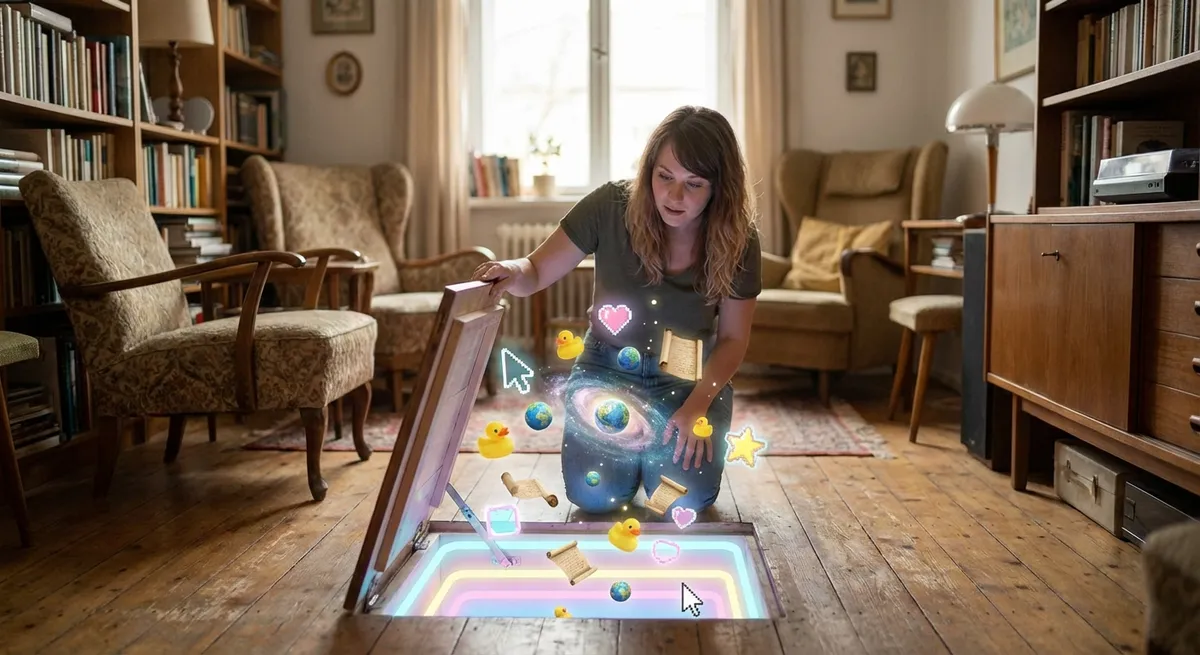
You know how life feels boring but then you learn an octopus has three hearts and suddenly your 2am spiral feels under-qualified? Welcome to the side quests of reality: the stuff nobody mentioned in school because they were too busy making you memorize the mitochondria again. These are the weird, screenshot-worthy facts that make you go, “Okay, the universe is definitely freelancing its plot.”
Let’s open the patch notes of existence and see what the devs snuck in.
The Moon Is Slowly Rage-Quitting Earth (But Very Politely)
The Moon is leaving us. Not dramatically, not with a slammed door—more like a slow Irish goodbye in space.
Every year, the Moon drifts about 3.8 centimeters farther away from Earth. That’s roughly the growth rate of your existential dread per month. This happens because of tidal interactions: Earth’s rotation drags the ocean tides a little ahead of the Moon, which transfers energy and gently yeets the Moon outward.
In the very, very distant future (we’re talking hundreds of millions of years), our days will be longer and total solar eclipses won’t work the same because the Moon will look smaller in our sky. Imagine future beings going, “Wait, people used to get perfect eclipses?!” and being jealous of a species that ate Tide Pods.
So yes, the Moon is ghosting us, but at the speed of a lazy snail, so we have time to work on the relationship.
Bananas Are Radioactive And Nobody Told You
Bananas are out here being slightly radioactive while you’re worried about microwaving leftovers twice.
They contain potassium, and a tiny fraction of that is potassium-40, a naturally radioactive isotope. Because of that, scientists sometimes use a jokey unit called the “banana equivalent dose” to explain small amounts of radiation. Eating a banana exposes you to a minuscule dose—so tiny it’s harmless and way less than you get flying on an airplane or living with your Wi-Fi router taped to your face.
You are technically a glowing goblin of mild radioactivity, too. Your body also contains potassium-40 and carbon-14. So if anyone calls you toxic, you can respond, “Scientifically correct, actually.”
Is a banana going to turn you into a superhero? Sadly, no. But it is scientifically accurate to say you just powered up with a radioactive snack.
Tardigrades Are Basically Immortal Space Beans
There is a tiny creature that can survive space, boiling water, freezing, radiation, and probably your group chat: the tardigrade, also known as the “water bear” or “moss piglet,” which sounds like a Studio Ghibli side character.
Tardigrades can survive temperatures from just above absolute zero to above the boiling point of water. They withstand pressures stronger than the deepest ocean trenches and can handle doses of radiation that would annihilate humans. Their secret move? They dry themselves out into a near-death state called cryptobiosis, turning into a tiny biological USB stick that can boot back up years later when water returns.
They’ve even been sent to space, exposed to the vacuum and cosmic radiation, and then revived back on Earth like, “Anyway, where were we?” Meanwhile, we get a headache if the weather changes by three degrees.
If there’s ever a “last survivor of the universe,” it’s not going to be humanity. It’s going to be a microscopic potato with legs.
There’s A Spot On Earth Where Gravity Is… Wrong
Imagine stepping on a scale and weighing slightly less in one part of the world—not because of a miracle diet, but because gravity is acting weird.
Welcome to Hudson Bay in Canada, where gravity is measurably weaker than in many other regions on Earth. Not enough for you to float out of your pants, but enough that extremely sensitive instruments can detect it. This “gravity anomaly” puzzled scientists for decades.
Two big suspects:
- A massive ancient ice sheet (the Laurentide Ice Sheet) that squashed the land and then melted, leaving the Earth’s crust slowly rebounding like a memory foam mattress.
- Weird distributions of dense rock deep in the mantle, changing how mass—and therefore gravity—is spread out below your feet.
So no, you’re not lighter there in any meaningful Instagram way, but yes, the planet’s gravity field is lumpy, and Earth is basically a badly frosted cake wobbling through space.
You’re Technically Made Of Stardust (And Exploded Stars Weren’t Subtle About It)
The phrase “we are made of stardust” sounds like something on a motivational poster next to a yoga mat, but it’s also straight-up physics.
Most of the elements in your body—carbon, nitrogen, oxygen, iron—were forged in the cores of stars through nuclear fusion. When massive stars ran out of fuel, they went supernova, yeeting those newly-created elements into space. That debris eventually condensed into new stars, planets, and everything currently stressing about their inbox.
So the iron in your blood and the calcium in your bones were literally cooked up in stellar furnaces and blown across the galaxy. You’re not just “a person having a human experience”; you’re rearranged space debris trying to remember your passwords.
Next time someone says you’re being dramatic, inform them you are a conscious arrangement of exploded star material, and drama is absolutely on-brand.
Conclusion
The universe is out here casually doing wild DLC content—radioactive fruit, tiny immortal space goblins, a Moon with commitment issues—while we argue about whether cereal is a soup.
Reality isn’t boring; it’s just badly marketed.
So the next time you’re zoning out, remember:
- The Moon is slowly friend-zoning Earth.
- Your snack is lightly radioactive.
- A microscopic moss piglet could outlive every one of your backup plans.
- Gravity sometimes glitches.
- And your atoms once lived in the cores of ancient stars.
Hit share so someone else can realize their life is less “normal existence” and more “cosmic fanfic with a questionable budget.”
Sources
- NASA – The Moon Is Moving Away From Earth – Explains lunar recession and how Earth–Moon dynamics change over time
- U.S. Nuclear Regulatory Commission – Fact Sheet on Background Radiation – Covers natural radiation sources, including bananas and the “banana equivalent dose”
- European Space Agency – Tardigrades in Space – Describes experiments where tardigrades survived exposure to the vacuum of space
- NASA Earth Observatory – Gravity Anomalies Explained – Discusses how gravity varies across Earth and why places like Hudson Bay have lower gravity
- Cornell University – Are We Really Made of Stardust? – Astronomer explains how elements in our bodies originated in stars