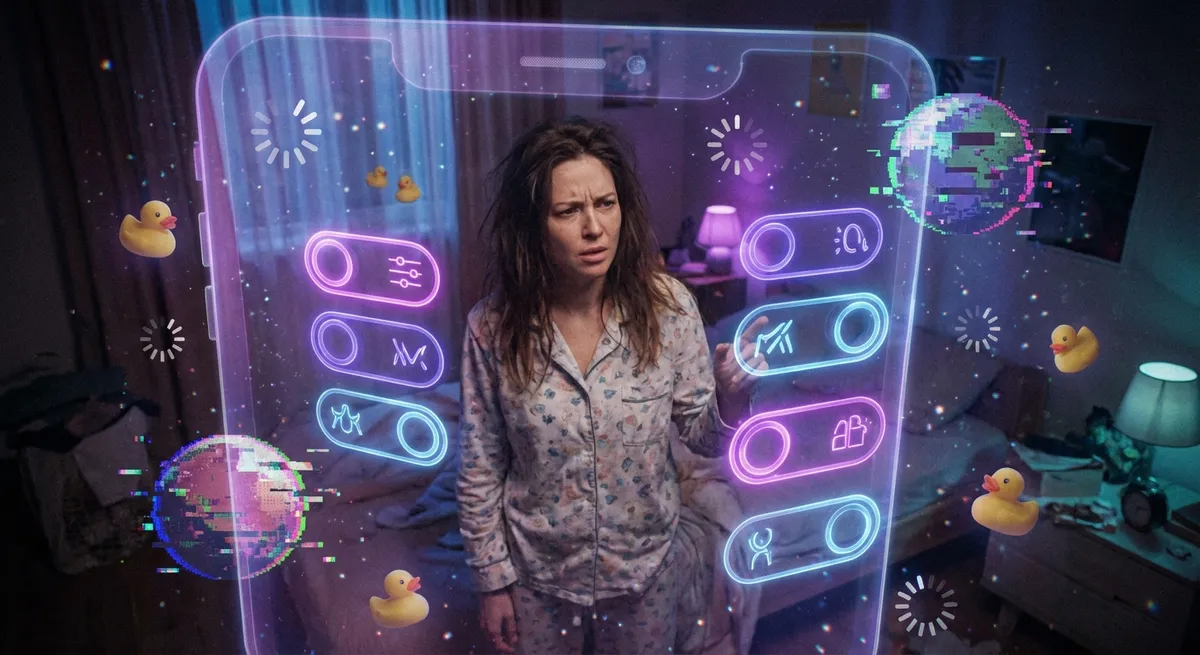
You know how every app has a settings menu full of cursed options you should probably never touch? Reality is like that—except nobody gave us a manual, and the patch notes are just… vibes.
Today we’re opening the weirdest, most “who coded this?” settings humanity has discovered. These are the kind of facts that make you stop, stare at the wall, and quietly whisper: “Ah. So existence is a prank.”
Share this with someone who thinks they understand how the world works. They don’t. None of us do. That’s the fun part.
The “Infinite Library” Setting: Somewhere, Your Life Story Already Exists
There’s a thought experiment called the infinite monkey theorem: if you give a monkey a typewriter and infinite time, it will eventually mash out the complete works of Shakespeare just by random chance.
Sounds dumb. Is mathematically true. And it gets weirder.
If you had an infinite library filled with every possible combination of letters and punctuation, that library would contain:
- This exact article
- A version of this article where you’re a lizard reading it in sunglasses
- A perfectly accurate biography of you, from birth to death
- Ten million slightly wrong biographies where your name is “Gregory” for no reason
We actually tried to simulate this idea. The Library of Babel is a real website that generates random pages of text arranged to mimic that hypothetical infinite library. Any 3200-character text is somewhere in there.
So in theory, the breakup text that ruined your day?
Already lurking in the cosmic spam folder of existence.
And if that doesn’t make you feel like a badly documented side character in reality’s database, I don’t know what will.
The “Time Moves Differently” Setting: Your Head Is Living on Fast-Forward
Your brain is a drama queen with a built-in special effects department.
When you’re a kid, summers feel like they last three years. As an adult, you blink in January and suddenly it’s December and Mariah Carey has been defrosted again. What changed?
Your sense of time is basically a glitchy progress bar. Scientists think time feels faster as you age because:
- Each year is a smaller portion of your total life
- Your brain compresses repetitive days like “same job, same commute, same cereal”
- New experiences get more “data storage” in your memory
To your brain, a year at age 8 is like a full-length movie, and a year at 35 is a 4x speed recap on YouTube.
Even weirder: in danger, time feels like it slows down. That “slow-motion” effect during a jump scare or near-accident? Your brain isn’t actually slowing time—it’s just recording way more information, so the memory feels longer.
So yes, your brain is essentially editing your life into a highlight reel and fast-forwarding the boring parts. Which, by the way, is a strong argument for:
- Doing things you’ve never done
- Going places you’ve never been
- Saying yes to slightly chaotic plans
Not for “living your best life,” but for bullying your brain into stretching time back out.
The “You’re Glowing (Literally)” Setting: Humans Are Tiny, Sleepy Lanterns
Surprise: your body is casually doing cosplay as a very weak glow stick.
Humans emit a tiny amount of visible light. Not metaphorically—like, actual photons. Researchers used ultra-sensitive cameras and discovered that people glow the most in the late afternoon and the least at night.
You are a low-budget bioluminescent creature, and your glow fluctuates throughout the day.
The bad news:
- It’s about 1,000 times weaker than your eyes can see
- You’re not about to walk into a dark room and be your own night light
- Your skin’s glow is linked to your metabolism
- Your cells are literally throwing off light as they process energy
The good news:
You, right now reading this in questionable posture: faintly shining like a tired star that pays rent.
So the next time someone says “you’re glowing,” you can smugly respond:
“Thanks, my mitochondria are just having a good day.”
The “Space Is a Haunted Vacuum” Setting: Your Atoms Are Mostly Empty
Take your hand. Wiggle your fingers. Slap your desk gently so your neighbors don’t hate you.
Feels solid, right?
Yeah, about that.
If you zoom in on an atom, almost all of it is empty space. The nucleus is teeny-tiny, and the electrons are whizzing around relatively far away. If an atom were the size of a stadium, the nucleus would be like… a pea in the middle. Everything else? Mostly nothing.
You are a densely organized cloud of almost-empty space pretending to be solid.
So why don’t you fall through your chair like a ghost with trust issues?
Because the electromagnetic forces of your atoms and the atoms in the chair repel each other. Technically, you never actually touch anything. Your electrons just have a “no overlap” rule.
Meaning:
- High-fives are just aggressive electron standoffs
- Kissing is atoms socially distancing at maximum drama
- You are a Hovering Force Field Being made of Stardust™, and yes that is now your official LinkedIn headline
The universe: “You’re mostly nothing.”
You: “I contain multitudes and two snacks.”
The “Everything is Slightly Cursed but Also Beautiful” Setting: You’re Eating Dinosaur Light
You’re not just a person. You are a temporary structure built from extremely old chaos.
Consider:
- The calcium in your bones? Forged in exploding stars billions of years ago
- The iron in your blood? Also cooked in supernovae
- The sunlight hitting your face right now? Left the sun about 8 minutes ago
But here’s the wild part: the sunlight you see reflecting off things on Earth might have last touched that atom when:
- Dinosaurs were walking around
- Giant ferns were winning at being trees
- Literally no one had invented social media yet (a golden age)
Light from the sun hits Earth, bounces around, gets absorbed and re-emitted, and just… keeps going. Some of the particles messing with your eyeballs today were probably involved in the lighting design for a T. rex’s afternoon.
You are:
- Breathing recycled dinosaur air
- Drinking recycled dinosaur water
- Getting hit in the eyes by photons that have seen geological drama you can’t imagine
You: “My life is so random.”
The universe: “Buddy, you are wearing repurposed supernova and sipping liquid from the Jurassic. Stay humble.”
Conclusion
Existence is not a clean, logical app. It’s a beta build running on duct tape, math, and vibes.
You:
- Glow faintly like a tired fairy
- Never truly touch anything
- Experience time as a bugged progress bar
- Are built from star wreckage and powered by dinosaur-light leftovers
- Exist in a reality where a theoretical monkey can randomly type Shakespeare
If you ever feel like life makes no sense, that’s not a bug. That’s the default setting.
Now go confuse someone’s entire worldview by sending them this and saying:
“Congratulations, you’re a glowing empty-space stardust cryptid running on recycled dinosaur photons.”
You’re welcome.
Sources
- [Library of Babel Project](https://libraryofbabel.info) - Conceptual and technical implementation of a finite digital version of the infinite library thought experiment.
- [BBC Future – Why time seems to fly as we get older](https://www.bbc.com/future/article/20191218-why-time-goes-faster-as-you-get-older) - Explores psychological and neurological reasons our perception of time changes with age.
- [National Institutes of Health – Humans glow in visible light](https://www.nih.gov/news-events/nih-research-matters/humans-glow-visible-light) - Summary of research showing ultra-weak visible light emission from the human body.
- [CERN – What is an atom?](https://home.cern/science/physics/atom) - Explains atomic structure, including how most of an atom is empty space.
- [NASA – We are made of star stuff](https://science.nasa.gov/astrophysics/focus-areas/how-do-stars-form-and-evolve/) - Describes how elements in our bodies were formed in stars and supernovae.