
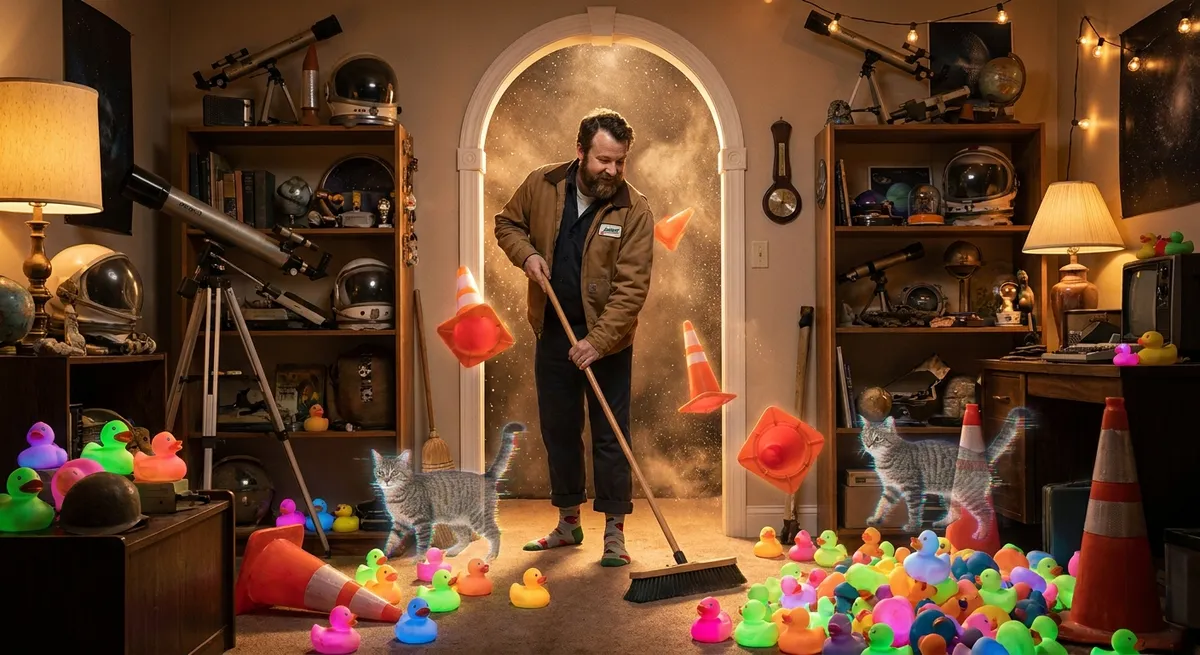
You know that feeling when the universe does something so bizarre you have to pause your podcast and stare into the middle distance? This article is that feeling, but in word form. Welcome to the digital equivalent of opening your brain’s “???“ folder and just scrolling.
These are the kind of weird facts you drop in a group chat and then immediately mute notifications, because you just know chaos is about to unfold.
The Moon Is Technically Socially Awkward Around Earth
Let’s start with the giant night light in the sky that refuses to show us its backside.
The Moon is tidally locked to Earth, which means it rotates at the exact same speed it orbits us. So we only ever see one side of it—forever. That’s not a cosmic coincidence; that’s the space version of someone turning their “good side” to the camera and never moving again.
Even better: the Moon is very slowly dipping out of this relationship. It’s drifting away from Earth at about 3.8 centimeters per year. That’s roughly the rate of your phone battery dropping when you “just open TikTok for a second.” Billions of years from now, solar eclipses won’t be a thing anymore because the Moon will look smaller in the sky.
So:
- The Moon only shows us one face.
- It’s slowly backing away.
- And we keep writing poetry about it.
If the Moon were a person, it would have already soft-blocked the entire human race.
Bananas Are Radioactive (But So Are You, Relax)
Here’s a sentence that sounds fake but isn’t: bananas are slightly radioactive.
This happens because bananas contain potassium, and a tiny fraction of that potassium is a naturally radioactive isotope called potassium‑40. Is your fruit bowl now a nuclear hazard? No. You’d have to eat something like millions of bananas in a short time to get a dangerous radiation dose… in which case, your bigger problem is not radiation, it’s that you ate millions of bananas.
Scientists even joke about a totally real not‑quite‑serious unit called the “Banana Equivalent Dose” to compare tiny amounts of radiation. Airplane flight? A few bananas. Living in a brick house? A bunch of bananas. Existing on planet Earth? Basically a fruit salad of background radiation.
So the next time someone claims to be “glowing,” they might just be low‑key full of potassium and bad decisions.
Octopuses Are Basically Aliens Doing a Social Experiment
Octopuses are so weird that if NASA announced tomorrow, “We checked, and yeah, they’re aliens,” most people would just nod.
They have:
- Three hearts
- Blue blood (copper-based, not royal)
- A brain that’s partially outsourced into their arms
- The emotional range of a moody genius—some can recognize individual humans, play, and hold grudges
Each arm can process information semi-independently, which means an octopus is basically eight semi-autonomous coworkers plus a squishy project manager in the middle. They can unscrew jars from the inside, solve puzzles, and some have been caught escaping tanks, sneaking into other exhibits, eating the fish, and going back before anyone noticed.
Also, octopuses can camouflage in fractions of a second—changing not just color, but texture. Imagine being able to cosplay as a rock, a coral, and a “nothing to see here officer” in under a second.
If there’s ever an intergalactic council, there’s a non‑zero chance an octopus is already on it, taking notes with seven arms and side‑eyeing humanity with the eighth.
You’re Technically a Little Bit Stardust and a Little Bit Explosion
Every carbon atom in your body once lived inside a star. At least some of your insides were cooked in ancient stellar explosions called supernovas. You are, on a molecular level, space glitter with anxiety.
A lot of the heavier elements—like the iron in your blood and the calcium in your bones—were forged in collapsing stars that died dramatically, yeeted their insides across the galaxy, and eventually helped form planets, oceans, snacks, and you doomscrolling at 2 a.m.
So your situation is:
- Atoms from dead stars
- Operating a brain that runs on electricity
- Using that brain to argue about pineapple on pizza
The universe did billions of years of astrophysics so you could send “u up?” texts and rewatch the same comfort show nine times. Honestly, iconic.
Tardigrades Are Out Here Speedrunning Survival Mode
Tardigrades—also known as water bears or tiny walking raisins—are microscopic creatures that look like someone tried to draw a bear from memory using a potato.
They are also basically indestructible.
These chaos beans can:
- Survive extreme temperatures (both boiling and near absolute zero)
- Endure pressures higher than the bottom of the ocean
- Handle doses of radiation that would absolutely delete humans
- Chill in the vacuum of space and then just… resume living
They do this by going into a cryptobiotic state called a “tun,” where they shrivel up, pause almost all biological activity, and wait out the apocalypse like it’s a slightly inconvenient weather pattern.
Humans: “I got 6 hours of sleep instead of 8, I will die.”
Tardigrades: “I dried out for 30 years and then came back like ‘sup.’”
If life were a video game, tardigrades are the unkillable background NPCs quietly winning.
Conclusion
The universe isn’t just big and mysterious; it’s also deeply weird in a “who programmed this” kind of way. The Moon is slowly ghosting us, bananas are radioactive, octopuses are running eight side‑brains, you’re made of stellar confetti, and tardigrades are casually immortal on hard mode.
You now have enough strange facts to:
- Derail a small talk conversation
- Confuse a date in a fun way
- Start an argument in a group chat and then vanish
Use this power responsibly. Or irresponsibly. The tardigrades will be fine either way.
Sources
- NASA: What Is Tidal Locking? - Explains how and why objects like the Moon show only one face to a planet
- U.S. Nuclear Regulatory Commission – Fact Sheet on Background Radiation - Covers natural sources of radiation, including food like bananas
- Smithsonian Ocean: Octopus Facts - Details the intelligence, biology, and behavior of octopuses
- NASA: We Are Made of Star Stuff - Explains how elements in our bodies were formed in stars and supernovas
- BBC: Tardigrades – The Toughest Animals on Earth - Describes tardigrades and their extreme survival abilities