
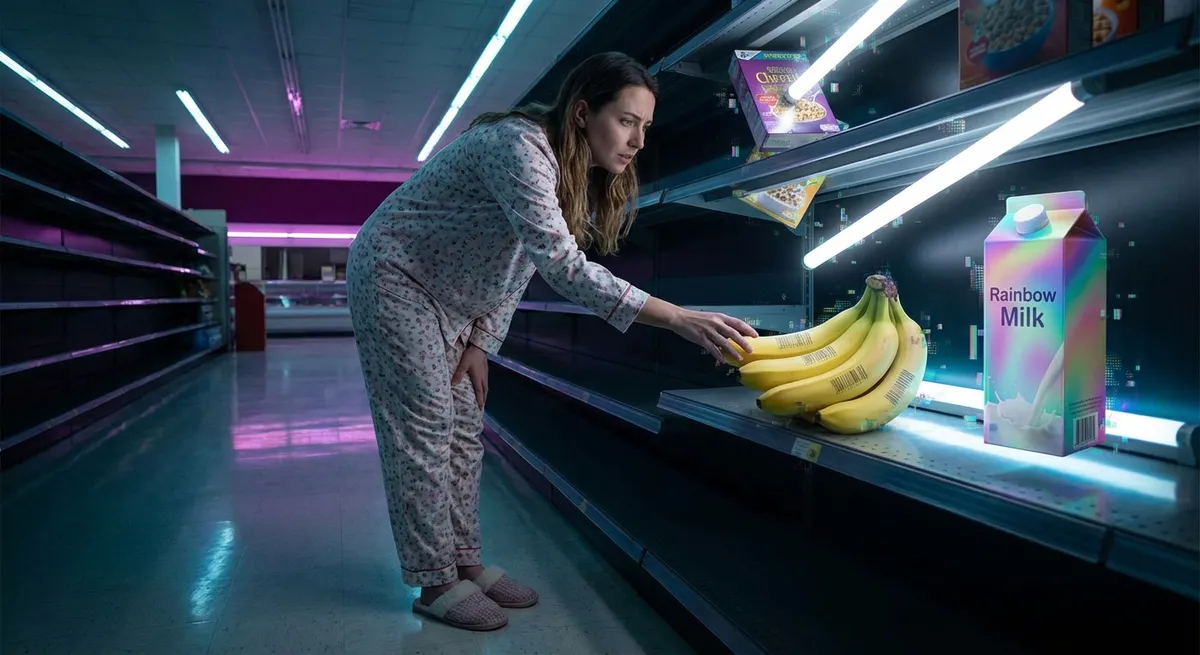
You know how video games sneak in secret levels and weird little details for no reason? Reality does that too. The universe has basically been adding bonus content and then refusing to patch the bugs.
This is your unofficial tour of some of Earth’s strangest “why is this allowed?” moments—perfect for sending to a friend at 2 a.m. with the caption: “Explain this, science.”
The Ocean Is Technically Glowing, and No One Signed Off on That
The ocean, in classic drama-queen fashion, sometimes just… lights up. Whole waves, glowing blue like someone turned on underwater LEDs and forgot to turn them back off.
This isn’t CGI, it’s bioluminescence: tiny organisms (often dinoflagellates) that treat movement like a motion-activated rave. Splash the water? Sparkles. Boat goes by? Neon trail. Dolphin swims through? Avatar sequel.
What’s wild is that we still don’t completely agree on why so many marine critters glow. Some use it like a flashlight, some like a glow-stick to attract food, and some probably just do it because evolution said, “YOLO, be shiny.”
You can actually see this in real life in places like Mosquito Bay in Puerto Rico or certain beaches in California. People pay good money to kayak through glowing water while trying very hard not to think about how many microscopic things are touching them.
If your computer ever lags, remember: the ocean is doing ambient mood lighting for no one in particular. Overachiever.
Your Bones Are Out Here Quietly Being Recycled Like a Subscription Service
Your skeleton is not the permanent structure you think it is. It’s less “marble statue” and more “ongoing home renovation project.”
Your body is constantly breaking down old bone and replacing it with new bone tissue. Over about a decade, most of your skeleton has been swapped out like it’s on a secret auto-ship plan. Same body, upgraded hardware.
Cells called osteoclasts handle the demolition, while osteoblasts are the construction crew. They’re basically arguing all day about whether your bones should be stronger or weaker based on your lifestyle, diet, hormones, and whether you ever leave your chair.
The result: the skeleton you had in high school physically does not exist anymore—which is honestly a relief for anyone who remembers their 14-year-old fashion choices.
So when people say “you’ve changed”? Yes. Correct. Even your bones were like, “We can do better.”
Bananas Are Quietly Radioactive and Everyone’s Just… Fine with That
Bananas are out here cosplaying as normal fruit while quietly emitting radiation. Actual, measurable radiation.
They contain potassium-40, a naturally radioactive isotope of potassium. Is this dangerous? Not unless you’re planning to eat truckloads of bananas per day like you’re trying to speedrun becoming a Marvel origin story.
Scientists even joke about a “banana equivalent dose” to explain tiny amounts of radiation exposure. Airport security scanner? A few bananas. Living on Earth? Hundreds of bananas a year. Vibes: mildly cursed, scientifically useful.
The wild part: we are constantly surrounded by natural radiation—from the ground, the air, space, and, apparently, our snacks. Bananas are just honest about it.
Next time someone calls you “toxic,” calmly inform them: “So is a banana, and we still put those in smoothies.”
Tardigrades Are Basically Unkillable Crumbs With Attitude
Tardigrades (aka water bears, aka “cursed gummy bears”) are microscopic creatures that look like a vacuum bag’s final boss—and they absolutely refuse to die.
They can survive:
- Being boiled
- Being frozen close to absolute zero
- Crushing pressure stronger than the deepest ocean
- The vacuum of space
- Radiation that would roast most living things
When things get rough, tardigrades dehydrate themselves, curl up into a tiny ball called a tun, and press pause on life. They can stay like this for years—then just rehydrate and casually resume existence like, “Anyway, what did I miss?”
We launched them into space to see what would happen. They lived. Of course they did. Put them in conditions that would obliterate a laptop, a houseplant, and your will to live, and tardigrades are like, “Neat.”
If there’s ever a cosmic reset, odds are it’ll just be tardigrades floating around waiting to reboot the sequel.
The Moon Is Slowly Leaving Us Like a Dramatic Ex
The Moon is, very politely, breaking up with Earth in slow motion. It’s drifting away at about 3.8 centimeters (1.5 inches) per year. That’s roughly the rate at which you distance yourself from high school acquaintances.
This happens because of tidal forces—the Moon pulls on Earth’s oceans, and in return, Earth’s rotation gives the Moon a tiny push outward over time. It’s like a very slow, very awkward cosmic dance.
Millions of years ago, the Moon looked bigger in the sky. Millions of years from now, it’ll look smaller, and solar eclipses won’t fit as perfectly. Future stargazers will never know the chaos of everyone Googling “is staring at an eclipse bad” at the same time.
The breakup isn’t catastrophic (for now). Days are actually getting slightly longer as Earth’s spin slows. Don’t try using this as an excuse for being late. “The Moon did it” is not HR-approved.
Still, it’s deeply on-brand for the universe that even our Moon has commitment issues.
Conclusion
Reality is basically an open-world game where:
- The ocean glows,
- Your bones respawn,
- Your fruit is radioactive-light,
- Indestructible micro-potatoes exist, and
- The Moon is slowly ghosting the planet.
None of this comes with a tutorial, patch notes, or even a “By the way, this might freak you out” warning.
So if life feels boring sometimes, remember: you live on a glowing-water, self-recycling, mildly radioactive rock with immortal dust bears and an emotionally unavailable Moon.
You are absolutely allowed to be weird. The universe started it.
Sources
- [National Oceanic and Atmospheric Administration (NOAA) – What is bioluminescence?](https://oceanservice.noaa.gov/facts/biolum.html) - Explains how and why certain marine organisms make the ocean glow
- [NIH / MedlinePlus – Bones: Anatomy, Conditions, and Treatments](https://medlineplus.gov/bones.html) - Overview of how bones form, remodel, and change over time
- [U.S. Nuclear Regulatory Commission – Fact Sheet on Background Radiation](https://www.nrc.gov/docs/ML1212/ML12123A336.pdf) - Includes information on naturally occurring radiation, including foods like bananas
- [NASA – Tardigrades: Surviving in Space](https://www.nasa.gov/mission_pages/station/research/news/tardigrades) - Describes experiments showing how tardigrades endure extreme conditions, including space
- [NASA – The Moon Is Slowly Leaving the Earth](https://svs.gsfc.nasa.gov/4720) - Visual explanation of how and why the Moon is drifting away from Earth over time