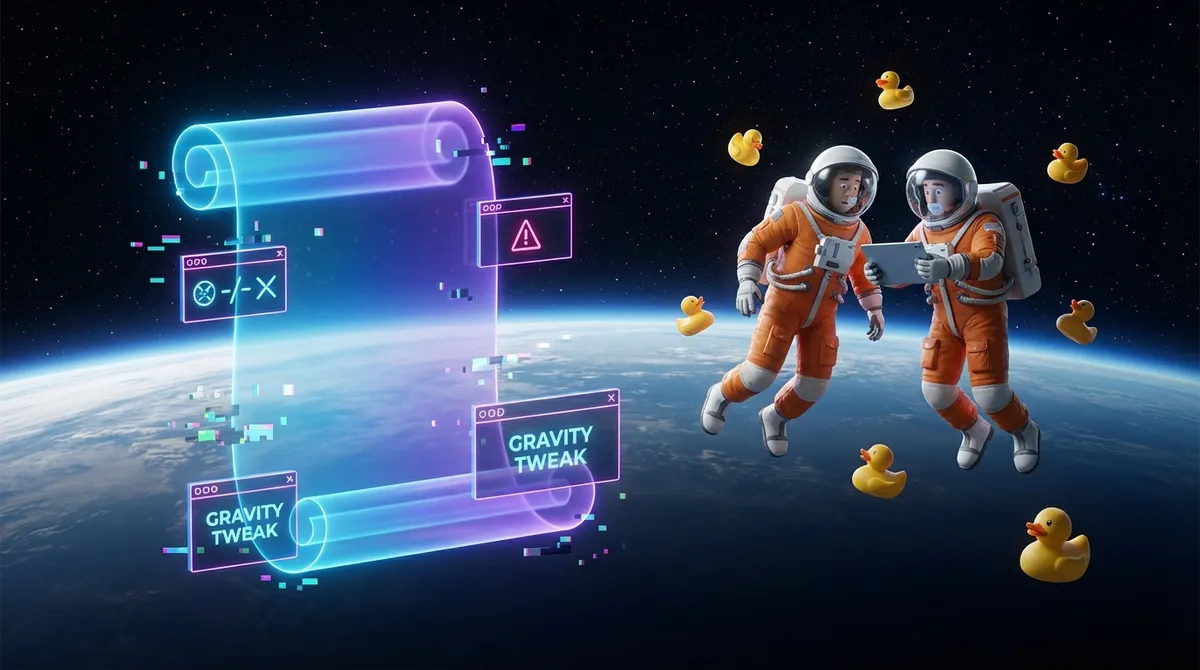
You know how life sometimes feels like a badly coded video game that keeps getting updates no one asked for? Same. The universe is just out here speed‑running chaos, dropping bizarre features, and never releasing a proper tutorial. So today, we’re peeking behind the cosmic curtain at some real‑life “that cannot be right” facts that sound like someone modded reality at 3 a.m.
These aren’t your usual “bananas are berries” and “octopus has three hearts” party tricks. These are the “I have to send this to the group chat immediately” kind of facts. Prepare to question everything, including your chair, your socks, and the duck that may or may not be judging you from a distance.
The Chair You’re Sitting On Is Mostly Nothing (Same, Honestly)
Right now, your body is confidently resting on a chair that is almost entirely empty space. Like, emotionally and physically. At the atomic level, both you and the chair are made of atoms, and those atoms are about 99.9999999999999% empty space. So technically, it’s two clouds of mostly nothing pretending to be solids, gently refusing to phase through each other because of electromagnetic forces.
Your molecules are not actually “touching” the chair; they’re kind of… hovering aggressively near it, like two people standing too close in line but never making eye contact. What you feel as “solid” is just atoms saying, “Nope, you stop there.” Touch itself is an illusion your brain builds on top of a physics argument about personal space. You are not sitting on the chair; your atoms are locked in a standoff with its atoms. You are, at this very moment, a polite force field hovering over a glorified force field—and somehow still late on rent.
There’s A Spot In The Ocean Where Pieces Of Rockets Go To Die
The ocean has a literal “space graveyard,” which is both metal and mildly unsettling. It’s called Point Nemo, a remote region of the Pacific Ocean that is so far from land, the closest humans are usually astronauts flying over it on the International Space Station. Because it’s so empty (like the group chat after you say “we should all hang out soon”), it became the official dumping ground for dead spacecraft.
Dozens of space stations, cargo ships, satellites, and other retired orbital junk have been intentionally crashed there, including parts of Russia’s Mir space station and various resupply ships. So somewhere underwater, there’s a cold, quiet pile of space tech slowly rusting like the universe’s Lost & Found bin. Marine life is just vibing while a graveyard of human “oops, we dropped that from orbit” collects nearby. If aliens ever visit Earth and go scuba diving there first, they’re going to assume we worshipped broken metal tubes.
One Guy’s Broken Clock Accidentally Defined The World’s Time
Our entire system of timekeeping got a massive upgrade because one dude’s clock refused to behave. In the 1950s, scientists were building early atomic clocks, which keep time based on the natural vibrations of atoms. One experimental clock using cesium atoms didn’t match the standard astronomical time… and instead of tossing it out as a mistake, scientist Louis Essen basically went, “What if this glitch is the real time?”
Turns out, it kind of was. That “wrong” clock became the basis for the official definition of the second. Long story extremely short: a second is now defined by how many times a cesium atom does a specific quantum wiggle. Your phone, your computer, GPS, international finance systems, and that oven clock you never set correctly all ultimately trace back to one stubborn lab instrument that said, “I’m not wrong, reality is.” The universe let one hyper‑precise tick happen repeatedly and humanity said, “Yeah, that’s the vibe now.”
Ducks Are Secretly Geometry Bosses (And They’re Winning)
Ducks look like goofy bread-obsessed marshmallows, but they casually flex on physics when no one’s paying attention. When a duck floats on a lake in cold weather, it doesn’t get frozen little duck feet because it runs a built‑in heat‑exchange system like an overachieving HVAC engineer. Warm blood traveling down the legs passes right next to colder blood coming back up, so heat gets swapped efficiently, and almost no warmth is wasted.
That means the duck’s body stays cozy while its feet are just “we live like this now” in freezing water. Its webbed feet are mostly tendon and bone, not much tissue to actually chill. The result: a duck is basically doing calculus-level thermal regulation while appearing to emotionally invest in your sandwich crust. And the geometry of their V‑shaped flight formations? That’s aerodynamic teamwork that reduces drag and saves energy, like a perfectly organized carpool… if the carpool occasionally screamed and bit strangers.
Your Brain Regularly Edits Your Memories Like A Shady Film Director
The memories you’re so sure are “100% accurate” are basically fan fiction your brain keeps rewriting. Every time you recall an event, your brain doesn’t play back a recording; it rebuilds the memory from scratch using fragments, context, and vibes. Then it saves that new, slightly edited version. Over time, your most vivid memories can drift pretty far from what actually happened, but they feel real because your brain sells it with confidence.
This is why multiple people can strongly disagree about what happened in the same moment and genuinely not be lying; their brains have just done different edits of the same story. Sometimes you even splice in stuff you saw in photos, movies, or conversations and stitch it into your own past like a chaotic director going, “Yeah, that scene needs more drama.” So technically, your personality is built on a carefully curated highlight reel of events that may or may not have gone down exactly the way you remember. You are your own unreliable narrator—and so is everyone else.
Conclusion
Our universe is out here running the strangest feature list imaginable: chairs made of almost nothing, a secret ocean boss arena full of fallen spaceships, a glitchy clock that defined time, ducks doing physics in their spare time, and brains improvising our entire backstory on loop. None of this makes sense, and yet all of it is happening while you’re just trying to decide what to eat.
Send this to someone who thinks reality is normal. Then stare at your chair, side‑eye a duck, and politely ask your brain to stop editing your memories like it’s pitching a Netflix series.