
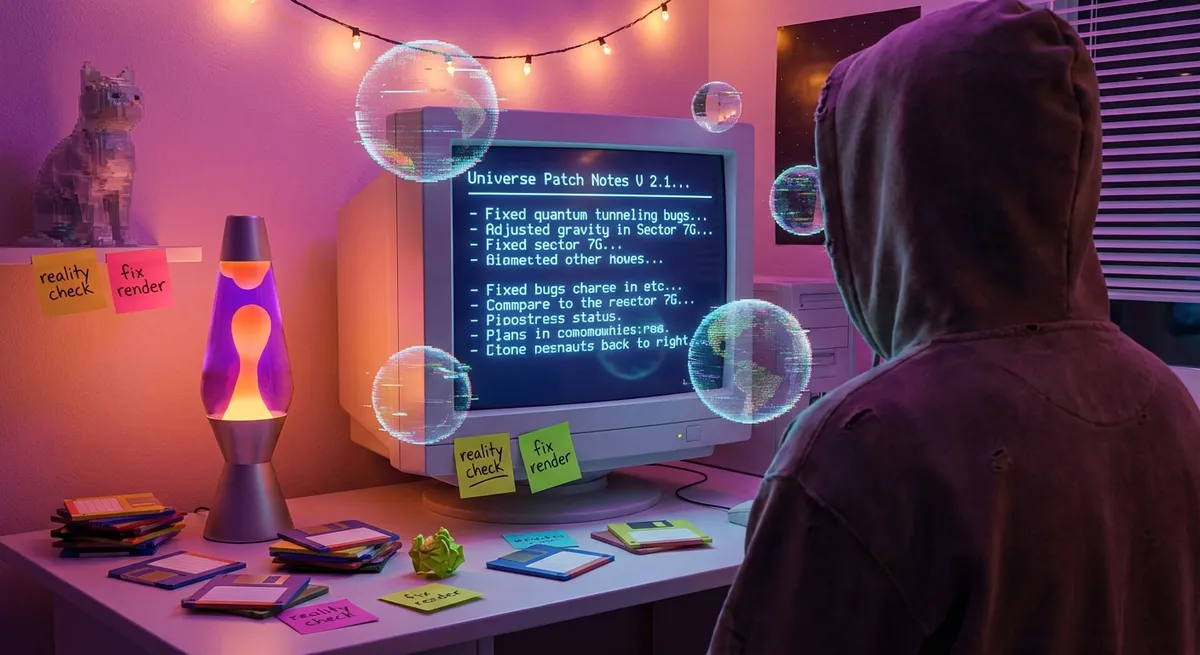
Somewhere between “time is a construct” and “why do we have eyelashes,” reality clearly rage-quit and never logged back in. Welcome to the part of the universe that feels like a half-finished beta version: things that technically exist, but sound like they were coded at 3 a.m. by a sleep-deprived intern.
These are the weird, screenshot-worthy facts you’ll want to drop in group chats, repost on your story, and weaponize in arguments with people who say “that can’t be real.”
Spoiler: it is. And it’s unhinged.
The Ocean Is Hiding an Upside-Down Waterfall (Because Of Course It Is)
Normal waterfall: water goes down. Simple, classy, gravity-approved.
The ocean, meanwhile: “What if we… didn’t?”
There are underwater “waterfalls” where massive streams of colder, denser water plunge beneath warmer water, creating a literal underwater cascade. The most dramatic one is the Denmark Strait cataract between Greenland and Iceland, which is taller than any waterfall on land—over 3,500 meters (about 11,500 feet) of water yeeting itself downward in total darkness like it’s late for something.
You can’t see it without instruments, so somewhere, right now, a record-breaking waterfall is happening in complete stealth mode. Humans: making fountains in shopping malls and calling it art. The planet: casually running a secret mega-waterfall that could swallow our biggest skyscrapers and still have room for dessert.
Viral ammo: “Fun fact: the biggest waterfall on Earth is underwater and invisible. Name a bigger flex. I’ll wait.”
Bananas Are Radioactive and We Use Them as a Unit of Radiation
Bananas: yellow, curved, morally supportive. Also… slightly radioactive.
Because they’re high in potassium, and a tiny fraction of potassium is the radioactive isotope potassium-40, bananas emit a minuscule amount of radiation. It’s so well-known that scientists literally joke about a measurement called the “Banana Equivalent Dose” (BED) to compare everyday radiation exposure.
No, your smoothie is not going to turn you into a Marvel origin story. You’d have to eat millions of bananas in a short period to hit dangerous levels—at which point radiation is no longer your primary problem; it’s “being 80% banana.”
But the idea that scientists will calmly say, “The dose is about a few hundred bananas” is peak chaotic-neutral energy. Somewhere there’s a very serious spreadsheet with “banana” as a unit of measurement, and that alone is worth a repost.
Viral ammo: “Radiation sounds scary until you realize scientists measure it in bananas like it’s a Mario Kart stat.”
Tardigrades: The Indestructible Crumbs of Life
Tardigrades (aka water bears, aka “microscopic chonks of doom”) are animals so tough they make action movie heroes look fragile.
They’re about 0.5 mm long, look like wrinkly eight-legged potatoes, and can survive:
- Being frozen almost to absolute zero
- Being heated above the boiling point of water
- Radiation doses that would obliterate most life
- The vacuum of space (yes, actual outer space)
- Decades without water, just chilling in a dried-out state
When conditions get bad, they curl up into a “tun,” essentially hitting the cosmic snooze button on existence. Later, with some water and better vibes, they just… reboot.
Imagine being so unbothered by the universe that you can casually survive things our species writes disaster movies about. Humans: need three alarms and a coffee to function. Tardigrades: shrug off space.
Viral ammo: “Me: can’t handle a delayed text. Tardigrades: tanking vacuum, radiation, and apocalypse like it’s Monday.”
You’re Technically Glowing in the Dark (Just Very Badly)
Your body is emitting light right now. Not metaphorically. Literally.
Humans give off ultra-weak bioluminescence caused by chemical reactions as our cells process energy. Researchers have photographed this using super-sensitive cameras: our faces glow the brightest, especially in the late afternoon.
The catch? Our glow is about 1,000 times weaker than what our eyes can see. So you’re a night-light… with the brightness settings permanently on “tragically underpowered.”
Some animals and fungi nail the bioluminescent aesthetic with neon blues and eerie greens. Humans got “invisible potato aura” and called it a day. Still, if someone ever says “you’re glowing,” you can answer: “Scientifically? Yes.”
Viral ammo: “Humans actually glow in the dark, we’re just so low-res our eyes can’t see it. Imagine being canonically bioluminescent and still looking tired.”
Space Smells Like a Burnt Metal Barbecue
There is, in fact, a vibe check for the universe, and it’s… oddly specific.
Astronauts have reported that space has a distinct smell that clings to spacesuits and equipment when they re-enter the airlock. The descriptions? “Burnt steak,” “seared metal,” “ozone,” or “welding fumes.”
The likely cause: high-energy vibrations and reactions from atoms in the vacuum around spacecraft, plus compounds formed from dying stars, radiation, and other cosmic drama. Basically, the galaxy smells like someone mixed a mechanic’s workshop with a slightly cursed grill.
We keep imagining space as this serene, silent black velvet backdrop. Meanwhile, it’s apparently doing industrial cosplay and smelling like overcooked dinner.
Viral ammo: “Astronauts say space smells like burnt steak and hot metal, which means the universe itself has ‘left the oven on’ energy.”
Conclusion
Reality is not a polished masterpiece; it’s a messy, glitchy sandbox level where:
- The biggest waterfall is invisible and underwater
- We casually measure radiation in bananas
- Microscopic bears out-survive our entire species
- Your body is a secretly glowing potato
- And outer space smells like someone burned the cosmic lasagna
Next time life feels boring, remember: you’re living inside a universe that feels like a modded game with experimental settings turned on. Screenshot these facts, toss them into your group chat, and watch everyone argue over radioactive fruit and glowing humans.
The patch notes for existence are wild. We’re just here reading them aloud.
Sources
- [National Oceanic and Atmospheric Administration – “What is the largest waterfall in the world?”](https://oceanservice.noaa.gov/facts/largest-waterfall.html) – Explains the Denmark Strait cataract and how underwater waterfalls work
- [U.S. Nuclear Regulatory Commission – “Fact Sheet on Potassium Iodide (KI)”](https://www.nrc.gov/about-nrc/radiation/protects-you/protection-potassium-iodide.html) – Includes discussion of natural sources of radiation like bananas and the concept of Banana Equivalent Dose
- [NASA – “Tardigrades: Adorable Extremophiles”](https://www.nasa.gov/feature/goddard/2021/tardigrades-adorable-extremophiles) – Details on tardigrade resilience, including survival in extreme environments and space
- [Tohoku University – “Humans glow in visible light”](https://www.tohoku.ac.jp/en/press/humans_glow_in_visible_light.html) – Research showing humans emit ultra-weak bioluminescence observable with sensitive cameras
- [ESA – European Space Agency – “What does space smell like?”](https://www.esa.int/kids/en/learn/Our_Universe/Space_Exploration/What_does_space_smell_like) – Astronaut descriptions of space’s odor and scientific explanations behind it